
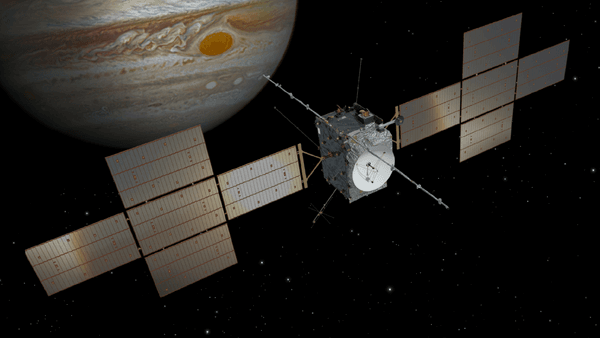
After more than three years zooming through our solar system, the European Space Agency’s Jupiter Icy Moons Explorer, or Juice, is coming back to Earth for a quick flyby: on Monday, the spacecraft will be just under 5,400 miles above the planet. But its real journey is still just beginning.
Juice will eventually travel to the outer solar system to investigate Jupiter and its moons. Once it arrives in 2031, Juice will conduct 35 flybys around these icy worlds, probing their hidden oceans and analyzing the unique magnetic field of Ganymede.
Jupiter is about 365 million miles away from Earth at their closest points in orbit around the sun. As a result, Juice isn’t relying on fuel alone to make the trip—it is also using the gravity of the moon, Venus and Earth to slingshot itself further into the solar system.
On supporting science journalism
If you're enjoying this article, consider supporting our award-winning journalism by subscribing. By purchasing a subscription you are helping to ensure the future of impactful stories about the discoveries and ideas shaping our world today.
Launched in 2023, Juice conducted an Earth-moon flyby in 2024 to help send it to Venus. The Venus flyby in 2025 sped Juice up—a lot—and it will be going about 24,600 miles per hour when it passes by Earth on Monday. It will make another Earth flyby in 2029 to fine-tune its trajectory on its way to Jupiter. Essentially, all these pit stops push and shove Juice onto the right path at the right speed.
In the meantime, Juice is making the most of its journey. As it flies by Earth, the spacecraft will collect data—and some pretty pictures—of Earth and some measurements of the planet’s magnetic field.
“This is great news for science, because it means we will be able to turn Juice in all different directions to point its science instruments at different parts of Earth and the moon,” said Claire Vallat, Juice project scientist at the ESA, in a statement.