New Issue: Orbital Catastrophe Ahead? Read Now

Interstellar Comet 3I/ATLAS captured speeding through the solar system by Jupiter-bound spacecraft

This mysterious interstellar visitor is on a whirlwind journey through our solar system

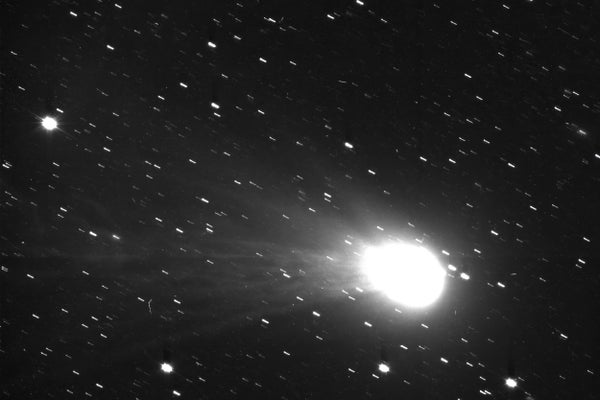
A photograph of a comet and its tail in space

A camera on the European Space Agency’s (ESA’s) Jupiter Icy Moons Explorer (JUICE) captured Comet 3I/ATLAS last November.

ESA/Juice/JANUS

Join Our Community of Science Lovers!

In late 2025 a mysterious comet flew between the orbits of Earth and Mars and reached a speed of more than 150,000 miles per hour during its closest approach to the sun. The rare interstellar guest to our solar system captured astronomers’ attention, and many trained their observations onto it in a bid to understand what exactly it is, why it is here and where it might be going.

Every new piece of data offers a glimpse at the space beyond our solar system. And as the comet, called 3I/ATLAS, speeds through our cosmic neighborhood, space agencies have coopted spacecraft to observe it as it goes. The European Space Agency’s Jupiter-bound spacecraft is no exception: a new image of the comet captured last November by the Jupiter Icy Moons Explorer, or JUICE, reveals it to be almost egg-shaped, with a cloud of gas veiling its central core, or nucleus.
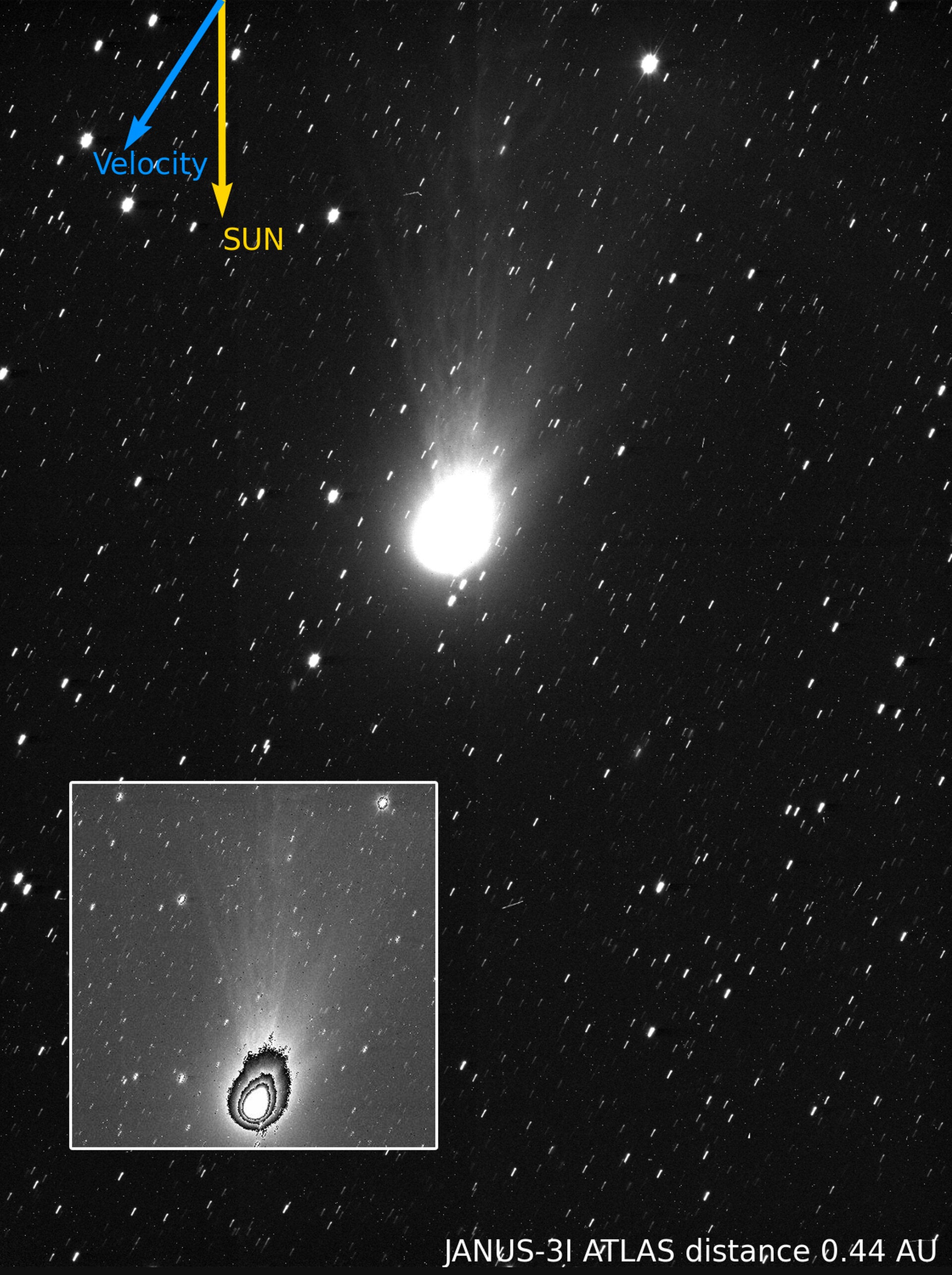
A photograph of a comet and its tail in space. Close-up reveals layers in its halo

Comet 3I/ATLAS, as seen from ESA’s JUICE.

ESA/Juice/JANUS


On supporting science journalism

If you're enjoying this article, consider supporting our award-winning journalism by subscribing. By purchasing a subscription you are helping to ensure the future of impactful stories about the discoveries and ideas shaping our world today.


“While 3I/ATLAS is a visitor from interstellar space, travelling from outside the Solar System, its behaviour is completely in line with that expected from a ‘normal’ comet,” the agency said in a statement.

“No one knows where the comet came from,” said David Jewitt, director of the Institute for Planets and Exoplanets at the University of California, Los Angeles, in a statement last year. “You can’t project that back with any accuracy to figure out where it started on its path.”
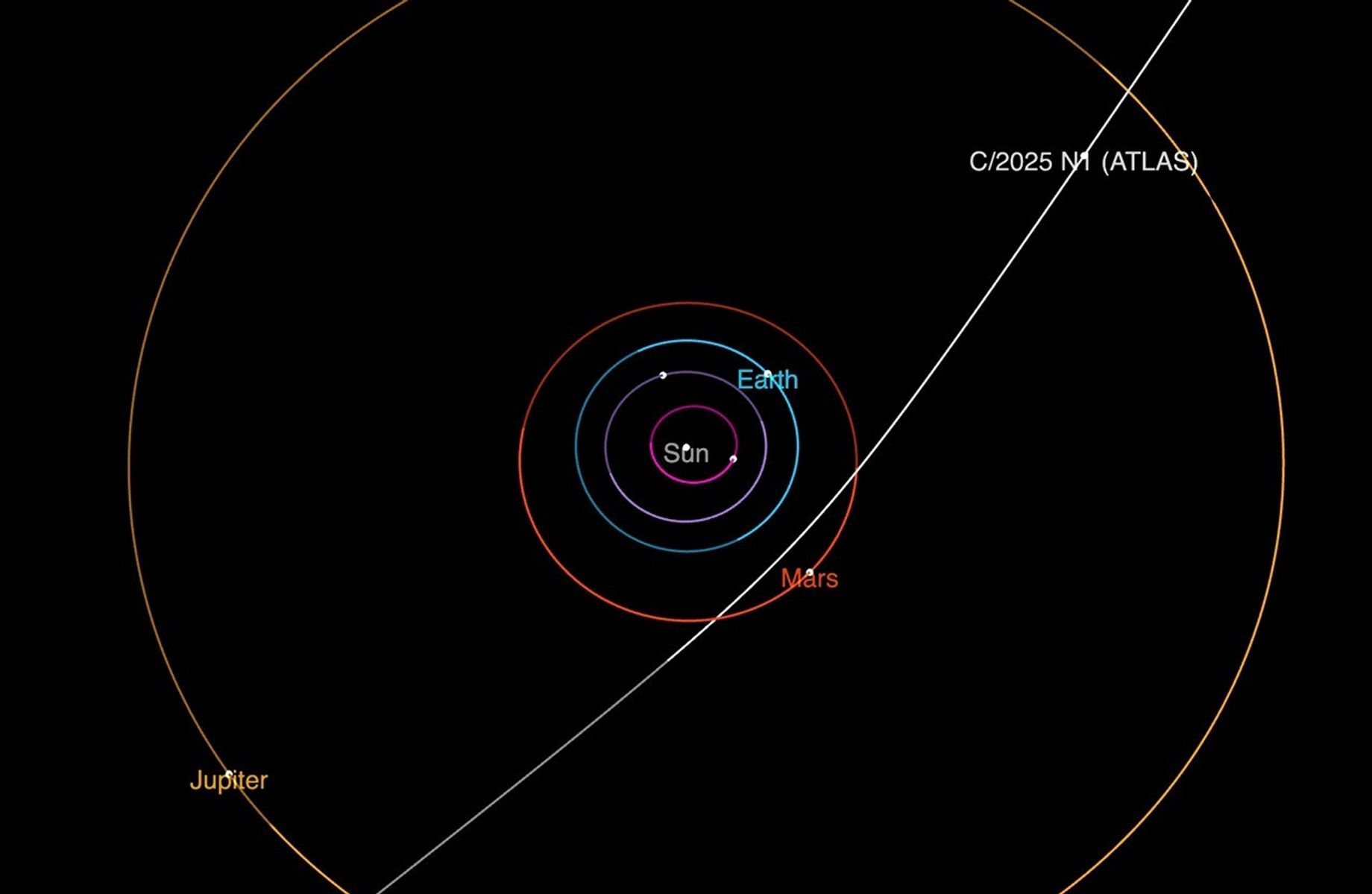
An diagram shows Comet 3I/ATLAS passing through the orbits of Earth and Mars

The trajectory of Comet 3I/ATLAS as it passes through the solar system.

NASA/JPL-Caltech

Comet 3I/ATLAS has puzzled and excited scientists since it was first spotted in July 2025. Its extraordinary speed at the time—137,000 miles per hour—and strange trajectory indicated that it must been traveling through interstellar space for possibly billions of years, according to NASA. Just three interstellar objects have ever been discovered passing through our solar system. And despite the scramble to observe it as it goes, Comet 3I/ATLAS remains very much a mystery.

“It’s like glimpsing a rifle bullet for a thousandth of a second,” Jewitt said in the same statement.

Jackie Flynn Mogensen is a breaking news reporter at Scientific American. Before joining SciAm, she was a science reporter at Mother Jones, where she received a National Academies Eric and Wendy Schmidt Award for Excellence in Science Communications in 2024. Mogensen holds a master’s degree in environmental communication and a bachelor’s degree in earth sciences from Stanford University. She is based in New York City.

More by Jackie Flynn Mogensen

Subscribe to Support Independent Journalism

Great science journalism requires human expertise, time, effort and creativity. And it costs money. That’s why I and the journalists here at Scientific American hope you’ll join our community.

When you subscribe, you are supporting staff and freelance journalists who are passionate about telling science stories that are true, important and compelling. Our editors and reporters are often experts in their fields, which means they understand the nuances of big discoveries and can untangle the breakthroughs from the hype. With a subscription, you are also supporting rigorous fact-checking to ensure the words we publish are precise and accurate. And you’re supporting original illustrations, graphics and photos that bring you closer to an advanced laboratory, an ice sheet in Antarctica or a space mission in orbit. You’re helping us craft other types of high-quality journalism as well: Our newsletters are carefully written, edited and curated by staffers you have or will come to know and love. Our Science Quickly podcast is based on original reporting, collaboration with editors and scientists and exacting production.

Subscriptions keep this engine running so we can continue to deliver thoughtful, rigorous and independent science journalism to you. In an era of viral misinformation, this work is crucial. If you value what we do, I hope you’ll consider joining us as a subscriber

Thank you,

Jeanna Bryner, Editor in Chief, Scientific American

Subscribe