
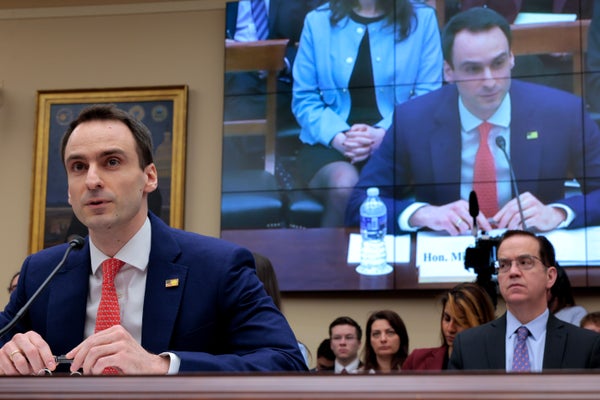
In a hearing before the Research and Technology Subcommittee of the House Committee on Science, Space, and Technology on January 14, Michael Kratsios, director of the White House Office of Science and Technology Policy (OSTP), answered questions about the Trump administration’s plans for artificial intelligence, including international collaborations and proposed approaches to regulation. In a roughly two-hour hearing in the Rayburn House Office Building, Democrats also pressed him on budget cuts to science agencies and the administration’s push to limit state-level AI rules.
Since President Donald Trump took office in January 2025, the administration has framed AI as a central scientific priority, and its approach to AI policy has emphasized two initiatives in particular. Kratsios pointed to what the White House calls “Winning the AI Race: America’s AI Action Plan,” which is framed around innovation, infrastructure, and international diplomacy and security. He also highlighted the Genesis Mission, an initiative that the administration says will promote AI as a tool for scientific discovery. Through private industry partnerships, the program, led by the Department of Energy and its 17 national labs, will pool federal scientific data and advanced computing to accelerate research, Kratsios said.
The next step for Genesis is to expand its reach past the DOE and incorporate other government agencies. “The underlying thesis of Genesis is that the government has extraordinary, valuable scientific data that, when pooled together..., can drive tremendous scientific discovery,” Kratsios said. By including data from health care agencies, the National Science Foundation, or the National Institute of Standards and Technology, for instance, Genesis’s models might expand beyond DOE research. The ultimate goal, Kratsios added, is for “research that took years to only now take months, weeks or even days.”
On supporting science journalism
If you're enjoying this article, consider supporting our award-winning journalism by subscribing. By purchasing a subscription you are helping to ensure the future of impactful stories about the discoveries and ideas shaping our world today.
The mission’s other immediate task is to recruit international partners. Kratsios said that “tech ministers from around the world” have already expressed interest in joining the program. Working with allies to deploy American technology, he said, will be key to maintaining the U.S.’s “very distinct and very obvious lead” in AI development.
Another top goal for the OSTP is to expand AI talent in the workforce and schools. Kratsios pointed to the administration’s U.S. Tech Force, which he described as designed to bring AI and technology specialists to the public sector. Around 35,000 people have expressed interest so far, he said. “The fact that we have so many great Americans that want to step in, move their families and their lives to [Washington] D.C. to solve these problems ... is just incredible,” he said.
As for education, the White House’s AI Education Task Force aims to teach AI literacy in K–12. So far, more than 200 companies and organizations have committed to provide AI resources free of charge to students and educators, Kratsios said.
Members raised concerns about xAI’s chatbot Grok, which recently came under fire for allowing users to generate nonconsensual sexual images, including those involving minors—and about the local effects of data centers.
In response to concerns about mass firings at agencies such as NIST, Kratsios said there was “a very appropriate look at how these organizations are structured and the way that we can best deliver results for everyday Americans.” Representative Suhas Subramanyam of Virginia responded, “We’ll agree to disagree.”
The ranking member of the Committee on Science, Space, and Technology, Representative Zoe Lofgren of California, criticized a recent executive order that directs the Department of Justice to sue states over certain AI laws. “This order asserts that ... the administration itself should have the power to decide what kind of state laws are too burdensome,” Lofgren said. “I think this order is unconstitutional.”
Kratsios said that forcing entrepreneurs to “comply with 50 different sets of AI rules is actually anti-innovation. And it’s something that I don’t think anyone on this committee actually supports.” He said he’s been tasked to develop a “sensible national policy framework,” even as the executive order carves out exceptions, including around child safety, computation and data-center infrastructure and state procurement of AI.