
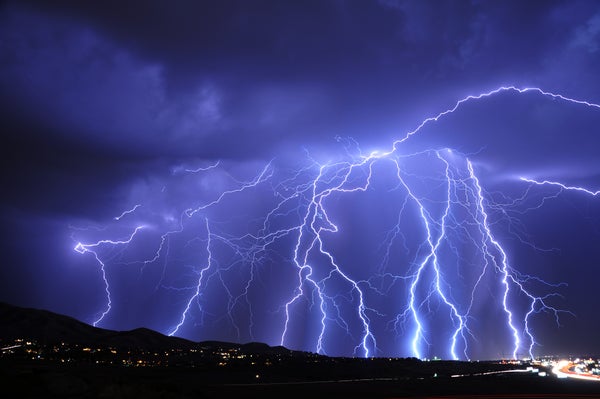
Guinness World Records may be the go-to organization for measuring the extent of (sometimes dubious) human achievement, but for natural phenomena, the World Meteorological Organization’s (WMO’s) Committee on Weather and Climate Extremes sets the bar. Recently the committee certified a new record: the longest lightning strike ever measured. The bolt, which materialized on a stormy day in October 2017, spanned a total of 515 miles from East Texas to an area near Kansas City.
When a potentially record-breaking weather event occurs, it gets passed to the committee, where a panel of scientists and other experts assesses whether the event truly represents a new record. If the panel votes to approve it, the record is entered into the WMO’s World Weather and Climate Extremes Archive. Michael Peterson, an atmospheric scientist at the Severe Storms Research Center at the Georgia Tech Research Institute, flagged the new record-holder last year while reanalyzing 2017 satellite data. Recording such extreme weather events can help us develop new tools to predict severe storms and understand their behavior, he says.
The previous record-holder, a bolt of lightning measuring 477 miles that struck during a storm in 2020, also originated in Texas. This is no coincidence, Peterson says. The south-central Great Plains in the U.S. represent one of few hotspots in the world for the giant complexes of thunderstorms in which these superlong “megaflashes” are most likely to occur. These complexes arise when many smaller storms coalesce into one large system. The 2017 complex spanned all the way from Texas to Minnesota.
On supporting science journalism
If you're enjoying this article, consider supporting our award-winning journalism by subscribing. By purchasing a subscription you are helping to ensure the future of impactful stories about the discoveries and ideas shaping our world today.
READ MORE: How to Stay Safe during Lightning Storms
Megaflashes often produce cloud-to-ground offshoots along their length. In fact, Peterson says, the 2017 flash produced more than 116 subsidiary strikes during the seven seconds it lasted, from start to finish. A typical lightning strike is visible for about half a second; the record-holder for the longest-lasting strike clocked in at more than 17 seconds. Strikes are measured using a combination of satellite technology and ground-based lightning mapping arrays—networks of sensors that record the radio signals produced by lightning.
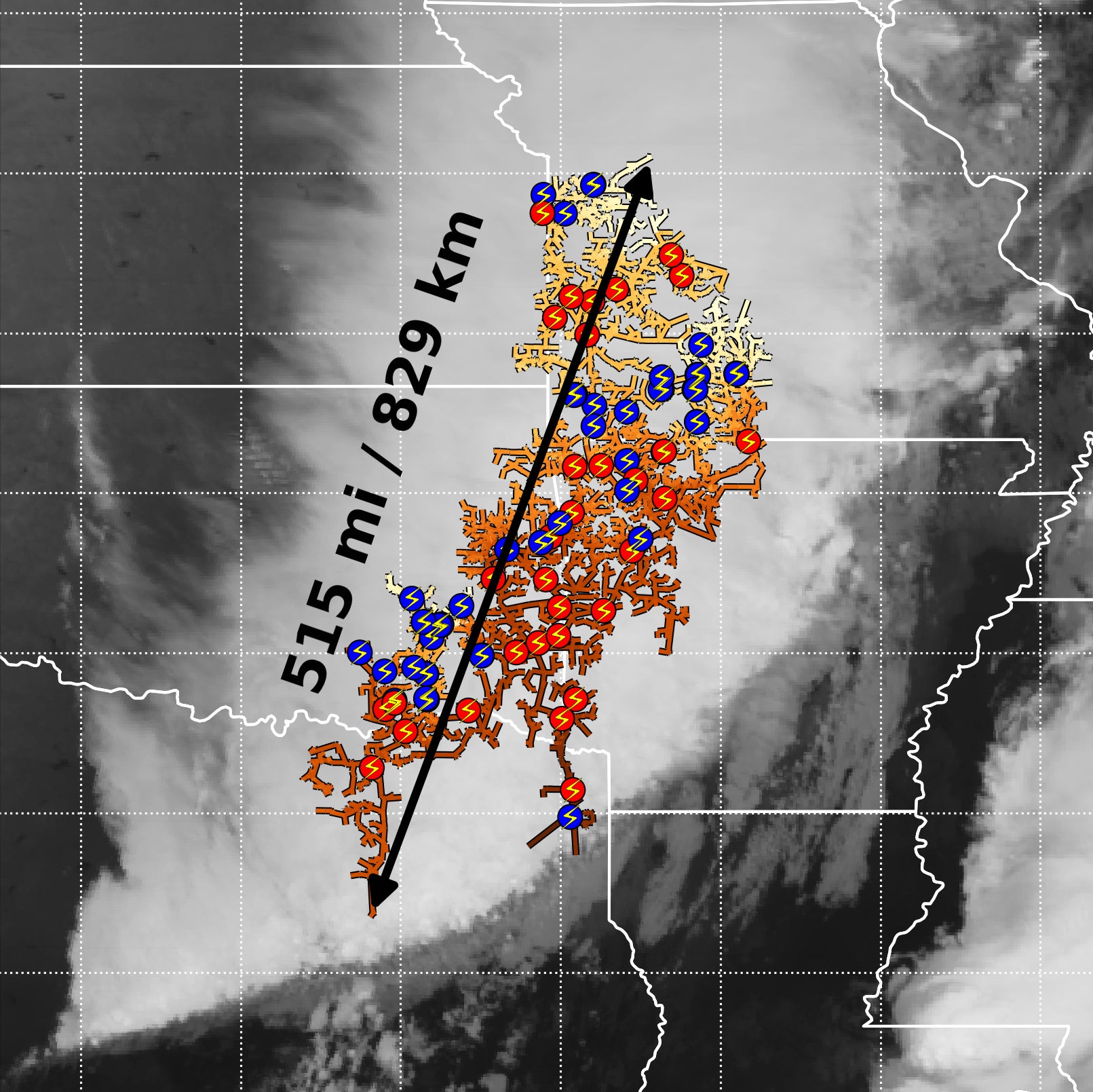
This map of the record lightning strike shows its development over time. The circles represent cloud-to-ground strikes and are colored by polarity.
Michael Peterson, GTRI
With increasingly powerful and accurate technology, Peterson and his colleagues are beginning to get better data about these storms to understand exactly what makes them tick. For instance, Peterson says, the researchers are investigating unusual, especially powerful forms of lightning and ones whose charge lasts particularly long (that is, a few hundred milliseconds) in the ground after they strike. “It is a very exciting time to be in lightning science,” he says.