
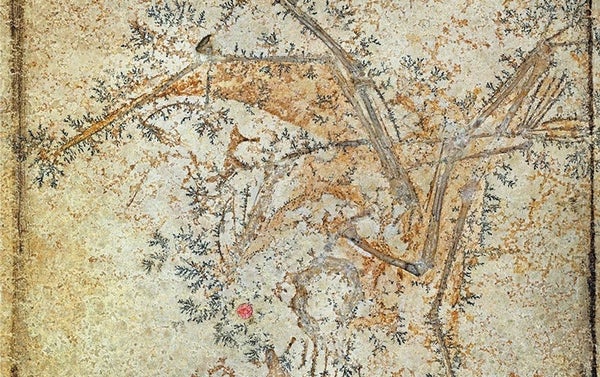
Ever since pterosaur fossils were discovered more than two centuries ago, paleontologists have wondered how these gawky-looking reptiles launched themselves into the air. Experts have recently focused on a “quad launch” hypothesis, which envisions pterosaurs rocking back and forth on their arms to jump into the air using a pole vault–like motion, whether from land or water. Direct physical evidence of this technique has been elusive, but now a small pterosaur from the Jurassic rocks of Germany is helping solve the mystery.
The sparrow-sized fossil, described by Natural History Museum of Los Angeles paleontologist Michael Habib and his colleagues in Scientific Reports, features unusually well-preserved bones and skin impressions of a pterosaur type called an aurorazhdarchid. The paleontologists used a process known as laser-stimulated fluorescence to detect the fossilized tissues, including a wing membrane and webbed feet. Analyzing these structures let the researchers determine how the pterosaur could have used them to take off.
Prior research indicates pterosaurs were not strong swimmers, Habib notes—so this fossil's soft tissues “are best interpreted as water-launch adaptations” rather than swimming gear. These structures offer the first physical evidence that pterosaurs could take off using quad launch, he says; until now the best evidence came from biomechanical models of skeletons. The skin impressions along the arms suggest that, when folded, the pterosaur's wings could help the reptile push off from the water's surface. The researchers found that the wings and webbed feet combined would have been enough to propel the animal from a resting position.
On supporting science journalism
If you're enjoying this article, consider supporting our award-winning journalism by subscribing. By purchasing a subscription you are helping to ensure the future of impactful stories about the discoveries and ideas shaping our world today.
Most modern birds use their muscular legs to spring into the air. But pterosaurs had different proportions and would have behaved differently, says University of Edinburgh pterosaur researcher Natalia Jagielska, who was not involved in the new study. Knowing that soft tissues like the pterosaur's can be preserved in the fossil record, Jagielska adds, “is a great reason for scanning other exquisitely preserved fossils with lasers and seeing if they can tell us a different story.”