
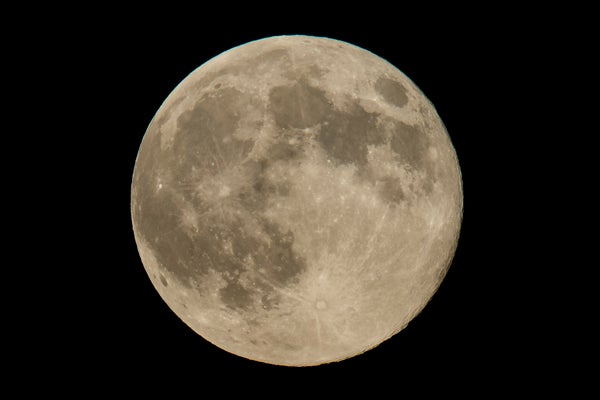
The “Man in the Moon,” the dark area of dried lava that looks like a face smiling from the lunar surface, may be older than anyone thought, scientists say. The consequences could echo through the entire solar system.
“It’s like changing the clock for all solar system objects,” says Stephanie Werner, a planetary scientist at the University of Oslo in Norway and a co-author of the new research, which she presented on July 14 at the Goldschmidt Geochemistry Conference in Lyon, France. The finding is currently in press in the Planetary Science Journal.
Unlike Earth, where plate tectonics and biological processes regularly reface the planet, the moon’s surface is an archive of scars from impacts that have occurred over the satellite’s 4.5-billion-year lifetime. Scientists use those craters to determine the relative age of different features: where craters overlap, the one on top must be younger (formed more recently) than the one on the bottom. The more craters covering a spot, the older the rock must be.
On supporting science journalism
If you're enjoying this article, consider supporting our award-winning journalism by subscribing. By purchasing a subscription you are helping to ensure the future of impactful stories about the discoveries and ideas shaping our world today.
Werner and her colleagues revisited analyses of moon rocks from NASA’s six crewed Apollo landings and Russia’s three robotic Luna sample-return missions, all in the 1960s and 1970s, plus China’s 2020 Chang’e 5 spacecraft. The samples revealed the rocks’ absolute ages through a chemical analysis of two forms of the element argon they contained. The researchers also used orbital data, which can indicate how a rock responds to different types of light, to determine whether samples originated from the area from which they were taken during each mission, eliminating any confusion from rocks tossed by past impacts to where they were recovered.
Armed with this knowledge, the scientists figured out that the moon’s large basins—including the dark lava plains we know as the Man in the Moon—formed before its volcanoes erupted. That would mean certain regions, such as the Mare Imbrium, or “Sea of Rains,” might be as much as 200 million years older than scientists once thought.
The finding fits with other recent research revisiting an Apollo-era hypothesis dubbed the late heavy bombardment, which suggested the moon underwent a burst of impacts about four billion years ago. Using a range of techniques, modern scientists have learned that instead, impact size and frequency appear to have trailed off steadily over the moon’s history. In this view, the large craters that are characteristic of the moon’s early existence—such as those that formed the “Man in the Moon”—may have formed earlier than previously thought.
Werner’s team’s age recalibration fits that new picture, says Nicolle Zellner, a planetary scientist at the physics department at Albion College, who was not involved in the research. “The fact that you’re getting the same story now from all of these different methodologies—that is cool,” Zellner says.
And the findings could rewrite history beyond the moon because scientists extrapolate from the moon’s craters to determine surface ages on planets, moons and asteroids throughout the solar system. For example, the recalibration might mean habitable conditions on Mars didn’t last as long as scientists think, Werner says.
Werner and her colleagues want to keep exploring what the recalibration means for our understanding of the moon and the wider solar system. “It’s opening a door,” she says of the new research. “We are not done at all.”