
Mars is a world of many mysteries, a freeze-dried desert planet that once, eons ago, was much warmer and wetter. Where did all its water go? How long was it habitable? And did it ever harbor life?
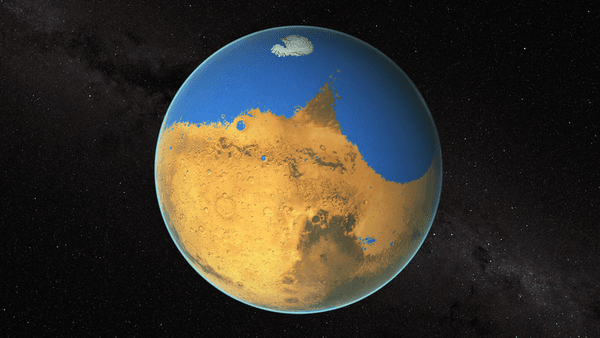
But the Red Planet’s most obvious mystery—clearly visible from orbit—is the glaring discrepancy between its two faces. Mars’s northern hemisphere is a smooth, low-lying plain, whereas its southern hemisphere stands several kilometers higher and is rugged and densely cratered. “The closest analogy for Earth would be the difference between continents and the ocean floor, if there were no oceans,” says Alexander Berne, a planetary scientist at the University of Arizona’s Lunar and Planetary Laboratory. In a new Nature study, Berne and his colleagues argue the planet’s two-faced appearance is more than skin-deep, extending all the way down to its core.
Called the Martian crustal dichotomy, this boundary between hemispheres is Mars’s largest single feature, with the crust on either side differing in average thickness by some 25 kilometers. Scientists have debated its origin for more than half a century. Berne and his colleagues have taken Mars’s internal temperature to help settle things, with intriguing results: beneath the southern highlands, the mantle appears to be 200 to 400 degrees Celsius hotter than it is under the northern plains.
On supporting science journalism
If you're enjoying this article, consider supporting our award-winning journalism by subscribing. By purchasing a subscription you are helping to ensure the future of impactful stories about the discoveries and ideas shaping our world today.
Almost everything known about Mars’s deep interior comes from seismic waves picked up by an instrument on NASA’s InSight lander, which operated in the northern lowlands from 2018 to 2022. One station in one place cannot tell north from south, however, so most subsequent models of Mars’s interior assumed the planet was uniform, with the same rocks at the same temperature at any depth, all the way around. Berne’s team got past that by estimating internal features via tiny deviations in the planet’s orbit.
Mars travels a lopsided path around the sun, and its axis is tilted, so the solar tug on the planet shifts over the 687-day Martian year. “That creates a tidal force, and the tidal force changes Mars’s shape over the year,” Berne says. The flex is minuscule, but it rearranges Mars’s gravity field enough to alter the motions of orbiting spacecraft.
To isolate that gravitational signal, the team reprocessed 16 years of radio tracking data from three Mars orbiters with a technique called tidal tomography, which was previously used to map the depths of Earth and of Earth’s moon but had never previously been employed for Mars. “If Mars has a weird structure in the mantle, this signal will be different than if it had a symmetric interior,” Berne explains. The readings, it turned out, deviated from the symmetric scenario by up to 300 percent. Based on how much the planet flexed, Berne’s team calculated that the Martian mantle’s stiffness should vary by more than 20 percent between hemispheres, with the mantle being rigid in the north and softer in the south.
Softer rock is also usually warmer. A naive interpretation of that 20 percent change between hemispheres would translate to a temperature difference of more than 1,000 degrees C—which is impossible, Berne notes, because “the whole southern half would be molten, which is not what we observe.” But if the planet’s tidal flexing is more gradual, stretching out across its year, this could yield a more plausible north-south temperature difference of just a few hundred degrees C. “It’s a deformation that creeps over time,” Berne explains.
The notion of Mars’s southern mantle being significantly warmer isn’t entirely new: in 2024 a separate study of “marsquakes” based on InSight’s data also suggested underlying warmth as a possible reason why seismic energy in the south seems to dissipate faster than in the north. But when Berne’s team performed numerical simulations to reconstruct the division line between harder and softer rocks, they found something truly unexpected.
According to their modeling, the dividing line runs directly beneath the surface dichotomy, following even the places where that boundary wanders north or south. “It was a happy surprise, and it’s what led to the writing of the paper,” Berne says.
Across the decades, theorists have devised three explanations for the origin of Mars’s crustal dichotomy: a colossal impact excavating the northern lowlands, convection warming the southern mantle from below or a thick southern crust acting as a thermal blanket over radioactive heat coming from inside the planet. Berne thinks, however, that these possibilities aren’t mutually exclusive.
“If you had a thermal anomaly, it would dissipate pretty quickly,” Berne says of the impact scenario. “We would not expect to have it in the mantle today if an impact was the only thing that happened.” According to him, some process must still be at work in the Martian subsurface, be it blanketing or convection, or both. An impact, Berne argues, may well have been what sparked the uneven heating, excavating the north and leaving the thick southern crust that has held in the heat since.
If that impact did happen, the vast basin it excavated across the northern hemisphere would have become the seafloor for any Martian ocean. Furthermore, an observed strong magnetization of the southern hemisphere’s crust could also trace back to that event; this may be a relic of Mars’s global magnetic field, which once shielded the planet’s atmosphere from the solar wind. Even leaving aside such “impact” scenarios, what seems increasingly plausible is that the planet’s deep dichotomy somehow set the terms for Mars’s early habitability. Uncovering more of its details could even reveal where we should look for traces of ancient organisms on the planet today—provided, of course, that all that heat isn’t just an artifact of the modeling by Berne’s team.
“It’s an interesting approach to retrieving information on Mars’s interior structure,” says Amir Khan, a planetary scientist at the Swiss Federal Institute of Technology Zurich, who was not involved in the study. “I think the most important [parts] of this paper are the observations. What follows is less relevant since it’s based on a range of modeling assumptions.” According to Khan, we can’t be sure if thermal anomaly interpretation is the only possible way to explain the observational data.
“There are still questions to be answered,” says Paul Byrne, a planetary scientist at Washington University in St. Louis, who was also not involved in the study. For instance, Byrne is puzzled by the fact that Mars’s largest volcanic province, Tharsis, lies along the dichotomy’s margins rather than in the southern uplands, where the study’s findings suggest the underlying mantle should be hotter.
The next step, Berne says, is to find more evidence for or against the thermal anomaly by landing instruments and taking Mars’s temperature from various locations directly. He acknowledges, though, that the tidal tomography approach he used may prove more impactful than the study’s actual findings. “To a certain extent, this paper is a bit of an advertisement for that method,” Berne says. The method, he argues, works entirely from orbit and thus offers a way to gain insights into the interiors of worlds, such as Mercury, Saturn’s geyser-spouting moon Enceladus or even Pluto, that no lander is going to reach anytime soon.
“We always complain about the huge budgets of space agencies. This is a way to make it a lot cheaper and get 80 percent of the result that you want,” Berne says.