
When Czech writer Karel Čapek coined the word “robot” in his 1920 play R.U.R., he imagined tireless “artificial workers” liberating people from drudgery. The lead character dreams of destroying poverty by turning the whole of humankind into an aristocracy, an elite class of elevated beings “nourished by millions of mechanical slaves.”
You won’t be surprised to learn that the plan ends badly. Čapek’s initially emotionless robots develop into conscious, thinking beings and then violently revolt against their human creators. The finale is less aristocracy and more apocalypse.
In the 106 years since, humanity has remained captivated by the notion that machines could take over our daily work, as well as by the grim but entertaining idea that toiling automata will get murderously sick of picking up laundry. But even after a century of progress, neither scenario seems remotely close to fruition: our best household robots can barely vacuum a floor without smearing cat food across the rug, much less successfully execute a workers’ revolution.
On supporting science journalism
If you're enjoying this article, consider supporting our award-winning journalism by subscribing. By purchasing a subscription you are helping to ensure the future of impactful stories about the discoveries and ideas shaping our world today.
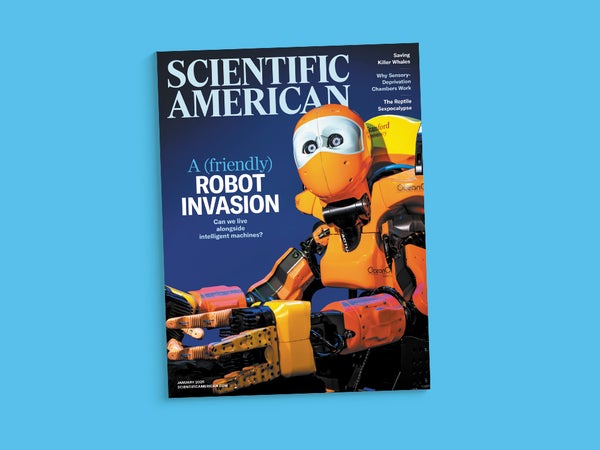
In this issue’s cover story, journalist and former Scientific American editor Ben Guarino investigates why the dream of mechanical helpers has remained so stubbornly out of reach and what it will take to finally bring it home. I was particularly excited to read about Stanford University’s TidyBot, a household robot that is currently part of a research project but could one day make my bed—although I admit I did briefly worry about the prospect of a rebellious bot imprisoning me by tucking the sheets in too tightly while I’m still under them.
If that thought makes you anxious, you might want to read journalist Diana Kwon’s piece about interoception, our ability to detect and interpret the body’s internal state. New research points to a link between how well we read the signals sent by our own bodies and a variety of psychological ailments. Findings suggest that unconventional therapies such as spending time in a sensory-deprivation chamber could help people improve their mental well-being.
Elsewhere in the issue, science writer Ann Finkbeiner dives into the fascinating topic of celestial transients. These astronomical objects appear suddenly from nowhere, shine with the light of entire galaxies and disappear soon after. New astronomical surveys are finding these seemingly improbable phenomena bursting to life all across the night sky at a rate of more than 20,000 a year and climbing, but astronomers are just beginning to understand what they are.
And make sure you join Scientific American multimedia editor Kelso Harper on a killer whale research expedition off the coast of Washington State around the San Juan Islands. Southern resident orcas have lived in the waters of the Pacific Northwest for thousands of years but are now on the brink of extinction. Harper joined a group of biologists who have studied the population for decades and discovered the research is at risk, too: government cutbacks threaten to stall or stop a swath of conservation studies at a crucial juncture for the species.
As you read that story, you might wonder what it looks and sounds like when Eba the orca hound gets on the scent of a hot killer whale scat sample in the Salish Sea. I’m happy to tell you that our entire multimedia team was on location in the salt and spray of the pursuit, and now you can experience it, too. Thanks to financial support from the Caplan Family Foundation, we’re excited to share The Protectors, a new 25-minute documentary that brings you to the edge of the bow with Eba and the researchers who are striving to understand and conserve the southern residents. My sincere appreciation goes out to Amy Caplan for making this project possible and helping us tell the story of a group of remarkably dedicated scientists. You can watch The Protectors right now on the Scientific American YouTube channel.