
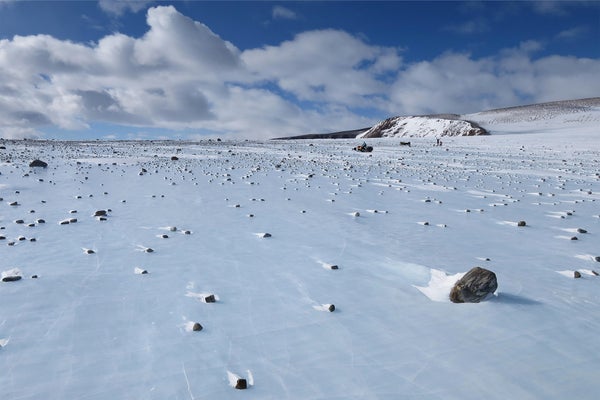
Climate change has pernicious impacts on Earth, affecting everything from the atmosphere to ice sheets and from algae to elephants. But even rocks from space aren’t immune to warming-weather-related upheavals either.
Meteorites are fragments of other worlds that survive whizzing through Earth’s atmosphere to land as dull, scorched-black rocks. For decades, planetary scientists have used meteorites to better understand the distant places they come from, and Antarctica has been a particularly valuable source, supplying more than 60 percent of those collected to date. But the bounty may be disappearing, according to research published on April 8 in the journal Nature Climate Change. In it, scientists estimate that we’re already losing Antarctic meteorites faster than we collect them—and that the rate of loss will increase as the planet continues to warm, with the rocks sinking deep in the ice sheets, out of scientists’ reach.
Although scientists have collected some 80,000 meteorites to date, there’s no telling which ones will reveal something new. “Usually, a few of the meteorites that are brought back every season are something we’ve never seen before,” says Cari Corrigan, a geologist and curator of the Antarctic meteorite collection at the National Museum of Natural History in Washington, D.C., who peer-reviewed the new paper but wasn’t directly involved in the research. “Each one is kind of a piece of a puzzle that helps us understand how the whole solar system formed.”
On supporting science journalism
If you're enjoying this article, consider supporting our award-winning journalism by subscribing. By purchasing a subscription you are helping to ensure the future of impactful stories about the discoveries and ideas shaping our world today.
This solar system detritus lands anywhere and everywhere on Earth, but most meteorites are lost—they plummet into the ocean or immediately blend in with terrestrial rocks. In Antarctica, in contrast, dark space rocks stand out from the bleak terrain. In addition, the ice’s slow flow over the continent concentrates space rocks in specific regions that have become treasure troves for scientists.
“Meteorites can fall anywhere on the ice sheet,” says Veronica Tollenaar, a doctoral candidate in glaciology at the Free University of Brussels (ULB) and co-author of the new research. “They become embedded into the ice, and they flow along with the ice, but when there is a barrier, the flow is redirected toward the surface.” That phenomenon is useful to scientists because it concentrates the space rocks in particular locations. In some areas on the continent, harsh winds scour the ice from above, revealing meteorites and other material in the ice, where the rocks can lie for millennia. Scientists call these spots “blue ice” because of their color. These two processes make for easy meteorite hunting; even so, scientists estimate hundreds of thousands more space rocks are still waiting to be found on Antarctica’s ice.
But as the world warms, these Antarctic meteorite dynamics are changing. Just like a black T-shirt on a sunny day, a meteorite on Antarctica’s surface traps heat that then radiates into the surrounding ice. When air temperatures are cold enough, the extra heat doesn’t make much difference—but as climate change warms the poles, the extra few degrees of heat from a meteorite will more often be enough to melt the ice around and under it, sending the rock deep into the ice sheet, out of scientists’ reach.
“Typically, once [a meteorite] is brought to the surface, it needs to kind of fight to stay at the surface,” says study co-author Harry Zekollari, a glaciologist at Vrije University of Brussels (VLB) and the Swiss Federal Institute of Technology Zurich (ETH Zurich). “What we see is that there’s kind of a magical threshold somewhere around minus 10 degrees Celsius [14 degrees Fahrenheit].” When temperatures are colder than that, the ice survives; any warmer and meteorites begin to disappear—even today. “Every year we find about 1,000 meteorites, but we lose five times as many,” Zekollari says.
Tollenaar, Zekollari and their colleagues used machine learning to identify where Antarctica’s remaining treasure troves of meteorites may be and then projected how different warming scenarios will affect each location.
Their analysis suggests that about a quarter of Antarctica’s meteorites will be lost by 2050—and up to three quarters will be out of reach by 2100 under the direst warming projections. Overall, Zekollari says, 1 or 2 percent of meteorites will disappear with each additional tenth of a degree Celsius of average warming. Corrigan notes that historically, the interior of Antarctica hasn’t seen much snowfall, but increasing rates from climate change will hide meteorites as well, further reducing the amount of samples scientists can collect beyond what the analysis suggests.
Losing meteorites has real consequences for scientists trying to understand the solar system. Expeditions to Antarctica are challenging but not as challenging as sending astronauts to the moon or robotic spacecraft to snag asteroid pieces, Corrigan says. “It is kind of a poor man’s sample-return mission, although it still costs money.”