New Issue: Orbital Catastrophe Ahead? Read Now

‘Microbubbles’ Help Spread Dangerous Microplastics Through Our Water, Study Finds

Water plays a crucial role in how tiny pieces of plastic enter our environment—and us

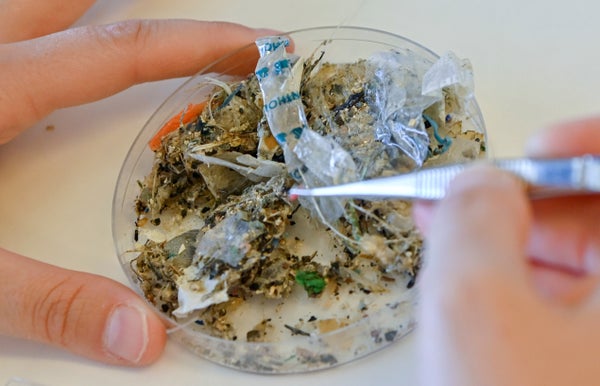
Microplastics in a sample of marine waste in a petri dish.

A researcher selects microplastics found in sea species at the Hellenic Center for Marine Research in Anávissos, Greece, near Athens, on July 15, 2025.

Photo by Milos Bicanski/Getty Images

Join Our Community of Science Lovers!

If you read the research on microplastics, these pollutants appear to be as frightening as they are ubiquitous. Found throughout our bodies, food and environment, both microplastics and their ingredients have been linked to heart attacks, stroke, respiratory conditions, fertility issues and death—to name just a few issues.

Yet despite these traits, scientists don’t fully understand how all the minuscule filaments of plastic get into our environment. A study published last month in Science Advances offers some new clues as to how water may be contributing to their spread.

Scientists already knew that plastics degrade through exposure to sunlight and repeated weathering by waves, sand or other debris. But the new study suggests contact with water itself is also a factor: in both marine and river environments, researchers found that microbubbles can form on the surface of a piece of plastic, breaking it down—and releasing tiny, practically invisible plastic bits into the surrounding water.


On supporting science journalism

If you're enjoying this article, consider supporting our award-winning journalism by subscribing. By purchasing a subscription you are helping to ensure the future of impactful stories about the discoveries and ideas shaping our world today.


From there, nanoplastics and microplastics often enter the food chain—and, in turn, us. An estimated 130 million metric tons of plastic waste enters our bodies and the environment every year, with that number on track to more than double by 2040.

The results, the researchers write, could inspire future research on how to control the release of microplastic into, well, everything. “Plastic degradation is an invisible threat to the environment and human health,” said John Boland, a professor in the School of Chemistry at Trinity College Dublin and senior author of the study, in a statement. “Society urgently needs to come to grips with the enormity of the challenge posed by our ubiquitous use of plastics.”

Jackie Flynn Mogensen is a breaking news reporter at Scientific American. Before joining SciAm, she was a science reporter at Mother Jones, where she received a National Academies Eric and Wendy Schmidt Award for Excellence in Science Communications in 2024. Mogensen holds a master’s degree in environmental communication and a bachelor’s degree in earth sciences from Stanford University. She is based in New York City.

More by Jackie Flynn Mogensen

Subscribe to Support Independent Journalism

Great science journalism requires human expertise, time, effort and creativity. And it costs money. That’s why I and the journalists here at Scientific American hope you’ll join our community.

When you subscribe, you are supporting staff and freelance journalists who are passionate about telling science stories that are true, important and compelling. Our editors and reporters are often experts in their fields, which means they understand the nuances of big discoveries and can untangle the breakthroughs from the hype. With a subscription, you are also supporting rigorous fact-checking to ensure the words we publish are precise and accurate. And you’re supporting original illustrations, graphics and photos that bring you closer to an advanced laboratory, an ice sheet in Antarctica or a space mission in orbit. You’re helping us craft other types of high-quality journalism as well: Our newsletters are carefully written, edited and curated by staffers you have or will come to know and love. Our Science Quickly podcast is based on original reporting, collaboration with editors and scientists and exacting production.

Subscriptions keep this engine running so we can continue to deliver thoughtful, rigorous and independent science journalism to you. In an era of viral misinformation, this work is crucial. If you value what we do, I hope you’ll consider joining us as a subscriber

Thank you,

Jeanna Bryner, Editor in Chief, Scientific American

Subscribe