
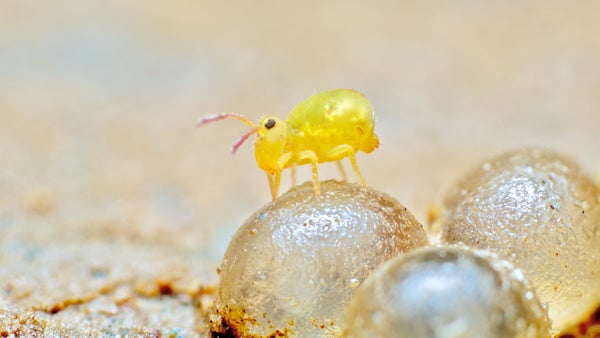
To many humans, soil is just the dirt under our feet. But new research shows that for more than half of all species on Earth, soil is crucial habitat—and an imperiled one at that.
“I think soil’s having a moment,” says Mark Anthony, a fungal ecologist at the Swiss Federal Institute for Forest, Snow and Landscape Research. “We’re starting to realize that we’ve really messed up our soils at a global scale.”
Anthony is co-author of a study, published on Monday in Proceedings of the National Academy of Sciences USA, that calculates that about 59 percent of species on Earth rely on soil for one or more stages of their life. That figure is a steep change from the only previous general estimate of about a quarter of all animals. “I did come in with expectations that the number would be way higher than everyone was saying because 25 percent felt low,” Anthony says. “It just felt wrong.”
On supporting science journalism
If you're enjoying this article, consider supporting our award-winning journalism by subscribing. By purchasing a subscription you are helping to ensure the future of impactful stories about the discoveries and ideas shaping our world today.
So Anthony and his colleagues set about collating existing global estimates of overall species richness and soil biodiversity for the most populous groups of life, including bacteria, fungi, plants, insects and mammals. It was challenging work, he says, because scientists still have a lot to learn about some of these groups—including their members who live or nest in or otherwise intimately depend on soil.
“It’s something I’ve been waiting for,” says Diana Wall, a soil ecologist at Colorado State University, who was not involved in the research but reviewed the study during the publication process.
“I think the authors did a good job based on the state of the science that we’re in now,” says Ember Morrissey, who studies soil microbial communities at West Virginia University and was also not involved in the new research. “There are definitely some blind spots whenever it comes to soil biodiversity, and there are lots of questions about ‘What are the best methods to assess diversity?’”
Of the groups they investigated, the researchers found the highest proportion of soil reliance—98.6 percent—in Enchytraeidae, or potworms. These animals are miniature cousins of earthworms and can spend their whole life in soil. The lowest soil reliance came from mammals, of which about 4 percent rely on soil for one or more stages of their life cycle. For example, some mammals, such as prairie dogs, nest underground. Other life groups, such as plants, fall in between these extremes. Although many plant species grow out of the ground, species such as air plants grow on trees, far from the soil.
Across the studied groups, about 59 percent of species require soil to survive. Anthony says that figure seemed surprisingly high even to him. He expects the exact number to change as scientists learn more about the species hidden underground, but he says the scale of reliance on soil is what’s most important because it shows this environment’s underestimated value to life on Earth.
“I’m thinking of this a lot like a census,” Anthony says. “Hopefully we can use the results of this to allocate more energy toward conservation and restoration in soils because we’re really not doing that at the moment.”