December 5, 2012
1 min read
 Add Us On GoogleAdd SciAm
NASA Releases Stunning Animation of Earth at Night
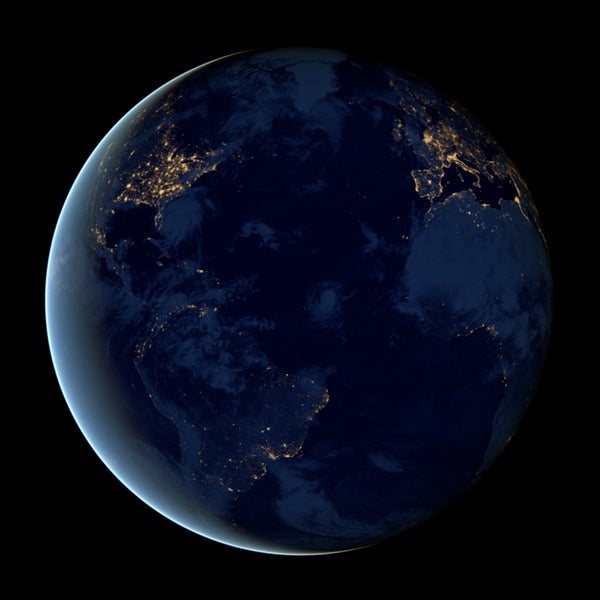
SAN FRANCISCO—This incredibly detailed 360-degree view of Earth at night was unveiled during a December 5 presentation at the American Geophysical Union conference.
By Mark Fischetti
On supporting science journalism
If you're enjoying this article, consider supporting our award-winning journalism by subscribing. By purchasing a subscription you are helping to ensure the future of impactful stories about the discoveries and ideas shaping our world today.
SAN FRANCISCO—This incredibly detailed 360-degree view of Earth at night was unveiled during a December 5 presentation at the American Geophysical Union conference. NASA stitched together two months of imagery taken by the new Visible Infrared Imaging Radiometer Suite (VIIRS) satellite to create a completely cloud-free view of the nighttime planet.
The resolution of VIIRS is six times finer than any previous light-sensing satellite. VIIRS can discern not just city lights but also light from industrial sites, fires, gas flares and boats at sea. NASA and NOAA have begun testing a long list of applications that the satellite will make possible. The observatory will help to improve weather forecasts by mapping nighttime cloud cover; track the movement of wildfires at night; and chart ice, snow and clouds across the Arctic during the long dark winter.
It’s Time to Stand Up for Science
If you enjoyed this article, I’d like to ask for your support. Scientific American has served as an advocate for science and industry for 180 years, and right now may be the most critical moment in that two-century history.
SciAm always educates and delights me, and inspires a sense of awe for our vast, beautiful universe. I hope it does that for you, too.
If you subscribe to Scientific American, you help ensure that our coverage is centered on meaningful research and discovery; that we have the resources to report on the decisions that threaten labs across the U.S.; and that we support both budding and working scientists at a time when the value of science itself too often goes unrecognized.
In return, you get essential news, captivating podcasts, brilliant infographics, can't-miss newsletters, must-watch videos, challenging games, and the science world's best writing and reporting. You can even gift someone a subscription.
There has never been a more important time for us to stand up and show why science matters. I hope you’ll support us in that mission.