
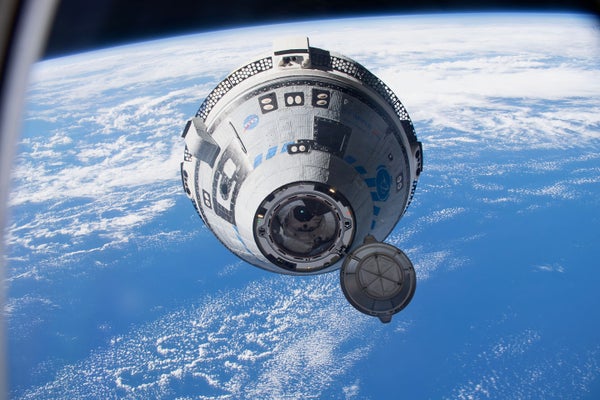
NASA’s own decision-making and leadership were partly to blame for the conditions that led to the months-long stranding of two astronauts, Butch Wilmore and Suni Williams, on the International Space Station (ISS) in 2024. That’s the major takeaway from a report released on Thursday by the space agency that summarizes investigations—some still ongoing—of what went wrong before, during and after the botched crewed mission to test the readiness of Boeing’s Starliner spacecraft to ferry astronauts to and from the ISS.
“Starliner has design and engineering deficiencies that must be corrected, but the most troubling failure revealed by this investigation is not hardware,” said NASA administrator Jared Isaacman at a press conference on Thursday. “It’s decision-making and leadership that, if left unchecked, could create a culture incompatible with human spaceflight.”
NASA has designated the incident a “Type A mishap”—the same categorization applied to the Challenger and Columbia space shuttle disasters, which resulted in the combined deaths of 14 astronauts.
On supporting science journalism
If you're enjoying this article, consider supporting our award-winning journalism by subscribing. By purchasing a subscription you are helping to ensure the future of impactful stories about the discoveries and ideas shaping our world today.
Starliner was conceived under NASA’s Commercial Crew Program in 2010 as a means to lift people and cargo into low-Earth orbit. Its first and second uncrewed orbital tests, in 2019 and 2022, each revealed unexpected performance shortfalls with Starliner’s thrusters.
Still, despite these thruster issues and other technical problems, NASA pushed ahead with a crewed test flight, launching Wilmore and Williams on June 5, 2024. The mission’s Starliner spacecraft, named Calypso, was supposed to dock at the ISS for an eight- to 14-day stay before it returned to Earth. But Calypso’s thrusters malfunctioned during docking, and the spacecraft temporarily lost its ability to fully control its motion and position in space—a moment that, according to Isaacman and other sources, could easily have ended in disaster. Wilmore and Williams eventually returned to Earth in March 2025 on a SpaceX Dragon spacecraft.
Isaacman emphasized during the press conference that NASA would continue to work with Boeing to resolve Starliner’s problems. But he also took pains to lay out how miscommunication and NASA’s lax oversight of Boeing, a long-time private contractor for the agency, may have contributed to Starliner’s life-threatening failures.
“We accepted the vehicle; we launched the crew to space. We made decisions from docking through postmission actions. A considerable portion of the responsibility and accountability rests here,” Isaacman said.
The report details how, during the incident, mission personnel on the ground had felt overwhelmed by frequent meetings and had voiced concerns over data transparency and inclusion, with personnel outside of Boeing and NASA’s Commercial Crew Program feeling particularly excluded. According to the report, some of those personnel stated that astronaut safety was not as central as it might have been.
At the same Thursday press conference, Isaacman said that the focus on proving Starliner’s fitness for flight among some in NASA’s leadership caused a “breakdown in culture, created trust issues. And where leadership failed was to recognize that this was taking place and to intervene and course correct.”