
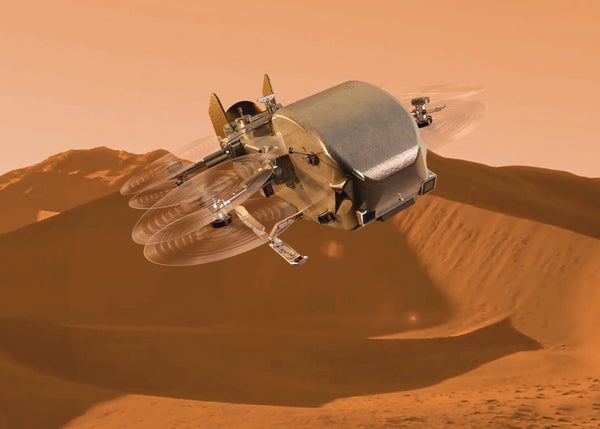
In 2034 NASA scientists will be flying around Titan.
Remotely, of course—Titan, Saturn’s largest moon, is more than a billion kilometers away from Earth, a journey no human can yet make. It’s also deathly cold, being so far from the sun. But our robotic proxies can endure the chill and make the trip, and, as it happens, we humans are getting pretty good at making these machines.
Still, even compared with the astounding missions that we’ve already launched to explore other worlds, this one, called Dragonfly, is massively ambitious. The spacecraft is not a lander or a rover; it’s a helicopter, or more accurately an octocopter, with four pairs of spinning blades to take it aloft and let it sail the giant moon’s frigid air. Powered and warmed by a nuclear battery, it will explore Titan for a nominal three-year mission, examining its brutally cold surface and atmosphere. It will even look for signs of extraterrestrial life—or at least its precursors.
On supporting science journalism
If you're enjoying this article, consider supporting our award-winning journalism by subscribing. By purchasing a subscription you are helping to ensure the future of impactful stories about the discoveries and ideas shaping our world today.
“Ambitious” may be too small a word for Dragonfly.
Titan is a world well worth our attention. At roughly 5,150 kilometers wide, it’s the solar system’s second-largest moon (Jupiter’s Ganymede is slightly larger), and it’s bigger than Mercury. Sans Saturn, we might be tempted to call Titan a planet on its own. It’s the only moon known to have a dense atmosphere, with a surface pressure about 1.5 times that of Earth’s. And much like Earth’s atmosphere, Titan’s air is mostly nitrogen, albeit with small and distinctly unearthly amounts of methane and hydrogen. The moon’s cryogenic cold is what really makes it alien: Titan’s surface temperature is about –180 degrees Celsius, so it’s a bit chillier than home. That’s so cold, in fact, that water there is as solid as granite here on Earth.
Yet, incredibly, there is liquid on Titan’s surface. Not water, though—NASA’s Cassini orbiter discovered lakes of liquid methane and ethane, some bigger than Lake Superior, near Titan’s poles. Titan has a methane cycle: liquid methane evaporates from the lakes, wafts up into the surrounding highlands, and then precipitates as snow or rain—which then melts and flows back to the lakes in rivers. This process is hauntingly similar to the water cycle that is so critical for life here on our own, warm planet.
Methane and ethane are carbon-based molecules, which raises a big question: Could life exist on Titan? Not only that, but there is also some evidence of liquid water deep underneath its surface, as is the case for many other outer moons. It may just be isolated pockets of water amid a huge shell of slush and ice, but the potential for life there is still a possibility worth further investigation.
It’s almost as if Titan is calling for us to investigate it. It’s a tempting target for planetary scientists. But like most endeavors worth pursuing, it’s also a difficult one.
We’ve gone there before, though—it can be done. Cassini’s amazing European Space Agency–built Huygens probe landed on Titan in 2005, but it was rather small and had a limited ability and lifespan. Repeating Huygens on a grander scale would be better but still not optimal: like on Earth, conditions on Titan change rapidly over distance, and it would be a shame (and a waste of significant effort) to just plop down in one spot and hope for the best. A rover would be even better, but “ground truth” for Titan’s terrain is hazy at best, and any number of plausible pitfalls could all too easily ensnare any vehicle trying to trundle around on the surface.
That leaves only one option: flight, which may sound ridiculous at first. Flying above an alien moon more than a billion kilometers away?
But it makes sense! The atmosphere there is actually thicker than Earth’s, providing more lift, and the gravity on Titan is only about 14 percent of our planet’s, making it easier to get off the ground. So why not?
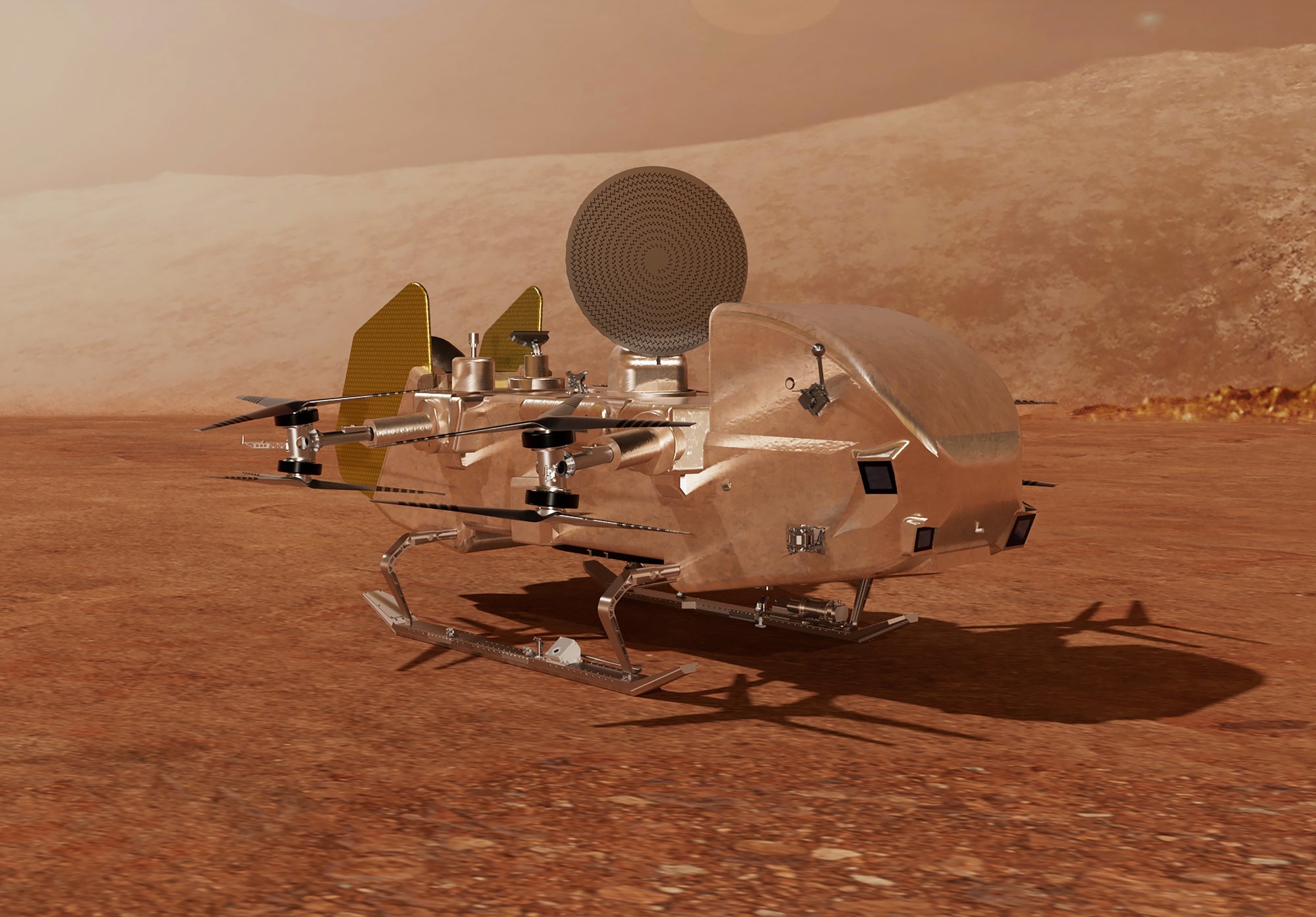
An artist’s concept of Dragonfly preparing to sample and examine the surface of a landing site on Titan.
NASA/Johns Hopkins APL/Steve Gribben
The brilliant team behind Dragonfly has taken all this into account. The drone is not small; its main body is about four meters long and one meter wide, thinner than a family sedan but about as long. It has a mass of 875 kilograms, so it weighs nearly a ton on Earth but much less on Titan. It’s equipped with four 1.35-meter-wide rotors, one at each corner, each with two vertically stacked counterrotating blades to increase lift and reduce torque.
It has multiple scientific instruments onboard, including a mineral mapper, a mass spectrometer to get detailed analysis of the chemistry on the surface (with a drill to get samples), an atmospheric meteorology device and, of course, a camera. All of them will be powered by a Multi-Mission Radioisotope Thermoelectric Generator that converts the heat of decaying plutonium into electricity. This approach is commonly used on deep-space missions; it powers the Curiosity and Perseverance rovers, for example.
Getting there is only half the challenge. Launch is planned for July 2028, and Dragonfly will cruise for six years, plying the empty vastness between the two worlds. When it reaches Titan, the real drama will begin. Its entry into the atmosphere and descent will be similar to the “seven minutes of terror” experienced by the Mars rovers. Dragonfly will ram through the atmosphere, protected by a heat shield, which will be ejected after slowing the spacecraft enough that parachutes can take over. When it’s still a little more than a kilometer above Titan, the octocopter will take over, making a powered landing on the surface. It will use radar and lidar to choose its site autonomously.
The targeted spot, called Shangri-La, is a region of sand dunes near the equator in the southern hemisphere of Titan. Shangri-La’s sand isn’t made of silicates like that on Earth; instead it’s most likely grains of frozen hydrocarbons. A series of flights are planned, including into a large nearby impact crater called Selk. There the craft could sample material excavated from the subsurface by the ancient impact, giving scientists deeper insights into the hotly debated origin and inner structure of the moon.
Dragonfly won’t be near those methane lakes, unfortunately, but there is still much to see on this frozen world. With so much carbon-based chemistry going on, it’s possible Titan cooked up at least the precursors for life. If some kind of biology did get a pseudopodal hold there, it would be very different from Earth’s—and even if the moon proved lifeless, we’d become more confident that there’s more to life than just cryogenic organic chemistry.
As a scientist, I’m excited by all of these possibilities, and I believe they will be realized in time. But as a human being, I’m most looking forward to the immediate imaging we’d get from Dragonfly. Titan is a whole world, vast and diverse and weird, and I want to see it for myself—even if it’s through the eyes of a nuclear-powered, eight-bladed, one-ton flying science laboratory sending that information a billion kilometers across the solar system.