New Issue: Orbital Catastrophe Ahead? Read Now

Astronomers Spot the Most Ancient Supernova Ever Observed

Astronomers have sighted the oldest known stellar explosion, dating back to when the universe was less than a billion years old

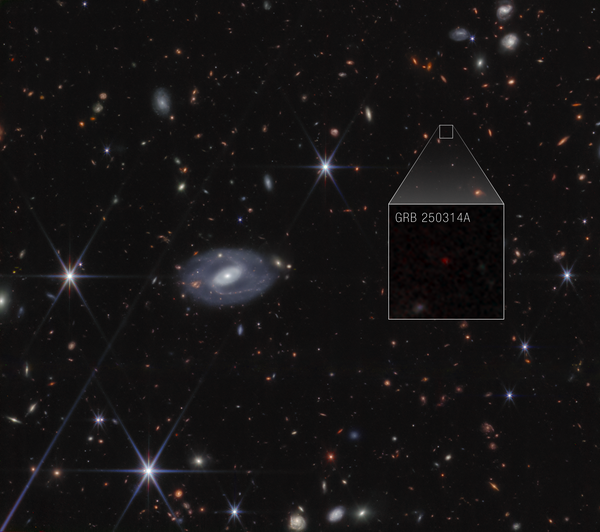
NASA’s James Webb Space Telescope identified the source of a super bright flash of light known as a gamma-ray burst: a supernova that exploded when the universe was only 730 million years old.

NASA’s James Webb Space Telescope identified the source of a super bright flash of light known as a gamma-ray burst: a supernova that exploded when the universe was only 730 million years old.

NASA, ESA, CSA, STScI, Andrew Levan (Radboud University); Image Processing: Alyssa Pagan (STScI)

Join Our Community of Science Lovers!

The James Webb Space Telescope has observed the oldest known supernova—the explosive death of a star that lived when the universe was only 730 million years old.

The ancient blast occurred when the cosmos was just 5 percent of its current age, and the supernova’s light has been traveling through space ever since. Astronomers were surprised to find that this primeval explosion strongly resembles today’s supernovae, which occur when massive stars run out of fuel for the nuclear fusion reactions that power them and then collapse under their own gravity.

Scientists had suspected that the universe’s earliest supernovae might look different because they represent the deaths of some of the first stars. Compared with today’s stars, they formed in a smaller, denser cosmos and contained lighter elements—mainly hydrogen, helium and trace amounts of lithium. And they were more massive than modern stars.


On supporting science journalism

If you're enjoying this article, consider supporting our award-winning journalism by subscribing. By purchasing a subscription you are helping to ensure the future of impactful stories about the discoveries and ideas shaping our world today.


Astronomers first spotted this primordial supernova in March, thanks to a 10-second-long flash of high-energy light known as a gamma-ray burst. Such a burst can be caused by a collision between a black hole and a dense object called a neutron star or—as in this case—by the death of a large star.

A telescope that scans for ephemeral events in space called the Space-Based Multi-Band Astronomical Variable Objects Monitor (SVOM) first detected the flash on March 14. That detection quickly set off a chain of observations around the world, including by NASA’s Neil Gehrels Swift Observatory, which pinpointed the flash’s location on the sky, the Nordic Optical Telescope on the Canary Islands, which suggested it was very far away, and the European Southern Observatory’s Very Large Telescope in Chile, which determined its age.

Because the object was so ancient, its light has been stretched as space has expanded over time. As a result, the light from the initial supernova that caused the gamma-ray burst was expected to become brightest a few months after the burst was sighted. The James Webb Space Telescope saw it in July, confirming that the flash was caused by a supernova, which has been designated GRB 250314A. The powerful observatory was also able to spot the galaxy that hosted the exploded star, although it appeared only as a small red smudge.

Clara Moskowitz is chief of reporters at Scientific American, where she covers astronomy, space, physics and mathematics. She has been at Scientific American for more than a decade; previously she worked at Space.com. Moskowitz has reported live from rocket launches, space shuttle liftoffs and landings, suborbital spaceflight training, mountaintop observatories, and more. She has a bachelor’s degree in astronomy and physics from Wesleyan University and a graduate degree in science communication from the University of California, Santa Cruz.

More by Clara Moskowitz

Subscribe to Support Independent Journalism

Great science journalism requires human expertise, time, effort and creativity. And it costs money. That’s why I and the journalists here at Scientific American hope you’ll join our community.

When you subscribe, you are supporting staff and freelance journalists who are passionate about telling science stories that are true, important and compelling. Our editors and reporters are often experts in their fields, which means they understand the nuances of big discoveries and can untangle the breakthroughs from the hype. With a subscription, you are also supporting rigorous fact-checking to ensure the words we publish are precise and accurate. And you’re supporting original illustrations, graphics and photos that bring you closer to an advanced laboratory, an ice sheet in Antarctica or a space mission in orbit. You’re helping us craft other types of high-quality journalism as well: Our newsletters are carefully written, edited and curated by staffers you have or will come to know and love. Our Science Quickly podcast is based on original reporting, collaboration with editors and scientists and exacting production.

Subscriptions keep this engine running so we can continue to deliver thoughtful, rigorous and independent science journalism to you. In an era of viral misinformation, this work is crucial. If you value what we do, I hope you’ll consider joining us as a subscriber

Thank you,

Jeanna Bryner, Editor in Chief, Scientific American

Subscribe