
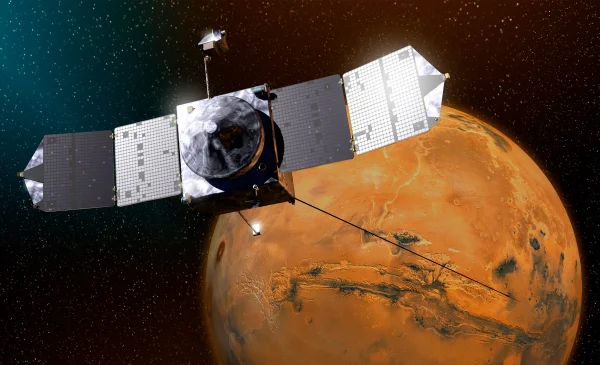
NASA has officially lost a decade-old Mars orbiter that performed vital scientific and communications work at the Red Planet.
The Mars Atmosphere and Volatile Evolution (MAVEN) mission, which launched in November 2013, was the first successful spacecraft dedicated to studying the atmosphere of the Red Planet and became a key node in the communications network supporting NASA’s Mars rovers on the surface. But MAVEN’s decade-long tenure has come to an end after NASA lost contact with the spacecraft last December and was unable to reestablish control over the orbiter.
“The science MAVEN has given us is key to informing what kind of radiation protection and safety measures we must take before sending humans to Mars,” said Louise Prockter, director of the Planetary Science Division at NASA, in a June 3 statement. “The data collected from MAVEN will continue to provide valuable insight into Mars for decades to come.”
On supporting science journalism
If you're enjoying this article, consider supporting our award-winning journalism by subscribing. By purchasing a subscription you are helping to ensure the future of impactful stories about the discoveries and ideas shaping our world today.
The new announcement about MAVEN has come after a preliminary report from an anomaly review board that NASA convened in February to investigate the status of the spacecraft. MAVEN’s troubles started abruptly while it was on the far side of Mars from Earth. NASA’s last detailed information from the spacecraft came on December 4, after which a small amount of additional tracking data were delivered on December 6.
Those data suggested to NASA engineers that the spacecraft was “rotating in an unexpected manner” and that its “orbit trajectory may have changed,” the agency wrote last December. That fear appeared to be confirmed when, from the Martian surface, NASA’s Curiosity rover looked toward where MAVEN ought to have been on two separate days in mid-December 2025 but couldn’t detect the spacecraft.
While trying to troubleshoot MAVEN’s condition, NASA had to work around some inconvenient celestial geometry in the form of the latest Mars solar conjunction. The term refers to times when Earth and Mars are on opposite sides of the sun, leaving Earthlings unable to communicate with the fleet exploring the Red Planet. Mars solar conjunction lasted from December 29, 2025, through January 16, 2026.
Even before Mars solar conjunction ended, NASA officials were losing hope for MAVEN. “We will start looking again, but at this point, it’s looking very unlikely that we are going to be able to recover the spacecraft,” Prockter told scientists in January, according to SpaceNews. Now, after additional attempts to reestablish contact with MAVEN, NASA has decided to formally end the mission, even while awaiting a final investigation into the underlying cause of the failure.
MAVEN’s loss will ripple through the fleet of spacecraft studying Mars because of its crucial role in the Mars Relay Network, a partnership between NASA and the European Space Agency (ESA) that handles communications with spacecraft on the surface of Mars—currently, NASA’s Curiosity and Perseverance rovers.
Before MAVEN’s loss, the network included five spacecraft in orbit, one of which was only a backup. And although ESA’s Trace Gas Orbiter handled the largest share of communications duties, MAVEN came in second place and tackled much more of the relay work than NASA’s other two spacecraft in the network.
Although MAVEN’s relay work has made it a keystone of NASA’s entire Mars program, its initial mandate was to unravel the mystery of how the Red Planet’s atmosphere became so tenuous—a key factor in making the world no longer habitable.
Some of the mission’s key work has included discovering that solar storms speed up the atmosphere’s erosion and mapping the planet’s high-altitude wind circulation. It discovered a new type of aurora, and it observed extreme conditions on the Red Planet, including a global dust storm that ended the mission of the Opportunity rover in 2018 and powerful solar storms in May 2024 that created remarkable auroras on Earth. MAVEN also observed the interaction of the Martian atmosphere with Comet Siding Spring, which passed Mars at less than half the distance between Earth and the moon.
“The MAVEN mission has truly advanced our understanding of the Martian atmosphere and evolution. This dataset has had a tremendous impact on the field,” said Shannon Curry, MAVEN’s principal investigator and a researcher at the University of Colorado Boulder, in the June 3 statement. “Our science team is exceptionally proud of all of these amazing discoveries.”