
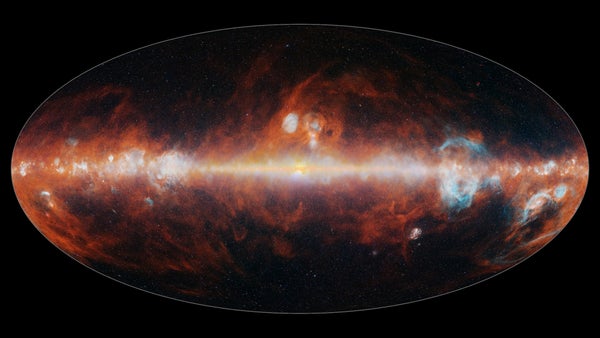
Just nine months since its launch, NASA’s newest space telescope has unveiled a jaw-dropping map of the cosmos unlike any we have seen before.
Spectro-Photometer for the History of the Universe, Epoch of Reionization and Ices Explorer (SPHEREx) is a two-year-long mission designed to study the universe in infrared light. It began science operations in May, yet the mission has already completed the first of four full-sky maps, showing the universe off in an image that includes more than 100 colors.
“The superpower of SPHEREx is that it captures the whole sky in 102 colors about every six months,” said Beth Fabinsky, project manager for SPHEREx at NASA’s Jet Propulsion Laboratory (JPL), in a statement accompanying the new map. “That’s an amazing amount of information to gather in a short amount of time.”
On supporting science journalism
If you're enjoying this article, consider supporting our award-winning journalism by subscribing. By purchasing a subscription you are helping to ensure the future of impactful stories about the discoveries and ideas shaping our world today.
READ MORE: New NASA Space Telescope Will See the Universe in 102 Colors
Space telescopes are typically optimized either to study a small patch of the sky across many wavelengths of light or to survey vaster swaths of the cosmos in only a handful of wavelengths. SPHEREx offers the best of both: with six specialized filters, the telescope can isolate light from 102 different wavelengths.
That’s powerful because of a fundamental feature of the cosmos: as light travels across the expanding universe, it stretches. Light from farther away is both older and more stretched, meaning it has a longer wavelength than light from closer objects.
Scientists can pinpoint an object’s distance using information gleaned from its light. In turn, what SPHEREx is producing is not a flat map of the skies but a three-dimensional atlas of everything it can see in the universe.
Mission scientists hope this atlas can solve three big challenges: mapping several key flavors of ice in and around our Milky Way galaxy, tallying all the light produced across the history of the universe and peering back to the earliest moments after the big bang.
But SPHEREx’s data will inform studies far beyond these narrow topics, astronomers say. Its full-sky view will illuminate the asteroids and comets littering our own solar system, for example. And by comparing repeated scans of the sky, it could reveal fast-changing so-called transients such as supernovae, the explosive deaths of massive stars.
“It’s really mapping the sky in a novel way,” said Olivier Doré, a cosmologist at JPL and the California Institute of Technology and a project scientist for SPHEREx, to Scientific American before the telescope’s launch. “It’s about opening up a new window on the universe.”