
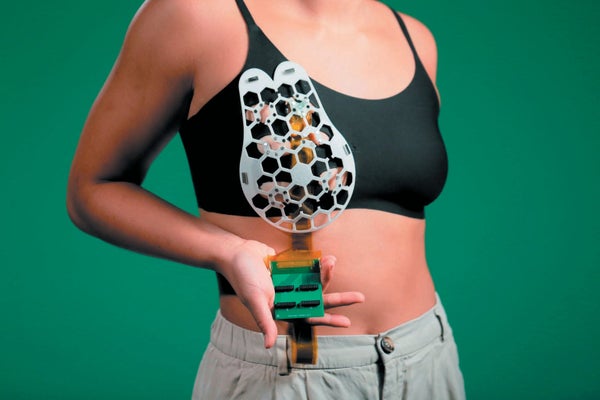
If breast cancer is caught early, its survival rate is nearly 100 percent. If not, that rate can quickly drop to roughly 25 percent. Women older than 50 in the U.S. are advised to get mammograms every two years, but the most aggressive tumors often arise and are diagnosed between screenings.
These “interval” cancers account for around a quarter of all breast cancer cases, “and by the time you're diagnosed, it [may be] too late,” says Canan Dagdeviren, a materials engineer at the Massachusetts Institute of Technology. So Dagdeviren and her team have developed a wearable ultrasound scanner that could be used at home to detect breast tumors earlier, particularly in high-risk people. “Frequent screening is the key for survival,” she says.
Conventional—and bulky—ultrasound scanning machines use piezoelectric materials (which convert electrical signals into movement) to send out sound waves that penetrate the body. Denser tissue reflects more sound, signaling the presence of a tumor. Dagdeviren says she and her team miniaturized a scanner using a new type of piezoelectric material that performs better and requires less power. “You get better penetration of deep tissue, using lower voltage,” she says.
On supporting science journalism
If you're enjoying this article, consider supporting our award-winning journalism by subscribing. By purchasing a subscription you are helping to ensure the future of impactful stories about the discoveries and ideas shaping our world today.
The researchers incorporated the scanner into a flexible, honeycombed 3-D-printed patch that can be fixed into a bra. The wearer moves the scanner among six different positions on the breast, where it snaps into place with magnets, allowing reproducible scanning of the whole breast. The scanner, which could be used once a week or month, was recently described in Science Advances.
The device achieves resolution comparable to ultrasound scanners commonly used in medical centers, but it does not have to be operated by a trained technician. “If you have a wearable solution that individuals can use at their pleasure, you can capture a lot more data,” says engineer Roozbeh Jafari of Texas A&M University, who was not involved in the work. That additional data can help doctors track a cancer's development and a treatment's efficacy.
Dagdeviren was inspired to develop the device when her aunt passed away from breast cancer at the age of 49, despite regular screening. “Just to comfort her, I sketched an ultrasound bra by her bedside,” she says. “It was a dream on a piece of paper, but now it's in my hands.” She and her colleagues believe the technology could have a profound impact. “With a very humble calculation, we found that this has the potential to save 12 million lives per year globally,” she says.
Clinical trials are underway in a bid for approval from the Food and Drug Administration. The device must still be connected to a conventional ultrasound machine to view the scans, but the team is working on a phone-sized device to analyze and transmit the data. “Depending on cost, the notion of equity could also be addressed because you no longer need to pay for hospital settings, physicians, nurses, and so on,” Jafari says. “This device could be used in ambulatory settings, remote areas and underserved communities.”