New Issue: Orbital Catastrophe Ahead? Read Now

U.S. Protesters Increasingly Reject Political Violence, ‘No Kings’ Survey Finds

Massive marches nationwide in the U.S. marked a turn against an increasing acceptance of political violence among protesters, report sociologists

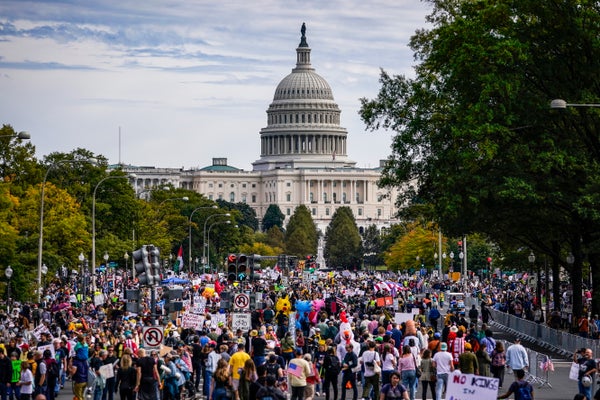
A large crowd marching along a street with the Capitol dome looming in the background.

Protestors march along Pennsylvania Avenue during the second “No Kings” protest on October 18, 2025, in Washington, D.C.

Nathan Howard/Getty Images

Join Our Community of Science Lovers!

The most recent “No Kings” marches across the U.S. marked a sharp turn away from protesters’ acceptance of political violence, suggests one early survey by sociologists.

Millions of people nationwide marched on Saturday in protests of Trump administration moves they see as undermining democracy. In an early survey, sociologists found that 59 percent of protesters in Washington D.C. reported disagreement with political violence, in a turn from similar surveys at previous protests.
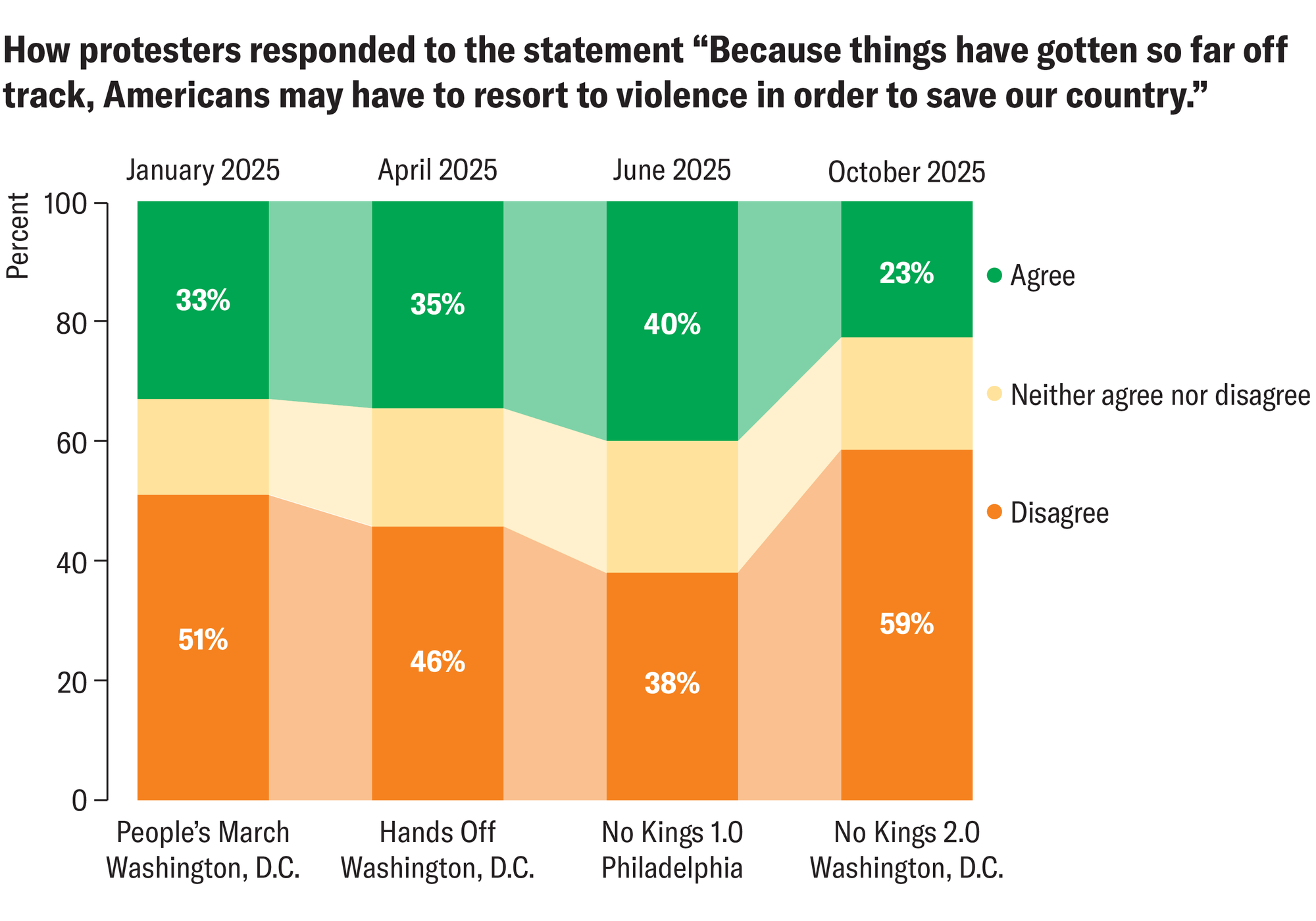
Stacked bar chart shows the percentage of participants in each of four 2025 protests who responded “agree,” “disagree” or “neither agree nor disagree” to the statement “Because things have gotten so far off track, Americans may have to resort to violence in order to save our country.”

Amanda Montañez; Source: Dana Fisher and Arman Azedi (data)


On supporting science journalism

If you're enjoying this article, consider supporting our award-winning journalism by subscribing. By purchasing a subscription you are helping to ensure the future of impactful stories about the discoveries and ideas shaping our world today.


Marchers there were “radically less supportive of political violence” than those previously surveyed, says sociologist Dana Fisher of American University, whose team has surveyed four large protests since January. “We also saw fewer violent signs and many more people in costume.”

Led by Fisher and her American University colleague, Arman Azedi, a team equipped with computer tablets and QR codes surveyed 348 marchers in the Washington, D.C., protest, which drew perhaps more than 200,000 people. In June at the No Kings protest in Philadelphia, as many as 40 percent of marchers agreed that “Americans may have to resort to violence in order to save our country,” the team had found. But on Saturday in the nation’s capital, only 23 percent agreed.

While the survey results are literally fresh off the tablets of scientists, the shift is worth noting, Fisher says. “My initial interpretation is the change in opinion is in response to the recent assassinations” that were politically motivated, she says, along with headlines about violent acts committed by federal agents moving into cities. In addition, march organizers emphasized peaceful protest ahead of the event.

Also ahead of the march, administration officials warned of “left-wing violence” associated with protests. But the Associated Press described the Saturday events as a nonviolent “street party” of marching bands, costumes and banners. A Harvard Kennedy School report released last week found that anti-Trump protests have spread more deeply into areas of the U.S. where a majority of people voted for Donald Trump in 2024.

“We are still not seeing the students joining these crowds,” says Fisher, who emphasized that more surveys of protests are needed to confirm substantive changes in U.S. public opinion. The survey found more young people among marchers at this protest compared with past events, and the majority of participants were female, highly educated, white and middle-aged.

Dan Vergano was formerly senior editor, Washington, D.C., at Scientific American. He has previously written for Grid News, BuzzFeed News, National Geographic and USA Today. He is chair of the New Horizons committee for the Council for the Advancement of Science Writing and a journalism award judge for both the American Association for the Advancement of Science and the U.S. National Academies of Sciences, Engineering, and Medicine.

More by Dan Vergano

Subscribe to Support Independent Journalism

Great science journalism requires human expertise, time, effort and creativity. And it costs money. That’s why I and the journalists here at Scientific American hope you’ll join our community.

When you subscribe, you are supporting staff and freelance journalists who are passionate about telling science stories that are true, important and compelling. Our editors and reporters are often experts in their fields, which means they understand the nuances of big discoveries and can untangle the breakthroughs from the hype. With a subscription, you are also supporting rigorous fact-checking to ensure the words we publish are precise and accurate. And you’re supporting original illustrations, graphics and photos that bring you closer to an advanced laboratory, an ice sheet in Antarctica or a space mission in orbit. You’re helping us craft other types of high-quality journalism as well: Our newsletters are carefully written, edited and curated by staffers you have or will come to know and love. Our Science Quickly podcast is based on original reporting, collaboration with editors and scientists and exacting production.

Subscriptions keep this engine running so we can continue to deliver thoughtful, rigorous and independent science journalism to you. In an era of viral misinformation, this work is crucial. If you value what we do, I hope you’ll consider joining us as a subscriber

Thank you,

Jeanna Bryner, Editor in Chief, Scientific American

Subscribe