
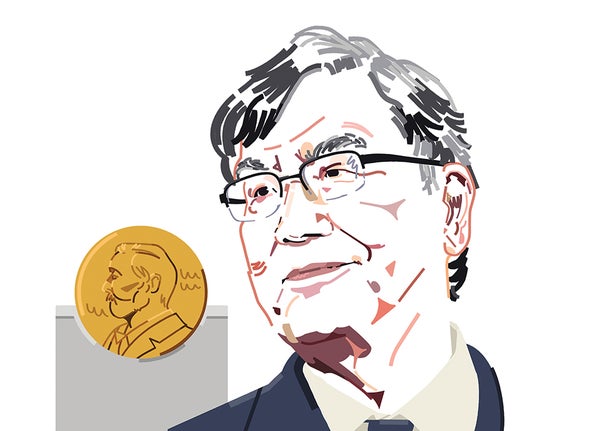
In 2006 immunologist Shimon Sakaguchi co-wrote an article in Scientific American that now feels prophetic. In the article, entitled “Peacekeepers of the Immune System,” Sakaguchi and his co-author, Zoltan Fehervari, now a senior editor at Nature, traced a timeline of important studies that led to Sakaguchi’s discovery of an elusive type of immune cell he called a regulatory T cell.
In the 1980s the field was not entirely convinced of the existence of such a class of cells, but Sakaguchi and other scientists proved that regulatory T cells, or Tregs, are the integral “peacekeepers” that prevent the immune system from overreacting and harming the body. That process, known as peripheral immune tolerance, stops the body’s primary defense mechanism from entering a self-destruct mode known as autoimmunity.
The experiments Sakaguchi cataloged in Scientific American nearly 20 years ago were recognized in December at the 2025 Nobel award ceremony in Stockholm, where he and immunologists Mary E. Brunkow of the Institute for Systems Biology in Seattle and Fred Ramsdell of Sonoma Biotherapeutics in San Francisco shared the prize in physiology or medicine for their discoveries.
On supporting science journalism
If you're enjoying this article, consider supporting our award-winning journalism by subscribing. By purchasing a subscription you are helping to ensure the future of impactful stories about the discoveries and ideas shaping our world today.
“I didn’t expect it, and of course I was very much pleased,” Sakaguchi says. “I’m happy to have this honor. But at the same time, I really appreciate the community of scientists who have worked together. The progress of this field is really due to the collective effort of many scientists and immunologists.”
In an exclusive interview, Scientific American caught up with Sakaguchi on the day after the award announcement. He discussed the crucial findings that led to the discovery of regulatory T cells and the clinical trials that have harnessed these cells to potentially treat chronic infections, cancer and autoimmune diseases.
An edited transcript of the interview follows.

Shimon Sakaguchi, an immunologist and a distinguished professor of Osaka University, attends a press conference after winning the 2025 Nobel Prize in Medicine, in Suita, Osaka prefecture, Japan on October 6, 2025.
Paul Miller/AFP via Getty Images
What was your journey toward looking for cells that suppressed the immune system? What drew you to them?
I was very much interested in autoimmune diseases. Our immune system normally defends our cells from invading microbes—viruses and bacteria—but sometimes it’s aggressive and destroys our body cells and causes autoimmune diseases such as rheumatoid arthritis and type 1 diabetes. So the immune system has two aspects: good and bad. What’s the mechanism behind this? If we can understand that mechanism, we may be able to treat autoimmune diseases—or the opposite: make the immune system attack abnormal cells, such as cancer cells, arising in our body.
That was my interest when I was a student in medical school, and then I became a researcher to tackle this conundrum. At that time [in the 1980s], the only available approach to study autoimmunity was the mouse model. I happened to find that in newborn mice, if you remove the thymus [an organ in the chest that produces various types of T cells], they spontaneously develop autoimmunelike diseases. And then what was interesting was that if you inoculate the thymus-free mice with normal T cells from nonaffected adult mice, you can prevent disease development—meaning that in the normal collection of T cells in the thymus, there must be some cells that can prevent or suppress disease development. That was the start of my research career.
What convinced you that regulatory T cells existed when others abandoned the theory?
I was convinced that one could produce autoimmune diseases in healthy animals by just manipulating the immune system—removing certain T cells—similar to [the way they arise] in humans. That was always a very solid phenomenon for me. If other hypotheses or other ideas could explain what we saw, I would follow that concept or idea. I always compared what I believed with what other theories showed to find out which had better explanatory powers. Our results were not so bad—and were even better—so that was the reason that I continued my research on regulatory T cells.
“It is really a key issue in modern immunology: How can we realize or understand why our immune system does not react with our body?” —Shimon Sakaguchi, Osaka University
For your 2006 Scientific American article “Peacekeepers of the Immune System,” how did you come up with the name “peacekeepers” for the cells?
That was coined by my colleague and co-author of that article, Zoltan Fehervari. At that time, we talked about how we could name them and make them more relatable. And then he came up with that idea: “peacekeeper.” It was a really nice name because, later on, we gradually realized that regulatory T cells not only are immunosuppressive but also have various other functions, such as promoting tissue repair. So they are peacekeepers for many things.
You essentially documented in the article, nearly two decades ago, how pivotal this work was. Did you think back then that your research would be recognized for a Nobel Prize?
Actually, I didn’t. I really hoped that we could have a better understanding of immunological self-tolerance. It’s a long-standing, important question in immunology. The 1960 Nobel Prize in medicine was awarded to Peter Medawar and Frank Macfarlane Burnet, who showed that immune tolerance is acquired, not innate. Well, that’s really interesting, but how does it happen? There have been several theories, including clonal deletion: deleting the dangerous self-reactive clones of T cells. They are eliminated when they are immature and being produced in the immune system. But that couldn’t explain how common autoimmune diseases happen—for example, type 1 diabetes or rheumatoid arthritis. So it is really a key issue in modern immunology: How can we realize or understand why our immune system does not react with our body?
Are any therapies based on or other applications of your work close to making it to the clinic?
What is fascinating about regulatory T cells is that they are specialized for immune suppression, which means that strengthening their functions or increasing their numbers could be a good way to treat autoimmunity or allergies or various other diseases. On the other hand, if you reduce the number of these cells or make their function weaker, then the immune response can be enhanced. That could be good for cancer immunity. My team and many others are pursuing both directions. There are many, many trials underway—at the Nobel announcement, the chairperson told us that more than 200 clinical trials are ongoing now.
Our approach is a bit challenging. For the cancer immunity, we’re looking into how to increase the efficacy of current cancer immunotherapies. For example, current immune checkpoint blockade [a type of therapy that uses laboratory-made antibodies, or inhibitors, that block certain signals so the immune system can attack cancer cells] is maybe 20 to 30 percent effective and not curative. So our idea is: Regulatory T cells are really abundant in cancer tissue and are suppressing effective antitumor immune responses. How can we remove them in tumor tissue? Antibodies can be designed to remove Tregs. We could combine that with the current immune checkpoint blockade and maybe make the cancer immunotherapy more effective.
In the future, we could perhaps develop an oral drug of small molecules that may have a similar effect as the molecular antibodies against Tregs [molecules that are typically delivered intravenously in most trials]. Then we could improve cancer immunotherapy not only in developed countries but also in developing countries.
You mentioned that this approach could be the basis for cancer treatments. How about infections that suppress the immune system, such as HIV/AIDS?
So, increasing immune response could be good in a tumor-immunity setting and also for chronic infection. We still don’t know whether it would work, but if we can strengthen the immune response by reducing Treg numbers, I think that’s one idea for tackling chronic infections.
What advice would you like to give early-career scientists?
It’s maybe a common one, but really what is important is this: If you are interested in something, in science or whatever, then pursue and continue working on that. Your interests may change along the course of your study or through your efforts, but you’ll find something in the landscape. Someday you might realize that you are doing something different from others that’s more fascinating than what you originally pursued. Nowadays you are expected to do something very, very soon and have a result. But it always takes time to arrive at something important.