
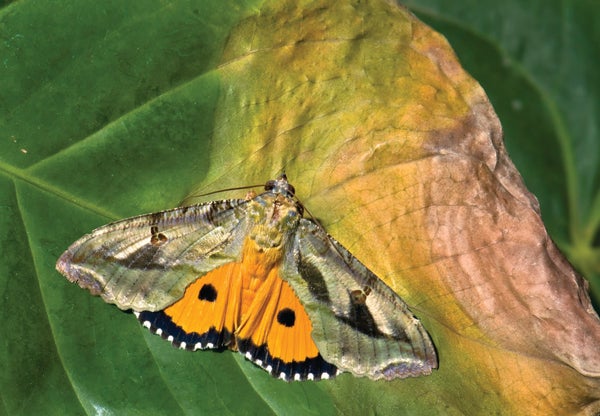
The nocturnal dot-underwing moth may use shape-shifting patterns on its wings as a stealthy way to attract mates in the dark. In a study published last September in Current Biology, scientists report the discovery on males' forewings of three patches that change darkness and size when viewed from particular angles. In females, the entire forewing darkens.
Although butterfly and moth species that are active during the day are known to employ dynamic visual effects to communicate, researchers had thought their nocturnal cousins relied almost exclusively on chemical signals because of the lack of light. But these changing wing patterns, now found for the first time in a nocturnal moth, suggest the insects may also incorporate visual signals. Because only the males have this pattern, researchers say it is likely a sexually selected mechanism.
Jennifer Kelley, an ecologist based at the University of Western Australia, and her colleagues first noticed the visual phenomenon while looking at museum moth specimens for another project. “As soon as we figured the effect was angle-dependent, we knew that to understand how it works, we had to understand the underlying optical physics,” Kelley says. The group contacted Gerd Schröder-Turk, who studies materials geometry at Murdoch University in Perth, and Bodo Wilts, a nanophotonics expert at the Adolphe Merkle Institute in Switzerland.
On supporting science journalism
If you're enjoying this article, consider supporting our award-winning journalism by subscribing. By purchasing a subscription you are helping to ensure the future of impactful stories about the discoveries and ideas shaping our world today.
Together the researchers traced the optical effects to nano-sized scales in the moths' wings. When the wings are viewed from above, the scales reflect available light directly, like a dull mirror. When viewed from an angle, however, they let some of the light through to reveal a deeper layer of darker scales, which appear as patches on the male's wings. If the insects were to beat their wings vigorously—a common behavior among males approaching potential mates—the patches would flash on and off, creating a striking signal even in very dim light.
“These moths have a great solution to the problem of eavesdropping,” says Elizabeth Tibbetts, a behavioral ecologist at the University of Michigan, who was not part of the study. “Their signal is very obvious from one direction but invisible from others, allowing males to advertise their sexiness to females without predators noticing.”