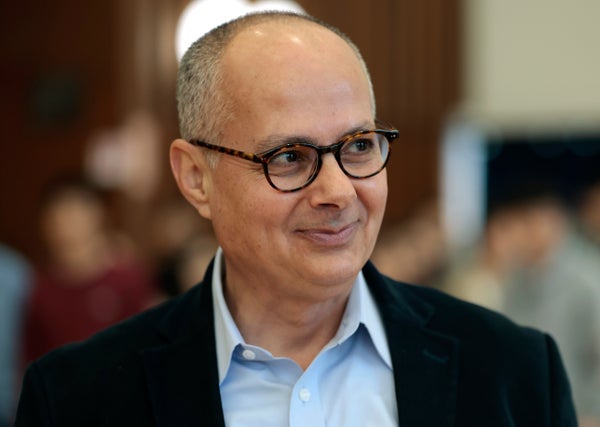
Omar Yaghi is a professor of chemistry at the University of California, Berkeley, who was jointly awarded the 2025 Nobel Prize in Chemistry for his pioneering work on metal-organic frameworks (MOFs). Yaghi is also founding director of the Berkeley Global Science Institute, which is aimed at creating research centers in developing countries. And he is co-director of the Kavli Energy NanoSciences Institute, the California Research Alliance by BASF and the Bakar Institute of Digital Materials for the Planet.
[This interview was edited for length and clarity.]
How would you describe the current state of American science?
On supporting science journalism
If you're enjoying this article, consider supporting our award-winning journalism by subscribing. By purchasing a subscription you are helping to ensure the future of impactful stories about the discoveries and ideas shaping our world today.
I think that American science, the culture of innovation, has always been strong because of something the U.S. system has that other systems don’t—the mentoring between a scientist and the students. This mentoring passes the knowledge from one generation to the next. The mentor also gives all they have, all they know, all their experiences, to the student with no reservations. This is how innovation gets passed on.
What fuels this innovation are top thinkers and researchers who are well funded by our government. For many, many years, our funding was very competitive; if you worked hard and you were doing good research, you would get funding. The current state is not so encouraging because of the cutting back on grants and support of science by the very agencies that many university researchers rely on.
I think one problem is that science is becoming very expensive to carry out, and so society is demanding some answers as to what this cost is leading to. And we often emphasize that “I have a product that could be deployed, that could be commercialized.” We forget that our best products are these new young scientists who think in a different way, who can solve problems in ways that nobody else can. The human element of this—human education and the human ability to solve problems and to discover new things that change the world—is not as emphasized as the actual product that might result. And I think that that’s missing the point of why universities are there in the first place.
What needs to change in American science?
Scientists need to engage in this artificial intelligence revolution. We need to engage in these AI models to make them more useful, not just in speeding up the tasks in the lab but also in suggesting questions that we normally wouldn’t ask. That needs to happen as a matter of survival of the advanced research system in the U.S. We need to be engaged in this important AI revolution so that we can modernize our labs and we can be commensurate with how society is proceeding and the rate at which it’s proceeding forward. That will be revolutionary for recruitment of the best minds of those young scholars because now they are going into a modern lab where they don’t have to slow down.
What gives you optimism right now?
In a large society like the U.S., you can always find enough young people interested in doing research and stimulating their minds by doing the hard work. And not everybody has to be able to do that, just enough to form a nucleus of great thinkers who want to study and advance the frontiers. What worries me is that we are not preparing for what I think is an AI revolution. We need to reinvent how research is being done to account for the fact that AI can speed up discoveries, and potentially it can carry out a lot of the tasks that are consuming our time and resources. In our labs, things proceed very slowly, and there is no reason for that, given that society is operating at the speed of light, whether it is trade or aviation or even summoning of information by individuals that they are learning more from online resources and LLMs [large language models] than from some of their university classes.
What’s your best advice for an early-career scientist?
My advice to somebody coming into science is that you have to weave AI and AI tools and machine learning into your research. Otherwise, you are not proofing your career, your future.
My second piece of advice would be: there has been no time in history where science is so great to do. We have sophisticated tools, we have sophisticated instruments, and they’re accessible and relatively inexpensive. No matter where you are in the world, you have access to some of these tools that can help you start science. Don’t wait for the ideal conditions to present themselves. Just start investigating, start experimenting. And no matter where you are, you can run an experiment and make a discovery. And maybe that discovery will change the world. I think experimentation is paramount in achieving discovery.
If you were given a $100-million grant that didn’t require any preliminary data or guaranteed milestones, what high-risk project would you start?
I would target the development of autonomous labs, where a researcher can sit at a terminal next to a box that will do the chemistry and instruct the robot on what to do, and the robot goes off, and it finds the conditions under which to make a new material, characterizes the material and gives you data.
What was a eureka moment when you realized a big idea was going to work?
I think when I was talking to one of my students back in the mid-1990s, and he had observed the formation of a beautiful crystal that looked like diamond, and he had taken this crystal out of its original solution, and it turned from looking like a diamond into looking like a white powder. The student deemed this observation unimportant, because it meant that whatever compound was behind this was not interesting, and it was not stable.
I said to the student, “Well, analyze it without taking it out of its original solution so that it doesn’t lose its diamondlike character.” When he analyzed that, and we discovered that it is what we called MOF-5, the very compound that the Nobel Committee [for Chemistry] cited and the very compound that broke all records of porosity and started the field of MOFs. We looked at each other, and I knew we had done something significant.
Now, he was at the Nobel celebration and reminded me of what I said when we saw the structure: “This is Nobel-worthy.”
What’s a favorite story from your early career?
Well, when I was a kid, the way I fell in love with chemistry was through chemistry drawings, molecular drawings. I didn’t know they were molecules. But when I was 10 years old, I saw those drawings in a library, and I thought, “Wow, this is very interesting.” I thought I had discovered drawings that nobody had seen before. So it got me interested in the drawings. And then later I learned they were molecules, and the molecules are all around us. I became really, really interested in chemistry, and nothing since has turned me away from chemistry. I think the love for things like that come from most humble circumstances and the most unexceptional circumstances. It was not an intellectual moment by any means. It was more like, “Oh, I see these things look strange, but something is drawing me to them.” And I felt, deep down, that maybe this is a secret I can keep, as if nobody has seen them before.
I think in retrospect, when I think deeply about it, maybe I was looking for structure in my life. My life was chaotic. My humble home with many kids was quite chaotic, and we were not a well-to-do family. Maybe I saw that as a structure in my life, maybe something that I can think about away from the day-to-day circumstances.
How has AI changed your own research?
My field, reticular chemistry, is about building structures from molecular building blocks, and we make porous materials, and these porous materials have applications in extracting water out of the air to make drinking water, taking carbon dioxide out of the air to make clean air or storing hydrogen to deliver clean energy. And the fact that they can be designed precisely on the atomic and molecular level makes them extremely important in customizing materials for very specific applications.
Two or three years ago, a colleague and a young student in my lab decided that AI would be very important in furthering the field because you can get to your answers much faster. It’s easy to make these materials but not so easy to crystallize them. There is a lot of trial and error in making them ordered. So we’ve discovered that [by] just using ChatGPT, we could speed up the crystallization from years to weeks. Crystallization is the ability of the building units to come together in an ordered fashion based on the conditions under which you assemble them. That’s a trial-and-error process of trying to find the right conditions under which all the pores are homogeneously distributed throughout the material, and the material can work cohesively and repeatedly for, in the case of water harvesting, many, many years.
Another example in my lab is that we are adapting machine-learning algorithms to a specific class of materials. Students that are using this machine-learning algorithm that has been adapted to our chemistry will discover twice as many new compounds compared with students not using these algorithms. So the answer to the question of “How did AI transform my field?”: it’s a revolution.