
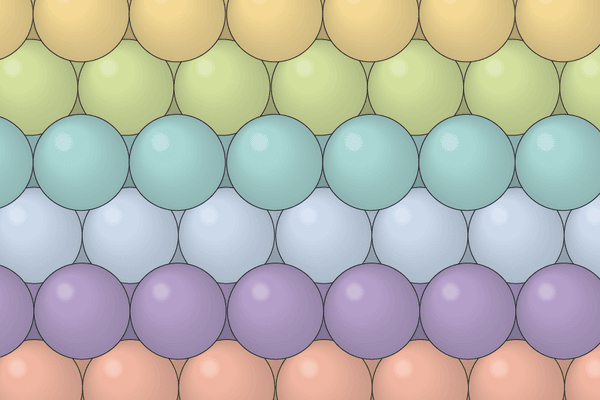
Spill your piggy bank on the table and try to lay out as many quarters as you can. Quarters must lie flat; they can touch at their edges as long as they don’t overlap. What’s the most efficient way to squeeze the maximum number of quarters into the space? If the tabletop extended infinitely in all directions, what fraction of it could you cover with the coins?
This puzzle is the starting point for an area of math called sphere packing. After pondering the two-dimensional case on a tabletop, it’s natural to hop to three dimensions (picture oranges stacked at a grocery store) and, from there, much higher dimensions. Efficiently packing high-dimensional spheres into their abstract spaces has surprisingly practical applications to digital communication technology. It’s a beloved area of research with notoriously difficult open questions. That’s why OpenAI caused a stir on August 1 when the company announced that its then-unreleased model Astra had made a notable advance in sphere packing, alongside nine other problems in math and theoretical computer science.
On supporting science journalism
If you're enjoying this article, consider supporting our award-winning journalism by subscribing. By purchasing a subscription you are helping to ensure the future of impactful stories about the discoveries and ideas shaping our world today.
To solve our opening puzzle about packing circles in 2D space, a tempting arrangement stacks the disks (quarters) in alignment like so:

Amanda Montañez
Dusting off some old geometry formulas, you can work out that circles stuffed in this way will cover about 78.5 percent of the surface (precisely π⁄4 percent of the space). To squeeze in more disks, consider that a circle can have as many as six other equal-sized circles simultaneously abutting it. With that in mind, you can more efficiently pack the disks onto a table, resulting in a repeating honeycomblike design.

Amanda Montañez
This pattern covers about 90.7 percent of the space and is known to be the optimal arrangement. In three dimensions, the familiar orange-stacking grocery store method is the densest possible arrangement. To build it, lay down a flat layer of spheres, and rest each successive layer into the dimples formed by the one below. When viewed from above, the shape of that first layer can resemble the hexagonal honeycomb arrangement or the simple square grid. As long as you nestle each new layer into the hollows below, either method will ultimately lead to a version of the same structure, with a density of about 74 percent. Johannes Kepler, the German polymath famous for his laws of planetary motion, conjectured that this arrangement was optimal back in 1611. Hundreds of years passed until this conjecture was confirmed in 1998, when American mathematician Thomas Callister Hales announced a massive computer-assisted proof.

Amanda Montañez
When jumping to higher dimensions, mathematicians shed the pictures and trust the equations. Just as a point in the two-dimensional x-y plane is denoted as a pair of coordinates (x, y), a point in three-dimensional space has three coordinates (x, y, z), and in four-dimensional space, it has four (x, y, z, w). Finding the distance between two points in four-dimensional space involves the same formula you’d use in three dimensions but with one extra coordinate.
Although the algebra extends comfortably to higher dimensions, finding optimal sphere packings in higher dimensions is extremely difficult. After the third dimension, researchers have found them only for dimensions 8 and 24. Ukrainian mathematician Maryna Viazovska cracked the former in 2016, a triumph that earned her a Fields Medal (the “Nobel Prize of math”) in 2022. Just a week after the 2016 discovery, Viazovska and four co-authors resolved the latter. Dimensions 8 and 24 harbor special symmetries that the researchers leveraged to cram them with spheres. Much less is known about other higher-dimensional spaces. Optimal packings in some dimensions might even be irregular and not follow a repeating pattern like the settled cases do.
Higher-dimensional spheres serve as excellent models for things that exist in our daily lives. Take digital communication—a messy, error-prone business. When you send a text message, your phone converts your words into bits, a sequence of 0’s and 1’s that are then translated into an electromagnetic signal. That signal broadcasts through the air to the nearest cell tower, where it gets channeled through a complex network of cables. This physical odyssey bombards your message with faulty wires, static, glitches and stray electromagnetic waves, all conspiring to warp the text into a garbled mess by the time it reaches its destination and gets converted back into words. So why do texts almost always come through intact? Better yet, why can you stream a full movie from a server in another country without a pixel out of place?
The answer lies in constructions from theoretical computer science called error-correcting codes, which are intimately intertwined with high-dimensional sphere packing. Because of the high likelihood of corruption, our devices encode messages with enough redundancy that they can be pieced together by the receiving machine despite the errors incurred in transit. Suppose I text you the word CODE, but somewhere along the trek, some bits flip and you receive COBE instead. Then you don’t know if I meant to send CODE, CUBE, LOBE or something else. If instead I send you a redundant message, CODE CODE CODE, and a similar amount of degradation occurs so that you receive CODE COBE CODE, then you’d feel confident that I intended to send the word CODE, even though a letter was altered. This simple method of duplication works, but we tripled the length of our message, and it could only tolerate one letter change. Longer messages mean slower communication, so people who study error-correcting codes devise more elaborate schemes to minimize the redundancy in the transmissions while maximizing the number of errors that can be corrected.
When phrased mathematically, the problem of designing error-correcting codes is actually a sphere-packing problem in disguise.
To get concrete, let’s say we want a method for mapping all possible 12-bit messages into unique 23-bit strings called code words so that if any three bits of the latter get corrupted, we can tell which code word had been sent and therefore identify the corresponding 12-bit message. The sender and receiver will agree on these code words in advance. If the recipient receives something that’s slightly off, they will “round it” to the most similar code word and take that as the intended message. To avoid ambiguities, none of the 23-bit strings can be too similar to any other. (If two code words are too similar, then after some bits are corrupted, the recipient might round to the wrong one.) How is this a sphere-packing problem?
A 23-bit string can be thought of as a point in 23-dimensional space. (Any set of 23 numbers can be thought of geometrically in this way.)
The number of bits you’d need to change to transform one point in that space into another corresponds to the distance between those points.
Every point within a radius of 3 of a given code word will be rounded to that code word by the recipient. This defines a sphere around each code word.
To avoid ambiguity, no string can belong to different code words’ spheres. If it did, then a recipient of that string wouldn’t know which code word to round it to. Geometrically, this means the spheres cannot overlap.
The more code words we have, the more messages we can transmit; that is, we want a dense packing of spheres with radius 3 in 23-dimensional space.
The specific parameters described here are a close cousin of a real code that NASA used in its Voyager probes to send images back to Earth. Mathematicians have cooked up all sorts of clever error-correcting codes (not all based on sphere packing) for varied applications. You benefit from them when you send or receive information through the Internet, cellular data or GPS. So while high-dimensional spheres might not exist in the physical world, our digital lives run more smoothly because of them.
Higher-dimensional spheres serve as excellent models for things that exist in our daily lives.
As we scale up the number of dimensions, the optimal packings rapidly become less dense. Just how rapidly this happens is a major open question in the field. OpenAI’s Astra model proved that as dimensions climb, the densities drop off more quickly than anyone had established before. It was the first substantive improvement on this question in 48 years. In the same stroke, Astra also showed the limits of one of the field’s most powerful tools, known as the Cohn-Elkies method.
For most specific dimensions, the maximum possible density for packed spheres remains unknown. Instead mathematicians settle for proving upper and lower bounds. Progress sometimes looks like lowering the known ceiling or raising the known floor until, one day, they hopefully meet. This is where the Cohn-Elkies method comes in.
In 2003 Henry Cohn of the Massachusetts Institute of Technology and Noam Elkies of Harvard University published a key paradigm for finding upper bounds on the density of sphere packings. Their recipe is almost mechanical: come up with a mathematical function, feed the function into their method, and an upper bound pops out. That bound is only as good as the function you choose, however. Cohn and Elkies created a short checklist of mathematical properties a function must have to be eligible for their method. Coming up with functions that check all those boxes is easy, but most produce large, uninformative upper bounds. The difficulty is constructing specific functions that push the bound down as close to the true density as possible.
They provided the field with a machine: identify the right inputs, churn it through their method, and a breakthrough in sphere packing might emerge. In fact, this is exactly how Viazovska proved the optimal density for sphere packings in eight dimensions. She drew novel connections to other branches of math to design the perfect function that, when fed to the machine, yielded an upper bound that matched the known lower bound for eight-dimensional sphere packings. When an upper bound on a variable equals a lower bound on the same variable, no doubt remains about its true value. So the Cohn-Elkies method is a mighty tool for making serious progress in the field.
Astra, the AI model behind the latest breakthrough, showed the limits of that tool. As part of its proof, it calculated a threshold for the best you can hope to get out of the method. For sufficiently large dimensions, no matter how meticulously you engineer a function and feed it through Cohn-Elkies, the resulting bound cannot be better than that threshold. When Cohn and Elkies introduced their method in 2003, no one understood its true power. It led to breakthroughs in specific small dimensions, but whether it could improve on the 48-year-old record for how fast density falls off as dimensions climb was an open question. Astra’s threshold answers it: the method can improve on that record but only to a point, and now that point is known exactly.
Of course, a claimed proof typically becomes a canon proof only after other mathematicians have verified it. OpenAI’s advances have a head start here because, like many other recent AI math breakthroughs, the proofs came with a formal write-up in a proof assistant language called Lean. Proofs written in Lean look like computer code but with more mathematical content. The magic of Lean is that it checks proofs for you. You write down a theorem statement in its language and follow it with the proof, and Lean will give a thumbs up if the proof does in fact imply the theorem. Although experts don’t need to check the proof to know if it’s correct, they do need to check that the theorem as written in Lean captures the mathematical claim being made. At the time of this story’s publication, subject matter experts have only partially checked the Lean files.
The announcement drew criticism from some researchers in the field, particularly from Stephen Miller, a mathematician at Yeshiva University. Miller claims that the new proof hinges heavily on his prior work and that Astra did not give that work adequate attribution. An OpenAI spokesperson told Scientific American senior report Joseph Howlett, “We take responsibility for the correctness of these results and are meeting the same standards generally expected of human mathematicians.”
OpenAI reported that finding the 10 proofs cost the equivalent of $2,000 in AI usage fees, although that figure omits the cost of unsuccessful attempts. Astra won’t be winning a Fields Medal for this work, but, pending human verification, it did advance the frontier of sphere packing, and we should expect to see more from it soon.