
Opioids relieve pain very effectively by activating particular receptors—proteins that are found on cells and respond to specific substances. But these drugs also cause serious side effects, including respiratory depression, which can be lethal. New research could inspire next-generation opioids that provide pain relief with fewer such risks.
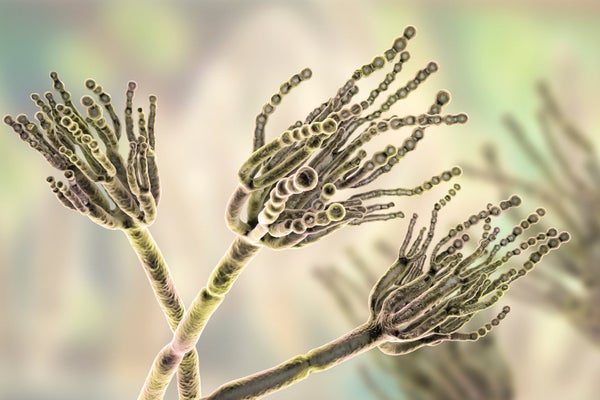
Scientists in Australia have discovered peptides, tiny strands of amino acids, that act like opioids in some ways and come from an unlikely source: a Penicillium fungus. “This beast was found in a very pristine estuary at the end of the world, in Tasmania,” says Macdonald Christie, a neuropharmacologist at the University of Sydney and senior author on the new study, detailed last October in the Proceedings of the National Academy of Sciences USA. Peptides that can activate opioid receptors to modify pain levels are rarely found outside the vertebrate nervous system, he says.
Opioid receptors belong to a family that controls countless brain functions. These receptors send signals within associated cells using molecules called G-proteins. For a long time, researchers thought drugs interacting with an opioid receptor would simply instigate G-protein signaling or block it, Christie says. But scientists have since learned that opioid receptors associate with many other proteins, too, influencing multiple signaling pathways within cells.
On supporting science journalism
If you're enjoying this article, consider supporting our award-winning journalism by subscribing. By purchasing a subscription you are helping to ensure the future of impactful stories about the discoveries and ideas shaping our world today.
“Most drug discovery has been based on efforts to turn on or off that G-protein interaction,” says Laura Bohn, a neuroscientist now at the Scripps Research Institute in Florida, who was not involved in the work. But “instead of continuing to just flip the switch, we can look for ways to dial in what we want—and what we want is pain relief. What we don't want is respiratory depression to [the point of] overdose, and we don't want addiction.” Bohn's research connected the pain-relief effects of the common opioid morphine to activation of G-proteins, and it linked morphine's respiratory depression to activating a regulatory protein called beta-arrestin.
Most opioids (and all known naturally occurring ones, Christie says) activate beta-arrestin as well as G-protein signals. But bilorphin—a compound the researchers in the new study created based on the fungal peptides—focused on just the G-proteins, Christie says. “That was something big to us,” he adds, “because we knew that everyone in pharma was working on developing [opioid compounds] that don't signal to arrestin.” (Bohn and Christie agree, however, that finding drugs free of side effects will be more nuanced than simply avoiding beta-arrestin signaling.)
The researchers tested bilorphin in mice, but it blunted pain signals only when injected directly into the spinal cord, which means that it could not cross the blood-brain barrier. The challenge will be to design bilorphin-inspired compounds that can get inside the brain and retain their unique signaling capabilities—ideally stopping pain without stopping breathing.