
New Issue: Orbital Catastrophe Ahead? Read Now

People Who Understand Evolution Are More Likely to Accept It

Even among the religious and conservative, knowledge of the theory influenced belief

Join Our Community of Science Lovers!

Science denialism can seem intractable, and studies on the topic are seldom encouraging. For example, research out of Yale Law School suggests that when people form their opinions on contentious topics such as climate change or evolution, political or religious values trump knowledge of the concept.

A study published in March in BioScience begs to differ, at least when it comes to evolution. Researchers at the University of Pennsylvania and their colleagues measured participants' knowledge of evolutionary theory, as well as their acceptance of evolution as fact. They found a significant link between understanding the fine points of the theory and believing in it, regardless of religious or political identity.

Unlike earlier research that involved only high school or college students, the demographics of the 1,100 subjects in the new study better approximated those of the overall U.S. population. The researchers also used more nuanced language in their questions to distinguish between subjects' intellectual grasp of evolution and their personal feelings toward it. It remains unclear whether science education leads directly to increased acceptance of evolution, but the Penn study supports this possibility.


On supporting science journalism

If you're enjoying this article, consider supporting our award-winning journalism by subscribing. By purchasing a subscription you are helping to ensure the future of impactful stories about the discoveries and ideas shaping our world today.
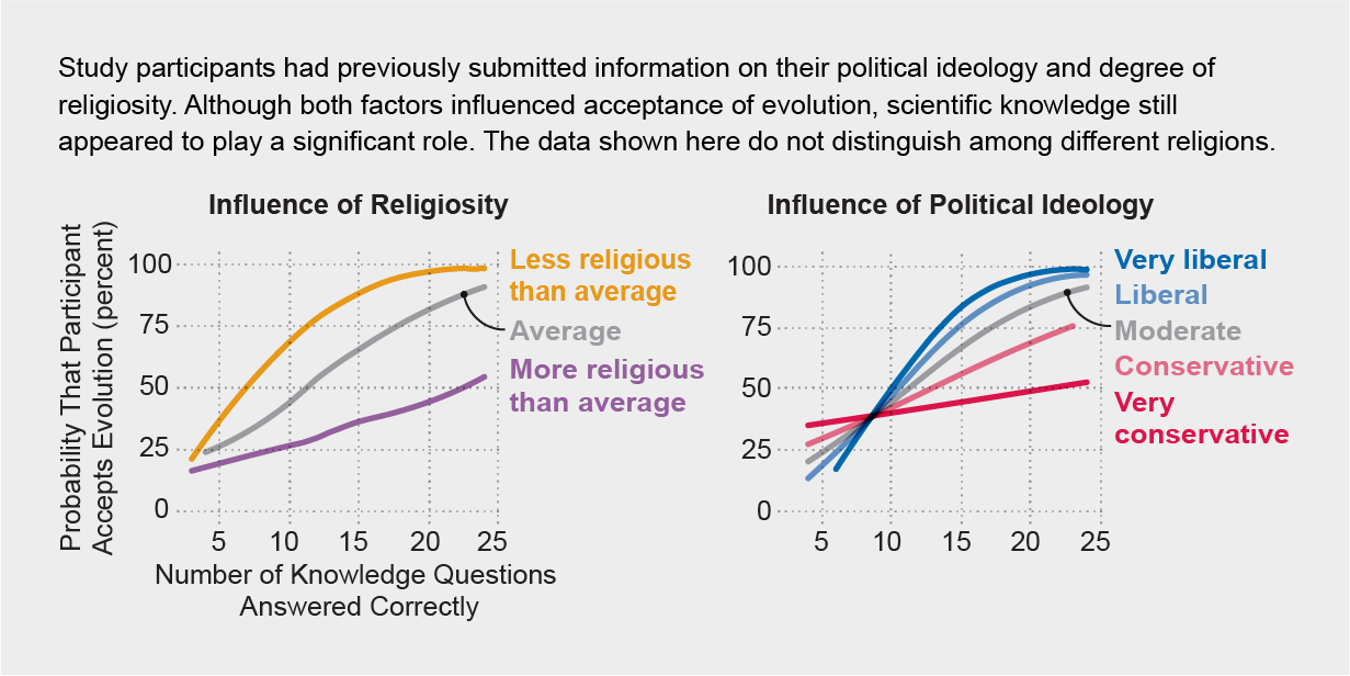

Credit: Amanda Montañez; Source: “No Missing Link: Knowledge Predicts Acceptance of Evolution in the United States,” by Deena Skolnick Weisberg et al., in Bioscience, Vol. 68, No. 3; March 1, 2018

Amanda Montañez is senior graphics editor and been at Scientific American since 2015. She produces and art directs information graphics for the Scientific American website and print magazine. Montañez has a bachelor's degree in studio art from Smith College and a master's in biomedical communications from the University of Toronto. Before starting in journalism, she worked as a freelance medical illustrator. Follow her on Bluesky @unamandita.bsky.social

More by Amanda Montañez
Scientific American Magazine Vol 318 Issue 5This article was published with the title “Views of Evolution Shaped by Knowledge” in Scientific American Magazine Vol. 318 No. 5 (), p. 24
doi:10.1038/scientificamerican0518-24

Subscribe to Support Independent Journalism

Great science journalism requires human expertise, time, effort and creativity. And it costs money. That’s why I and the journalists here at Scientific American hope you’ll join our community.

When you subscribe, you are supporting staff and freelance journalists who are passionate about telling science stories that are true, important and compelling. Our editors and reporters are often experts in their fields, which means they understand the nuances of big discoveries and can untangle the breakthroughs from the hype. With a subscription, you are also supporting rigorous fact-checking to ensure the words we publish are precise and accurate. And you’re supporting original illustrations, graphics and photos that bring you closer to an advanced laboratory, an ice sheet in Antarctica or a space mission in orbit. You’re helping us craft other types of high-quality journalism as well: Our newsletters are carefully written, edited and curated by staffers you have or will come to know and love. Our Science Quickly podcast is based on original reporting, collaboration with editors and scientists and exacting production.

Subscriptions keep this engine running so we can continue to deliver thoughtful, rigorous and independent science journalism to you. In an era of viral misinformation, this work is crucial. If you value what we do, I hope you’ll consider joining us as a subscriber

Thank you,

Jeanna Bryner, Editor in Chief, Scientific American

Subscribe