
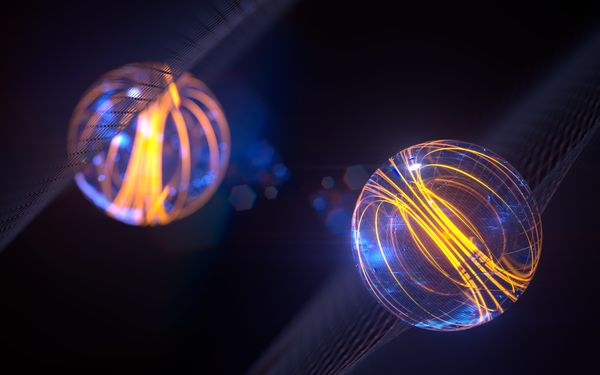
At the foundation of photonic quantum computing are pairs of light particles. Linked together through a process called quantum entanglement, these so-called entangled particles mirror each other, no matter the distance between them. And now researchers have shown that good old sunlight can create these specially entwined particles.
In a study published in Optica, a team led by researchers at the University of Ottawa and the Max Planck Institute for the Science of Light (MPL) in Erlangen, Germany, generated pairs of entangled photons using nothing more than focused sunlight.
“What we want is really to make quantum technology more and more accessible for everybody,” says Cheng Li, who co-led the work as a graduate student at the University of Ottawa and is now at Lawrence Berkeley National Laboratory. “If it’s possible with sunlight, then you can virtually do it anywhere.”
On supporting science journalism
If you're enjoying this article, consider supporting our award-winning journalism by subscribing. By purchasing a subscription you are helping to ensure the future of impactful stories about the discoveries and ideas shaping our world today.
For decades, physicists have relied on high-energy lasers beamed through special crystals to produce entangled photons—a process called spontaneous parametric down-conversion. The incoming light beam is almost always a laser because physicists long assumed that producing such a strongly ordered connection would require strongly ordered light: A laser’s waves oscillate in lockstep, at a single color. Sunlight, by contrast, is a jumble of wavelengths headed in every direction.
Lasers also come at a high energy cost. They run on electricity, demand constant stabilization and shed much of their power as heat. Physicist Robert Boyd of the University of Ottawa, the new study’s senior author, and his colleagues had already begun probing whether the laser was truly necessary—showing, in theory and in light-emitting diode (LED) experiments, that incoherent light could still yield entanglement, so long as the entanglement depends on a property of light that doesn't depend on color or direction.
Sunlight is free, which is why it was so appealing. “We take out the electrical-to-optical conversion part of entanglement generation,” Li says. “We go straight from light to light.” Focusing diffuse sunlight onto a millimeter-scale crystal posed its own challenge. Study co-author Hanieh Fattahi’s team at MPL built an all-glass, cone-shaped solar concentrator that funnels light from a window-sized Fresnel lens into a very thin optical fiber.

In outdoor tests at MPL that were conducted over three days, the system’s resulting photon pairs matched a perfectly entangled state with a fidelity of roughly 94 percent and violated Bell’s inequality—a statistical test used to determine if quantum behavior is confirmed —by a modest margin that the team partly attributes to weak seasonal sunlight and passing clouds. The entanglement quality fell slightly short of the best laser-driven sources, but Li ascribes that gap to distortions from the optical components—something further engineering can fix—rather than to the sunlight’s incoherence.
“This is a proof of principle,” Li says. Now the team is working to boost the source’s brightness and entanglement quality toward a field-deployable device.
One day, such a system could help satellites generate quantum encryption keys from the sunlight streaming past them, he says. And with data centers already straining power grids, Li argues, quantum technology’s energy appetite is a problem that it is best to solve before it truly arrives.
“Sunlight is just there,” he says. “We just cut out the middleman and let sunlight do all the work.”
