
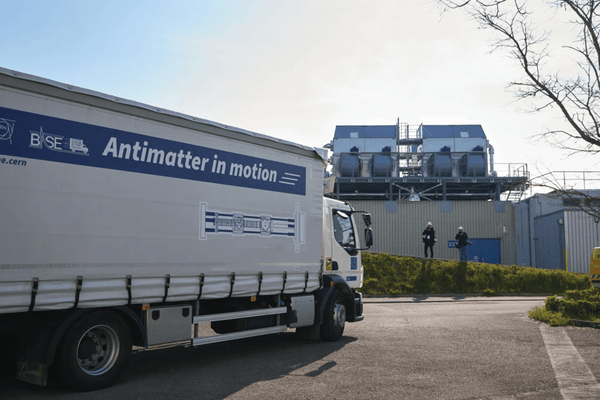
Physicists just pulled off perhaps the coolest road stunt a scientist can do: they loaded a truck up with antimatter and went for a drive. The feat marks the first time scientists have ever managed to transport antimatter out of the lab—and could help usher in a new era of antimatter discoveries.
To understand the achievement, it’s important to fully appreciate why antimatter is so hard to handle. Antimatter is like the mirror image of matter. Unlike regular matter, which is made up of particles, antimatter is made up of antiparticles, which are similar in mass to typical particles but have opposing electrical charges and magnetic properties. Antimatter is produced naturally in some nuclear or cosmic ray interactions, and it can also be generated in specialized facilities such as the Antimatter Factory at CERN, the European laboratory for particle physics near Geneva. But if regular matter and antimatter meet, they annihilate each other instantly in a burst of energy. This quality, perhaps unsurprisingly, makes antimatter both incredibly rare and notoriously difficult to study.
But scientists at CERN were undeterred. On Tuesday the physicists loaded 92 antiprotons—the antimatter version of protons—into a truck and drove them around for about an hour and a half.
On supporting science journalism
If you're enjoying this article, consider supporting our award-winning journalism by subscribing. By purchasing a subscription you are helping to ensure the future of impactful stories about the discoveries and ideas shaping our world today.
This is the reason why: CERN’s scientists have been able to successfully create and store antimatter, but the facility’s particle accelerators create “magnetic noise” that disturbs any measurements of the antimatter, says physicist Christian Smorra, project manager of the antiproton transportation project. So to really investigate the antimatter they create, the researchers need to trap it and move it to other labs. But first they had to work out how.
“We wanted to build something that fits in the back of your car in the beginning,” Smorra explains. “But then, when you start looking at the details, what you need to build this trap, then it becomes bigger and bigger.” The final trap they designed—essentially a massive box—ended up weighing about a metric ton and had to be lifted with a crane.
That said, “we managed to build something slim enough to fit through a door,” Smorra adds.
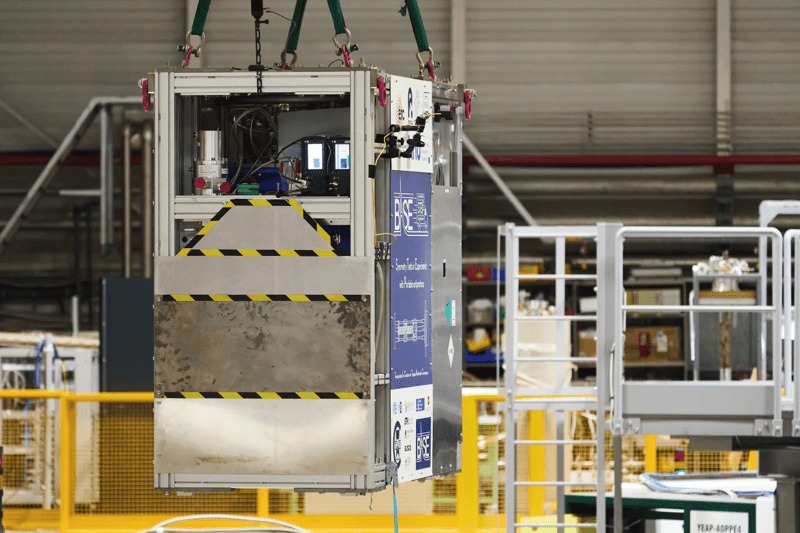
A portable cryogenic Penning trap used to transport antimatter.
© 2026 CERN
The antiproton trap contains a magnetic field that spins the antiparticles in a circle, suspending them in space. Then the antiparticles are cryogenically cooled to keep them at low energy. The trap also maintains an ultrahigh vacuum so that there’s no chance that any regular particles will collide with the antiparticles.
During Tuesday’s test, CERN scientists and other researchers from Heinrich Heine University Düsseldorf in Germany, loaded the antiproton trap into a small truck and drove it around the CERN campus. The team monitored the antiprotons throughout the journey and found them all to be safe and sound when they were returned to the lab. Eventually, the researchers hope, antiprotons will one day be transported on the eight-hour drive from CERN to Heinrich Heine University Düsseldorf for further study.
Studying antimatter particles could help physicists answer a long-standing mystery of the field: If antimatter and matter are both created and destroyed together, why isn’t there as much antimatter as there is matter in the universe?
In the meantime, for Smorra, Tuesday’s test was the ride of a lifetime.
“I think [the] truck drive was maybe the most exciting drive I’ve had,” Smorra says.