
Much of modern astronomy revolves around the study of strange alien worlds—from the sun’s retinue of satellites to the thousands of known exoplanets orbiting other stars. But what about a world that never quite came to be?
That seems to be exactly what one research group has discovered in a new study published in the journal Earth and Planetary Science Letters. By analyzing the chemical composition of an about 4.56-billion-year-old meteorite recovered from the Sahara Desert in 2019, the team found that the primordial space rock probably came from the high-pressure depths of a massive, maybe moon-sized, long-lost protoplanet during the solar system’s earliest epochs.
The discovery has major implications for our understanding of cosmic history, says Francois Tissot, a geochemistry researcher at the California Institute of Technology, who was not involved in the study. “This means that, within four million years [of the solar system’s formation], you’re making things that are the size of the moon,” he says. “It’s a very, very rapid formation timescale.”
On supporting science journalism
If you're enjoying this article, consider supporting our award-winning journalism by subscribing. By purchasing a subscription you are helping to ensure the future of impactful stories about the discoveries and ideas shaping our world today.
A Lost World
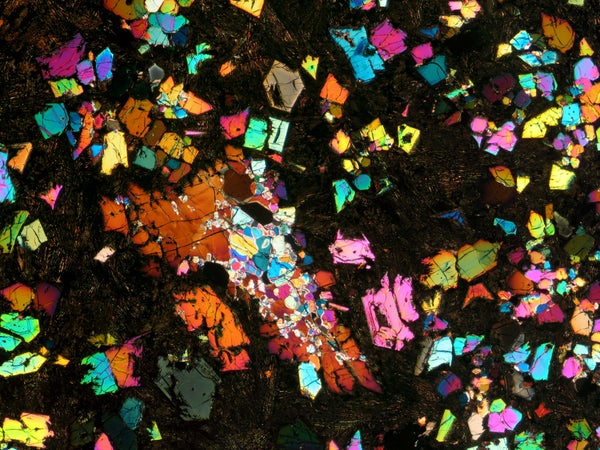
The meteorite in question, called NWA 12774, is of a very rare class called angrites. These are among the oldest known volcanic rocks, tracing back to just a few million years after the formation of the solar system itself some 4.56 billion years ago. Of the about 80,000 meteorites ever cataloged on Earth, fewer than 70 are angrites.
Despite angrites’ rarity and extreme antiquity, and the fact that no one has ever confirmed the meteorites’ parent body, many scientists had previously assumed they were fragments chipped from larger space rocks rather than remnants of full-fledged worlds. The idea of a large parent body had come up before, but “most people had looked at angrites as being from a small, asteroidal-sized body,” says Aaron Bell, an experimental petrologist at the University of Colorado Boulder and lead author of the new study. “We just accepted that because there was no evidence of the contrary.”
Bell and his colleagues began reconsidering that assumption when their examination of NWA 12774 showed that the meteorite’s crystals of a mineral called clinopyroxene contained an especially large amount of aluminum. This is a telltale sign that the crystals formed at great pressure within a parent body. “That was the flashing red light that there was something unusual about this meteorite,” Bell says.
To figure out just how much pressure the strange signature demanded, Bell and his team had to devise their own computational tool, a so-called a geobarometer based on clinopyroxene. The idea is relatively simple: if you know the exact composition of the aluminum-rich clinopyroxene, and you can infer the most likely chemical makeup of the molten rock from which it grew, then you can feed this information into a computer model to constrain the physical characteristics of the original parent body. There’s a beauty, Bell says, in following “that chain of reasoning, from atomic scale to lost world.”
After about a year of developing and carefully vetting the model, the team unleashed their new geobarometer on NWA 12774. What they found was astonishing. This angrite’s clinopyroxene must have formed at a pressure of at least 17.5 kilobars. That’s in excess of 250,000 pounds per square inch and more than 15 times the pressure you’d feel at the deepest point of Earth’s oceans—much higher than you’d expect within an asteroid, for instance.
The findings suggest the parent body of NWA 12774 was much larger than a typical denizen of the asteroid belt. Bell and his colleagues calculate its minimum radius would’ve been about 1,000 kilometers. Other clues hint that the parent body could’ve been even larger; the crystals still retain sharp edges that should’ve been melted away if they were too deep underground, meaning that the clinopyroxene may have formed at relatively shallow depths within an object about 1,800 kilometers in size—nearly as large as Earth’s moon. Bell even explores a hypothetical where the object’s size could approach that of Mars, some 3,300 kilometers in radius.
New Clues
Overall, “it’s a very sound study,” says Carl Agee, who researches meteoritics at the University of New Mexico and wasn’t involved with the new work. “I don’t think we’re at the point where we’ve proven beyond a shadow of a doubt that there was a very large early planet or body in the solar system that had these pressures. But this one particular angrite seems to be consistent with that idea.”
Other lines of circumstantial evidence also suggest shockingly large objects roamed the early epochs of our solar system. Earth’s moon, for example, is thought to have formed from a Mars-sized impactor striking our planet when our world was between 60 million and 140 million years old.
Beyond the question of how an angrite-spawning protoplanet could have arisen so early on, the details of its demise are unknown. Perhaps, Bell says, the object was ripped apart by collisions, after which its material could’ve reincorporated into the terrestrial planets we see today. Or, instead all its fragments may have scattered into the asteroid belt to rain down as angrites across the eons, says William Bottke, a solar system scientist at the Southwest Research Institute, who was uninvolved with the study. Further refinements of planet formation models, he notes, could help researchers clarify this emerging picture.
Assembling more evidence in favor of this large parent body probably won’t be easy, however. “We’re entering a new era, and there is a lot to be confirmed,” Tissot says. While he hopes that paying attention to understudied meteorites could help flesh out this theory, “at the same time, how many remnants or fragments of very large bodies we are going to be able to find is a difficult question,” he says.
For Bell, too, answers likely lie in meteorites that have perhaps gone overlooked. “People love NASA missions where we go and collect samples and bring them back to Earth,” he says. “But we actually have a huge diverse array of meteorites on Earth already.” Perhaps, he says, the next big breakthrough in charting our solar system’s deepest history won’t come from exploring some distant world but rather from studying samples of space rocks grabbed from remote regions of Earth or even a dusty drawer in a museum.