
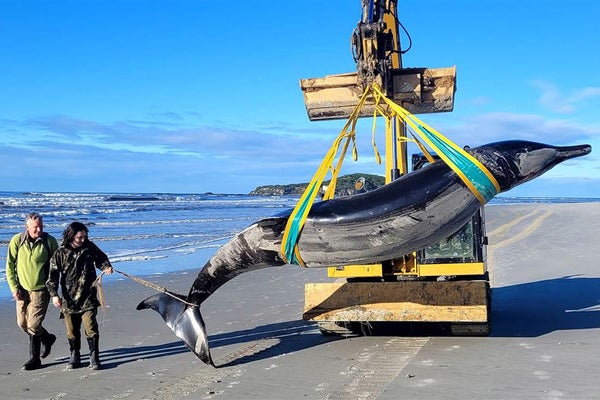
When the 16-foot-long corpse of one of Earth’s most elusive marine mammals—a spade-toothed whale—washed onto a beach in New Zealand’s Otago region, scientists scrambled to get eyes on the beast.
The persistently stealthy species, first identified in 1874, has evaded any known live sightings; science knows very little about it. Until the recent stranding was reported to local officials on July 4, scientists had documented only six such specimens, according to the New Zealand Department of Conservation (DOC).
The newly observed whale is “a really remarkable specimen,” says Emma Carroll, a molecular ecologist at the University of Auckland in New Zealand, who has studied marine mammals for more than a decade. “It's a once-in-a-lifetime kind of event to find one of these whales in such good condition.”
On supporting science journalism
If you're enjoying this article, consider supporting our award-winning journalism by subscribing. By purchasing a subscription you are helping to ensure the future of impactful stories about the discoveries and ideas shaping our world today.
No one had reported seeing the entire body of a spade-toothed whale—alive or dead—before 2010, when the bodies of a cow and a calf beached in northern New Zealand.
“Up until then, no one had seen the species with flesh on,” says Anton van Helden, science adviser for the DOC’s marine species team.
The specimen found this month was carefully hoisted off the beach using a digger provided by a local contractor and was then transported to a facility in Otago to be preserved in frozen storage. The DOC is now working with local Māori people, Indigenous people of New Zealand, who consider the whales spiritually and culturally significant, to plan what scientific analyses can be carried out.
If research on the specimen is agreed to, scientists will complete a full anatomical description of the species for the first time, van Helden says. “A slow dissection would enable the description of organs and key muscle groups, as well as getting organ weights, and the possibility of examining stomach contents for diet information,” he adds. “All of this will be new to science.”
The description could help marine mammal scientists estimate the number of spade-toothed whales alive today. Because researchers have no clear reference details about the whale’s defining physical features and coloration, they haven’t known what to look for—which may help explain why there have been no confirmed live sightings.
The whales’ apparently remote habitat could be another factor. “Beaked whales generally prefer deeper waters off the continental shelf,” van Helden says, which suggests that spade-toothed whales might spend most of their time at depths that are rarely explored by humans.
Genetic analyses of the new spade-toothed whale specimen might also reveal some secrets. “If we get a small piece of tissue from the whale, we can learn so much about it,” Carroll says. Traces of chemicals, absorbed by the whale’s body from its food, could even potentially help researchers determine where spade-toothed whales fit into the ocean food web—a network of interrelated food chains connected across an ecosystem.
Van Helden says further examination might help researchers figure out why the whale beached—possibly a result of age, disease or injury.
Even though so little is known about the deep ocean and species that live there, including spade-toothed whales, potentially harmful activities such as deep-sea mining are still being considered. “This might be the most abundant habitat that hasn't been impacted by people yet,” Carroll says. “We don't know much about these whales and their ecosystems, but people are already talking about how to exploit the ecosystem—their environment—without really understanding them. I think we need more knowledge before we start doing that.”