
AI AND AUTHORSHIP
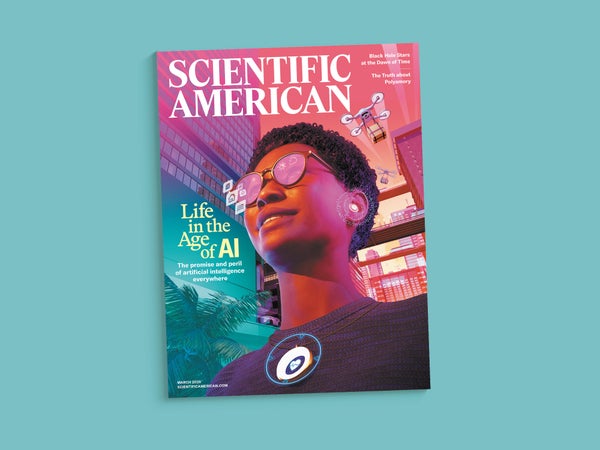
In “The Ghost in the Machine” [From the Editor], David M. Ewalt writes that he talked to an artificial intelligence, which then transcribed and assembled what he said into the column. He then asks, “Did I write this? Did the AI write it? Or is the truth somewhere in between?”
Although Maxwell Perkins, for example, drastically reshaped the works of Thomas Wolfe, we recognize Perkins as an editor and Wolfe as the author. And when a book is “written by John Doe, as told to Richard Roe,” John Doe is credited with the authorship, and Richard Roe is regarded as a collaborator or ghostwriter. In Ewalt’s piece, the AI is an editor, and he is the author. Crediting the editor is optional.
On supporting science journalism
If you're enjoying this article, consider supporting our award-winning journalism by subscribing. By purchasing a subscription you are helping to ensure the future of impactful stories about the discoveries and ideas shaping our world today.
MARTIN B. BRILLIANT HOLMDEL, N.J.
Ewalt did not write that article, nor did he provide its “soul.” It was manufactured by a machine, just like any other commodity. As he notes, he dictated what was effectively a bullet list of thoughts, which is how many competent authors begin creating their work. This is not writing but prep work.
He states that “we must embrace these tools so we can control them.” Large language models (LLMs) aren’t tools; they’re simply a means to further enshittify our lives with misinformation and spurious appeals to authority. LLMs provide nothing that a human brain can’t do. Data-analyzing AI, on the other hand, is indeed a useful tool but still requires a human to validate its results.
JOHN PETRI VIA E-MAIL
Regardless of the capabilities, ease or convenience they offer, I believe that as long as LLMs and similar models continue their current unrestrained demands on resources such as fresh water and power generation, use of them—especially for amusement or for tasks no more onerous than composing an e-mail or essay—is plainly unjustifiable.
NITA L. LEWIS KENOSHA, WIS.
My question to Ewalt is simple: If early on in your life, you had discovered a tool that could clearly organize the “rambling points” you wanted to make in essays you were writing, would you have learned to organize your thinking on your own, thereby acquiring a valuable skill? When it comes to the use of AI and cognitive development, product and production may be violently at odds.
EVELIN SULLIVAN SAN CARLOS, CALIF.
I completely understand the ambiguity that Ewalt expresses. I spent my first working years programming before switching to mostly architectural and managerial tasks. In that period, there was a large project where I wrote the fewest lines of code of all team members. Still, I always said that I “made the software” because the team wrote it according to my (and others’) ideas.
If Ewalt had the idea and checked everything thoroughly, the style was consistent with his “biological style,” and he was fine with the result, then it is his text. Nevertheless, there is a clear danger of letting go of these controls.
MARCO HAHN VIA E-MAIL
My worry about AI is inaccuracies being propagated. We humans can do that, too. But with footnotes and bibliographies, our sources can be scrutinized.
Ewalt believed he provided the soul of the piece. Although that was initially true, his soul’s creative output went through a process of reductionism and mimicry. Even if AI develops flavor choices for writers, I’ll probably be biased against the lack of authenticity.
ANNIE WILLIAMS VIA E-MAIL
This will not be the only response you receive pointing out that saying AI tools are “improving at a logarithmic pace” is the inverse of the usual expression “improving at an exponential pace.” Logarithmic growth starts fast and slows down. Exponential growth starts slow and speeds up, which is I think what Ewalt meant. As to what the AI system meant, maybe it was trying to be original at his expense.
KARL STEPHAN VIA E-MAIL
Ewalt cites the findings of “a major 2025 study.” He is citing a document entitled ExplanAItions 2025: The Evolution of AI in Research. Although Wiley calls the project a study, the document is not a scientific study in a peer-reviewed journal but a report with no attributed author. I simply wish to draw attention to evidence of the utter inadequacy of Ewalt’s AI assistant, not to him or his writing.
It seems to me that an AI tool greatly enhances a writer’s ability to intuitively and automatically write coherent text. This makes the writer less reliant on but therefore less likely to recruit his or her analytical and deliberative faculties.
ALEXANDER TRAPLIN GUELPH, ONTARIO
EWALT REPLIES: The entire magazine is fact-checked, but because the point of my letter was to consider the capabilities of AI, I intentionally let the text run as “written” by machine. It’s comforting that so many people caught the terminology error and somewhat specious reference; while the experiment convinced me AI can be a useful helper, it’s clear people are still the superior beings.
AI AND DISCRIMINATION
In “When Care Becomes Code” [Living in the Copilot Society], Hilke Schellmann writes that Ziad Obermeyer of the University of California, Berkeley, School of Public Health “found that some [AI] algorithms used in patient care turned out to be racist.”
I looked for clarification in an October 2019 study in Science that Obermeyer co-authored. It showed that a common health algorithm assessed Black patients as having a significantly lower medical risk than white patients with the same level of condition because it used health-care costs as a proxy for health needs.
The study authors didn’t use the term “racist.” Rather they concluded that the algorithm was “racially biased.” I think this terminology was used because it entails discriminatory behavior based on subconscious or nonprejudicial differentiation rather than conscious belief.
The algorithm in Obermeyer’s study made an incorrect inference from spending data; it had not been directly fed notions of prejudice.
WENDY ROSENBLUM STAMFORD, CONN.
SCHELLMANN REPLIES: In answer to Rosenblum’s thoughtful question, these terms can have different interpretations, and I used “racist” to describe discrimination in a broader structural sense: algorithms have no intent, of course, but they can still produce racist outcomes. Obermeyer’s work shows how using seemingly neutral data points, including health-care costs, can reproduce racial bias in patient care.