
This article is part of a special report on the total solar eclipse that will be visible from parts of the U.S., Mexico and Canada on April 8, 2024.
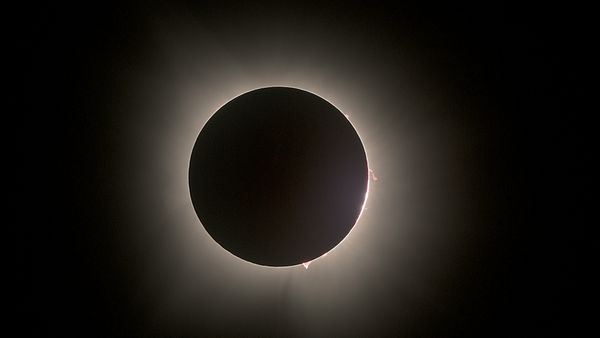
Sky watchers got a special treat during the April 8 total solar eclipse when the always stunning spectacle of totality was adorned with a couple of solar prominences, which appeared as reddish dots in locations around the moon’s outline.
On supporting science journalism
If you're enjoying this article, consider supporting our award-winning journalism by subscribing. By purchasing a subscription you are helping to ensure the future of impactful stories about the discoveries and ideas shaping our world today.
“There was a very impressive prominence visible during this eclipse,” says Lisa Upton, a solar scientist at the Southwest Research Institute in Boulder, Colo. “Stunning to behold!! This was such a magnificent eclipse for anyone who was fortunate enough to see totality.”
A total solar eclipse is the only time when earthlings can see the sun’s atmosphere, or corona. During an eclipse, the moon blocks all the light from the sun’s visible surface, which usually masks the corona. But during totality, for just a couple of minutes, the corona appears as a fiery white halo around the black moon. And scientists knew that the corona could be particularly interesting during this eclipse, which coincided neatly with the maximum of the sun’s 11-year activity cycle.
Those expectations were met when the sun provided a stunning prominence that was visible near the bottom of our host star to many during totality. (The sun’s orientation varies depending on a viewer’s location on Earth. The sun appeared to be rotated about 90 degrees between Mexico, where the eclipse’s shadow made landfall, and Canada, where it returned to the ocean.)
A solar prominence is a massive loop of the sun’s plasma that hangs attached to the visible surface of the sun, forming perhaps within a day but lasting as long as several months, according to NASA. They come in a couple of different varieties, most notably eruptive prominences, which are more dynamic structures, and quiescent ones, which can become eruptive when a new prominence forms below them.
Prominences often appear reddish because their plasma can originate deeper in the sun’s atmosphere, in a layer called the chromosphere, which is characterized by hydrogen at high temperatures that emits red light. By the 18th and 19th centuries, scientists were familiar with prominences during eclipses but initially believed that these features were potentially caused by clouds in the moon’s atmosphere. We now know that the lunar atmosphere is much too thin for clouds.
The moon does cause a different stunning phenomenon during every total solar eclipse, called Baily’s beads. These are brief flashes of light along the moon’s outline that occur at the very beginning and end of totality and are caused by sunlight sneaking through valleys on the moon’s surface. Baily’s beads aren’t visible during the rest of totality, however, like the prominences were during the April 8 eclipse.