
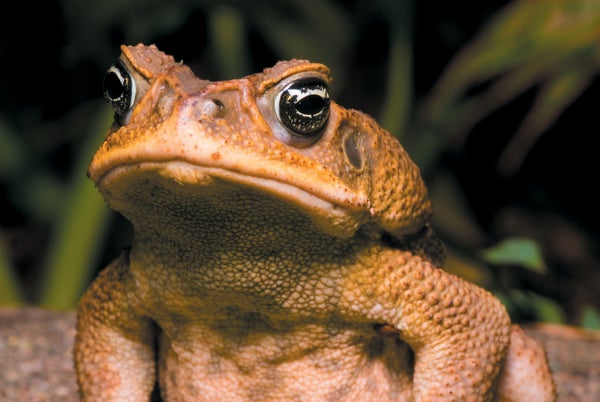
After South American cane toads were introduced to Australia in the 1930s to control pestilent beetles, they ravaged the country’s ecosystems—and their disruption continues today. These invasive amphibians secrete toxins from their skin, killing pets and other predators that eat them. The yellow-spotted monitor, a big lizard found mainly in Australia, has been especially hard-hit: populations have declined by more than 90 percent in most areas where cane toads invaded, with cascading effects on entire ecosystems. Now, to stem the problem, scientists are experimenting with a surprising way to dissuade the lizards from feasting on the toads.
Cane toads typically invade new areas as adults and then start reproducing. Wildlife management agencies and Indigenous groups track and predict the toads’ progress across the continent based on their yearly movements and signs of their approach—such as dead animals they’ve poisoned. For a study in Conservation Letters, researchers tested what may at first seem like a counterintuitive idea: releasing cane toad eggs, tadpoles and youngsters in areas where monitors are present and adult toads are about to invade. Previous research had shown that monitors are only sickened—not killed—when they eat young cane toads, and the lizards thus have a chance to learn to avoid the more toxic adults in future encounters. “It’s like we are rearranging the invasion dynamics,” says Georgia Ward-Fear, a conservation ecologist at Macquarie University in Sydney and lead author of the new study.
For the new work, the researchers first identified seven areas in Australia’s tropical Kimberly region that would soon be overrun by cane toads. They then released a total of about 200,000 eggs, tadpoles and young cane toads across three of the seven sites during two years’ wet seasons. The team used remote infrared and motion-detecting cameras to record the yellow-spotted monitor populations at each site before and after the adult cane toads eventually invaded.
On supporting science journalism
If you're enjoying this article, consider supporting our award-winning journalism by subscribing. By purchasing a subscription you are helping to ensure the future of impactful stories about the discoveries and ideas shaping our world today.
The study found that monitor populations exposed to the young “teacher toads” often survived the adults’ influx. In completely unexposed areas, however, the lizards virtually disappeared after the big toads showed up. “It’s a management strategy that’s now being adopted,” Ward-Fear says, adding that Indigenous groups and wildlife management agencies have already begun using it based on the study’s evidence.
“This research provides much hope in reducing the impacts of invasive species on native biodiversity,” says Jodi Rowley, a conservation biologist at the Australian Museum in Sydney who wasn’t involved in the study. She adds, however, that although this approach is “extremely exciting,” each invasive species is likely to interact with its surroundings in different ways, and specific research is needed to find effective methods for protecting other animals and ecosystems.