
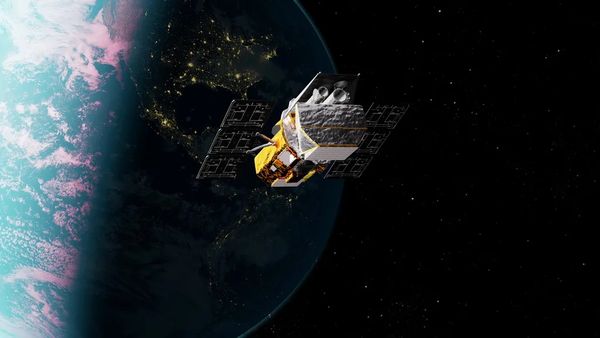
A commercial spacecraft launched on an unprecedented mission to rescue an aging NASA observatory now needs a rescue of its own.
Launched in early July, the Lightweight In-Space Navigation and Kinematics (LINK) servicing spacecraft went from contract award to launch in just nine months. The Arizona-based start-up Katalyst Space Technologies built it at the space agency’s behest for $30 million. The rush was justified: NASA’s Neil Gehrels Swift Observatory, which for nearly 22 years has been a critical tool for studying gamma-ray bursts and other cosmic explosions, is plunging to Earth faster than expected because of heightened solar activity. NASA has already paused Swift’s observations. Without intervention, one of the most scientifically productive space observatories ever launched could burn up in the atmosphere later this year.
Equipped with three robotic arms for grabbing the observatory some 350 kilometers above Earth, LINK is meant to rendezvous with and capture Swift and then use xenon-gas thrusters to raise the observatory’s orbit, giving it a new lease on life. Instead, according to a NASA statement on Tuesday, the rescue spacecraft began spinning out of control and temporarily lost communications. Two of its three onboard reaction wheels are now out of operation, and a set of smaller thrusters has lost some functionality.
On supporting science journalism
If you're enjoying this article, consider supporting our award-winning journalism by subscribing. By purchasing a subscription you are helping to ensure the future of impactful stories about the discoveries and ideas shaping our world today.
The wheels control LINK’s orientation, and the small thrusters are for fine-guidance control; both are essential for carrying out a safe rendezvous with Swift, which was not designed to be captured by another spacecraft.
The setback puts more than Swift at risk. LINK is also a test of whether robotic spacecraft can service satellites that weren’t designed to be repaired in orbit, a capability that could dramatically extend the lives of costly space missions.

Amanda Montañez
The trouble began over the weekend, NASA said, well after LINK had hit several preliminary milestones, such as deploying its solar-power arrays and test firing its xenon-gas thrusters, during its commissioning phase.
Katalyst is now trying to stabilize LINK’s spin using the spacecraft’s xenon-gas thrusters. The company said in a statement on its website that its initial corrective maneuvers are working as intended, though the effort is expected to take several days. LINK’s other major subsystems are functioning properly, the company said. Any attempt to approach and capture Swift remains at least a few weeks away.
If Katalyst can stabilize LINK, it plans to adjust the spacecraft’s software to work around the failed hardware. The company and NASA would then decide whether LINK is healthy enough to approach Swift safely.
“The mission remains active,” Katalyst said. “We continue to believe that with these changes, LINK has a viable path to rendezvous with Swift.”
With its unique ability to detect sudden cosmic outbursts and then swivel quickly in the sky to focus its ultraviolet, optical and x-ray sensors on them as they fade, Swift is considered an indispensable resource for astrophysical research. Its utility is set to grow in coming years as survey observatories such as the Vera C. Rubin Observatory in Chile and NASA’s Nancy Grace Roman Space Telescope begin finding more transient phenomena that demand rapid follow-up.
NASA’s space shuttles performed several servicing missions during their lifetimes, most notably five flights to the Hubble Space Telescope, but all of those relied on astronauts for careful hands-on work and the ability to respond when things went wrong. LINK will have to perform that delicate on-orbit choreography with robotics alone—an ambitious test of whether machines can take on work once reserved for astronauts.
“If you’re successful, the scientific benefit is tremendous,” said Swift’s principal investigator Brad Cenko, an astrophysicist at NASA’s Goddard Space Flight Center, to Scientific American earlier this year. “It’s almost like it’s a new mission, but you’re getting it for just a fraction of what it would cost to actually build something from scratch and fly it.”