
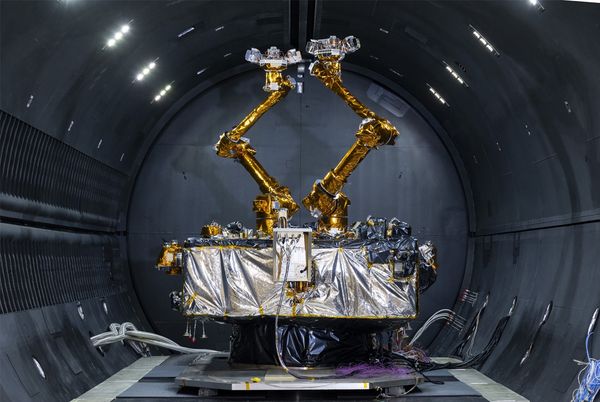
Far overhead, out of sight and mind for most people on Earth, two different robotic missions are on the cusp of a revolutionary new era in 21st-century spaceflight.
One of the missions, Katalyst Space Technologies’ Lightweight In-Space Navigation and Kinematics (LINK) spacecraft, is a troubled high-stakes project to rescue an aging NASA space telescope, with its failure or success set to unfold in coming months. The other, Northrop Grumman’s Mission Robotic Vehicle (MRV), is a less urgent effort to give multiple satellites a new lease on life and will close on its first target in about a year. Together, the two missions could reshape what’s possible in space science and commerce.
Since the dawn of the space age, spacecraft have been treated as disposable because salvaging them was too expensive—or too technically challenging—compared with the easier, cheaper task of launching fresh replacements. Now, however, thanks to radical advances in robotics and rocketry, the prospect of routinely servicing spacecraft is no longer the stuff of science fiction. This emerging capability could prove crucial not only for extending the longevity of one-of-a-kind missions but also for mitigating the growing threat of space junk from derelict spacecraft abandoned in Earth orbits.
On supporting science journalism
If you're enjoying this article, consider supporting our award-winning journalism by subscribing. By purchasing a subscription you are helping to ensure the future of impactful stories about the discoveries and ideas shaping our world today.
Weeks after its liftoff in early July to boost the decaying orbit of NASA’s Neil Gehrels Swift Observatory, which launched in 2004, LINK ran into trouble, spinning out of control and suffering sporadic communications. Mission controllers have since pulled LINK back from the brink, but whether it can still save Swift is unclear. In coming months, LINK must reach the space telescope some 190 miles above Earth’s surface, grapple it with its three robotic arms and boost it to a higher orbit.
“We knew there were going to be some challenges, [but] you never know till you get up there which ones you’re going to meet,” says Shawn Domagal-Goldman, director of NASA’s astrophysics division, which runs Swift. He has hope for the “Hail Mary” rescue attempt: “We still do see a pathway to success here in a number of ways,” he says. “The capabilities that they have... are sufficient enough to still grab onto the telescope and boost it and extend its lifetime.”
Northrop Grumman’s MRV mission has loftier goals—literally. It launched last month carrying a Robotic Servicing of Geosynchronous Satellites (RSGS) payload co-developed by the U.S. Defense Advanced Research Projects Agency (DARPA) and the U.S. Naval Research Laboratory. The MRV spacecraft is now making its way to the Optus D3 communications satellite, which sits some 22,000 miles above Earth’s equator in a geostationary orbit to cover Australia and New Zealand. There, with the help of the RSGS payload, the MRV will use two 10-foot robotic arms to bolt a “jet pack” electric thruster onto the nearly 17-year-old satellite so it can stay on-station, keeping Optus D3 working for at least another six years and maybe more. After that, the MRV operators plan to do the same for two as-yet-unannounced geostationary satellites operated by the company Intelsat.
“There’s on the order of 20 to 25 opportunities, on average, per year for servicing in GEO [geostationary orbits],” says James Shoemaker, who heads the RSGS program at DARPA. Both he and Domagal-Goldman point out there’s a lot of money to be made in this field; Optus D3’s cost was reportedly around $150 million, and a replacement could cost twice that. The MRV mission, however, could add half again its lifetime for maybe a quarter as much (the Northrop Grumman subsidiary that sells the service, SpaceLogistics, hasn’t disclosed a price). The Swift space telescope, meanwhile, cost about $250 million to develop and launch, while Katalyst was paid about $30 million to save it. And there are hundreds of geostationary satellites and ever more and stranger missions into space that will need servicing. Domagal-Goldman says the commercial space industry has already developed business capabilities that were not possible before: “It’s very different now from where we were a couple of decades ago,” he adds.
The idea of repairing spacecraft in orbit has a long history. Impromptu repairs were critical for many early American spaceflights—including Apollo 13 in 1970—and several Soviet missions. Astronauts visiting NASA’s Skylab 2 space station carried out space walks in 1973 to repair a meteoroid shield and a solar array, saving the habitat from destruction. And the space agency’s space shuttles helped U.S. astronauts perform orbital repairs on satellites twice in the mid-1980s; such work reached its peak across the next two decades, with five shuttle servicing missions to the Hubble Space Telescope. Minor experiments on the International Space Station (ISS)—using astronaut-controlled robotic arms to cut wires and unscrew caps, for example—have also occurred.
Today most developments focus on robotic interventions that avoid the expensive and risky prospect of lofting repair worker astronauts into orbit. In 2007 the DARPA-led Orbital Express mission (for which NASA and commercial contractors were partners) used two spacecraft to execute a complicated sequence of rendezvous, docking and fuel transfer; one of the spacecraft replaced a component on the other with a robotic arm. Northrop Grumman’s MRV program traces back to the company’s two Mission Extension Vehicle (MEV) missions, which respectively launched in 2019 and 2020 and have, so far, successfully rescued two satellites. The U.S. Space Force is also partnering with the private company Astroscale to demonstrate refueling in geosynchronous orbit sometime next year.
The next stage will be using robots not just to rescue, repair and refurbish in-space assets but to build entirely new ones. Shoemaker explains that spacecraft are designed to withstand the intense forces of launch, which only last a few minutes, but they experience almost no forces for the rest of their commercial lifetimes. “If you launched satellites in pieces and assembled them in space, you could pack them tighter, and you wouldn’t have to make them as strong,” he says.
The football-field-sized ISS is the best-yet demonstration of what in-orbit assembly can achieve—but still relied on astronauts for most of that work. Domagal-Goldman says NASA is considering plans to robotically assemble parts of the Habitable Worlds Observatory in orbit from the 2040s: “We haven’t determined that we’re definitely going to build it in space.... But we’re opening that up as a possibility,” he says.
China, the European Union and Japan also have state-funded programs to develop robotic in-space servicing and assembly of spacecraft, with China in particular demonstrating remarkable progress in recent years. The latest U.S. efforts could have applications, too, in NASA’s crewed Artemis program, which calls for refueling spacecraft in Earth and moon orbits to allow astronauts to visit the lunar surface. “It’s one of the joys of being at NASA,” Domagal-Goldman says. “We’re like a team of teams, and so when we do fun stuff, there’s a lot of people paying attention.”
Aerospace engineer Anita Sengupta explains how assembling objects in space will get around the limitations of rocket launches: “The primary advantage is that launch vehicles no longer dictate the size of the spacecraft,” she says. “In-space assembly enables much larger telescopes, communications arrays, solar power systems and eventually spacecraft designed for deep-space missions. Rather than designing spacecraft around the constraints of launch, we can begin designing them around the requirements of the mission.” In addition, every item launched into orbit carries a significant cost, so sustainability in space is not just environmental messaging but an “engineering necessity,” she says.
The idea of sustainability in space is a relatively new concept. Most space technology throughout history has been expendable, and balancing what goes up with what comes down is a recent concern.
“We’ve had a pretty consistent model—‘get it into space, and then we’re finished,’” says Danielle Wood, founder of the Space Enabled research group at the MIT Media Lab. But that model has created tons of trash in the “graveyard orbit” above the geostationary belt, while defunct spacecraft in low-Earth orbit can circle for decades before they burn up when their orbits decay, pumping potentially problematic amounts of vaporized metal into Earth’s sensitive upper atmosphere. “Both are not sustainable,” Wood says; future space missions will have to deal with the problem of cleaning up after they've finished. “Sustainability in space means that we are able to leave to future generations something like the natural state of the Earth, the moon and the solar system.”