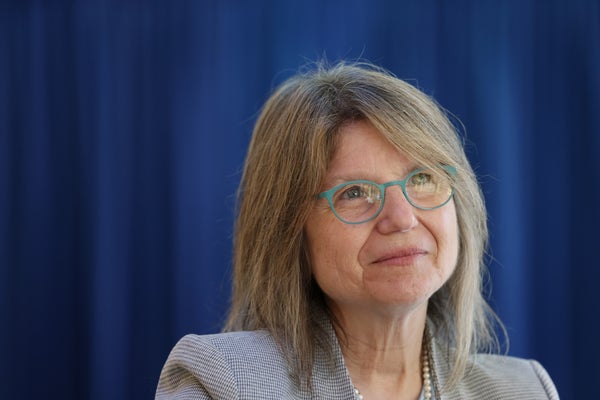
Sally Kornbluth is the 18th president of the Massachusetts Institute of Technology, where she has launched several initiatives to spark collaboration and innovation across M.I.T. The most recent of these initiatives—the M.I.T. Generative AI Impact Consortium—is aimed at using generative artificial intelligence to find solutions to real-world problems in a way that is beneficial to society. Before taking the helm of M.I.T., Kornbluth studied the biological signals that instruct a cell to divide or die, processes linked to both cancer and neurodegenerative diseases.
[This interview was edited for length and clarity.]
How would you describe the current state of American science?
On supporting science journalism
If you're enjoying this article, consider supporting our award-winning journalism by subscribing. By purchasing a subscription you are helping to ensure the future of impactful stories about the discoveries and ideas shaping our world today.
Uncertain. It feels like we’re perpetually operating in a state of cognitive dissonance.
On one hand, we’re at a time, technologically, where things could not be more exciting [and] our science [could not be] more cutting-edge. At the same time, we’ve never seen a situation where people felt so uncertain about the continuity of science funding, particularly when it comes to the basic discovery science that fuels the economy and will fuel societal impact a decade or two from now.
As a result, I think many in American science are feeling both hopeful and doubtful—hopeful because of the exciting work, the dreams within reach, and doubtful because we are by no means confident we’ll be able to realize those dreams.
What needs to change in American science?
I don’t think, fundamentally, that American science is broken. American science has produced an unending stream of exciting work for many decades and an unending stream of societal impact. What the U.S. did by investing in science at the end of World War II changed modern history. Talent, innovation, new knowledge—we were able to have it all; that investment paid off in an incredible way.
So it’s not so much that American science needs to change. It’s the conditions in which we operate. What’s needed is a rededication to public investment in American science. Even if I were not the leader of a premier scientific institution, this is what I’d say. Investing in American science is not a gamble; if you look back in time, there is no question about the benefits.
What we are obligated to do is better engage the public and the government on the repercussions of not making these investments. Curiosity—a deep drive to discover—is part of our American DNA and has yielded vast returns to the citizens of this country and the world.
What gives you optimism right now?
First, we are seeing the fruits of many years of investment in basic discovery science in terms of societal impact. There are examples of this everywhere you look. Immunotherapy for cancer was grounded in years and years of fundamental immunology research. Or look at the recent Artemis II launch; from an M.I.T. perspective, there were years of work that contributed to the communications modules from the Artemis [space capsule] to Earth.
The engine of American science is robust and can generate incredible advances for humanity. The discovery pipeline, things that are in pipeline now, are super exciting so long as we enable them to come to fruition.
The other thing that gives me optimism right now is the unbelievable talent around us. I worry about that talent being able to be as productive as it can be, given the environment we’re in. But in terms of the sheer breadth and depth of the talent, I’m optimistic.
What’s your best advice for an early-career scientist?
The most important discoveries you’re going to make will come from following your nose in terms of what is interesting. You can’t overthink things or try to overdetermine your path. It’s very difficult to tell up front where your science is going to go, and you have to be willing to be adaptable and follow your nose.
Is the U.S. still the undisputed destination for the world’s brightest minds, or are we losing that pull?
I think the data would say that we’re starting to lose that pull.
One issue has to do with immigration and visas. There’s the logistical issue of coming to the U.S., and if you’re worried that, in your fourth or fifth year of your Ph.D., someone will say that you can’t stay here anymore, that’s a concern for the brightest talent who have their pick of destinations.
The second concern is strictly financial. If you’re worried about the continued funding of your research, you might decide to move your career somewhere else. My greatest concern is that, at a time when the brilliance of the science and the depth of the technology [are] at [their] apex, we are driving [them] to other places by not allowing ourselves to reap the benefits of this moment with continued focus, attention and investment.
Places like China are investing in their talent, and they are investing in their infrastructure. We may not see a difference today, but five, 10, 20 years from now, we’re going to see a very significant difference if we don’t lean into (instead of away from) American science and into research at our universities in particular. Every part of our system offers unique strengths, but universities are where the long-term science critical to America’s future happens. It’s the part of our scientific enterprise that most drives the pipeline of discovery and trains the talent that goes on to work in American industry and in our national laboratories and federal research centers.
What’s the biggest thing you were wrong about, and how did you learn from that?
This is an interesting question. When I was a graduate student, I didn’t realize the incredible power of collective action to focus on a single problem when it was needed. For example, I think about the human genome sequencing. At the time, as a student, I thought, “Oh, why are we squandering our resources on that particular project when there’s so much science going on?” But in retrospect, the benefits that came from that incredible focus and investment have had an enormous impact. It accelerated biomedical discovery incredibly.
I have to say, from the perspective of where I’m sitting right now, I think that if we don’t invest in quantum [science] in a big way and we don’t invest in centers of excellence, we’re going to regret it down the road. I think in quantum engineering and in quantum physics, we are at that inflection point. We’re at the fundamental place where, if we make those kinds of investments, the benefits are going to be huge.