
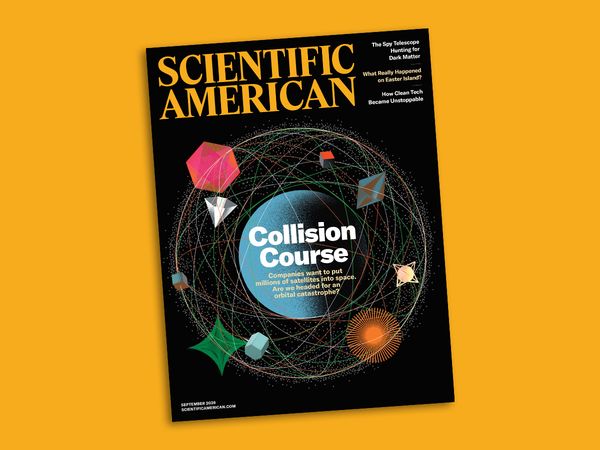
As this issue heads to print and our meticulous editors read through the final page proofs to ensure accuracy, we at Scientific American are packing up our office next to Battery Park in New York City’s Financial District. Both literally and metaphorically, we are on the move. After being sold by Springer Nature to LabX Media Group in June, the publication will have a new headquarters. More important, the sale has opened a new chapter in the history of this nearly 181-year-old institution.
Shortly after Scientific American was founded, its publishers established what would become a leading U.S. patent agency, helping everyday tinkerers get credit for their creations. Our pages became the hub for chronicling these innovations—tens of thousands of them, from the sewing machine to the airplane. Thomas Edison reportedly visited the magazine’s New York office in 1877 to demonstrate his newly conceived phonograph for the editors. I often wonder what such historically weighty occasions might have felt like to the staff. Did the person who edited Albert Einstein’s April 1950 article on his general theory of relativity enjoy a philosophical chat with the revolutionary thinker? Did Nikola Tesla’s eccentricities emerge during conversations with editors when he wrote, for an 1891 supplement, an article on the alternating-current experiments that led to the Tesla coil?
Over the years more than 150 Nobel Prize winners have written for Scientific American, relaying their breakthroughs and ideas to our readers. Our journalists have explored groundbreaking discoveries and achievements, from the lifesaving development of penicillin to Charles Darwin’s theory of evolution to Bell Labs’ invention of the transistor. Not all of our past is laudable, of course. The publication’s editors advocated for patents for white Americans only, furthered sexist scientific theories, and provided a platform for eugenicists. But today the magazine is ready to lean into its greatness. As many researchers have pointed out to us, there is no better time in history to be doing science, even when working against the headwinds of funding cuts and the rampant spread of misinformation.
On supporting science journalism
If you're enjoying this article, consider supporting our award-winning journalism by subscribing. By purchasing a subscription you are helping to ensure the future of impactful stories about the discoveries and ideas shaping our world today.
As the new editor in chief, I can’t promise that the next chapter will be free of mistakes or tumult. I do promise we will be a voice of reason, we will continue sharing scientists’ accounts of their own work, and we will enlighten and delight you with 21st-century equivalents of the discovery of the DNA double helix and the invention of the Tesla coil. And I want to thank our outgoing editor in chief David M. Ewalt, whose leadership shaped this publication in ways that will outlast his tenure.
The bar is high. The average consumer is bombarded from every direction with news and shorts and explainers and how-tos. We know what we’re up against—unlike in the 1850s, the media landscape is saturated with science “content.” To rise above the noise, our staff will continue to use their expertise to serve up only the most interesting and illuminating ideas. We aim to inspire you to dig deeper, ask hard questions and have fun. If you’re not already a subscriber, we hope to convince you to join the Scientific American community.