
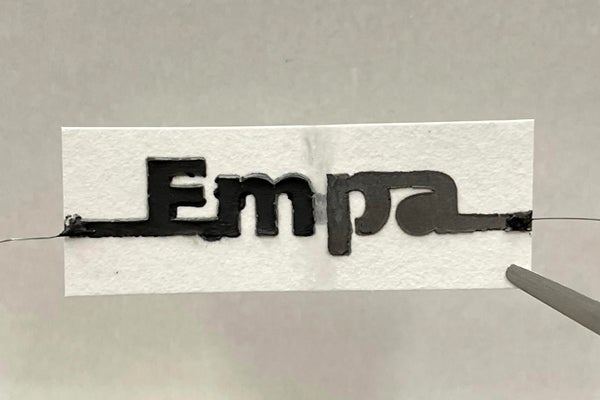
Discarded electronics are piling up fast, pushing researchers to explore creative ways to reduce this e-waste. Now one team has crafted a water-activated disposable battery made of paper and other sustainable materials.
The wires, screens and batteries that make up our devices—not to mention the plastic, metal and other materials that encase them—are filling up landfills with hazardous debris. Some e-waste is relatively large: old flip phones and air conditioners, for instance. Other e-waste is more insidious, such as electronic single-use medical diagnostic kits, environmental sensors, and smart labels that contain disposable batteries and other equipment.
“It’s these small batteries that are big problems,” says University of California, Irvine, public health scientist Dele Ogunseitan, who is a green technology researcher and adviser for major tech companies and was not involved in developing the battery. “Nobody really pays attention to where they end up.”
On supporting science journalism
If you're enjoying this article, consider supporting our award-winning journalism by subscribing. By purchasing a subscription you are helping to ensure the future of impactful stories about the discoveries and ideas shaping our world today.
Researchers at the Cellulose & Wood Materials Laboratory at the Swiss Federal Laboratories for Materials Science and Technology (Empa) are working to address this problem. Their new paper in Scientific Reports describes a water-activated paper battery developed from environmentally friendly materials that could eventually present a sustainable alternative to the more harmful batteries common in low-power devices.
The paper battery has the same key components as standard batteries but packages them differently. Like a typical chemical battery, it has a positively charged side called a cathode, a negatively charged side called an anode, and a conductive material called an electrolyte between the two. A traditional battery’s components are encased in plastic and metal; in the new battery, the anode and cathode are inks printed onto the front and back of a piece of paper. That paper is infused with salt, which dissolves when the paper is dampened with water. The resulting saltwater solution acts as the electrolyte.
Sustainable materials were a prerequisite for the researchers, who considered only nontoxic and abundant ingredients to create their device. “We were fairly confident that we would have something that would work in the end, but developing these materials and ink systems is far from trivial,” says Gustav Nyström, head of the Cellulose & Wood Materials Laboratory and senior author of the study. After trying hundreds of formulations for the battery components, the researchers settled on a graphite ink to make the cathode, a zinc ink for the anode, and salt-infused paper to create the electrolyte.
When the paper is dry, the battery is shelf-stable. Add just a couple of drops of water, however, and the engrained salt dissolves, allowing electrons to flow. Once the paper is moistened, the battery activates within 20 seconds. At that point, if the battery is not connected to an electronic device, it has a consistent voltage of 1.2 volts. (For comparison, AA batteries have a voltage of about 1.5 volts.) The new battery’s operating performance declines as the paper dries. When the scientists rewet the paper during testing, the battery regained functionality and lasted an hour before beginning to dry out again.
Although the researchers demonstrated that their battery could power an alarm clock, disposable paper batteries are unlikely to replace standard AAs on store shelves. Instead Nyström envisions a future where these batteries are embedded in diagnostic tests and environmental sensors, ideally with other sustainable components such as screens and packaging.
That future may not be so far off. It is hard to predict a time line for manufacturing such items at scale, but Nyström says he is in contact with potential industry partners and believes these batteries could make their way into products within the next two to five years. “The performance that you see on this device, I think, is sufficient for a lot of these applications already,” he says. It is mostly a matter of scaling up production and integrating the batteries into systems such as diagnostic tests and environmental sensors.
“This is work that really starts with the development of sustainable materials,” Nyström explains. From there, he says, “I think we were able to create something that is quite useful.”