
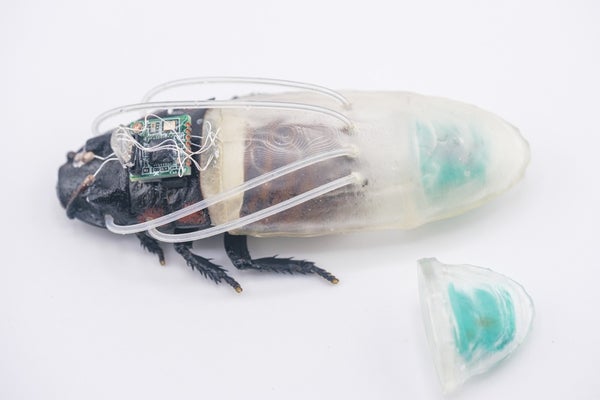
What’s more unnerving than a giant cockroach? Perhaps a part-robot, part-insect giant cockroach capable of diving underwater for as much as three hours at a time. In a new study, researchers describe how they made “cyborg” insects that could help explore aquatic spaces where humans can’t safely go, such as flooded areas.
In the study, which was published on Monday in Nature Communications, researchers outfitted Madagascar hissing cockroaches—one of the largest species of cockroach in the world—with a “diving suit” that included oxygen tubes and a protective shell. The oxygen tubes, similar to a scuba diver’s regulator, attach to the cockroaches’ “thoracic spiracles,” or breathing holes, on their bodies.
“By fitting a cockroach, which is a terrestrial species, into this diving suit, we allowed it to survive and operate in oxygen-deprived environments such as underwater, transforming it into an amphibious cyborg robot capable of operation across land and water,” the authors write in the study.
On supporting science journalism
If you're enjoying this article, consider supporting our award-winning journalism by subscribing. By purchasing a subscription you are helping to ensure the future of impactful stories about the discoveries and ideas shaping our world today.
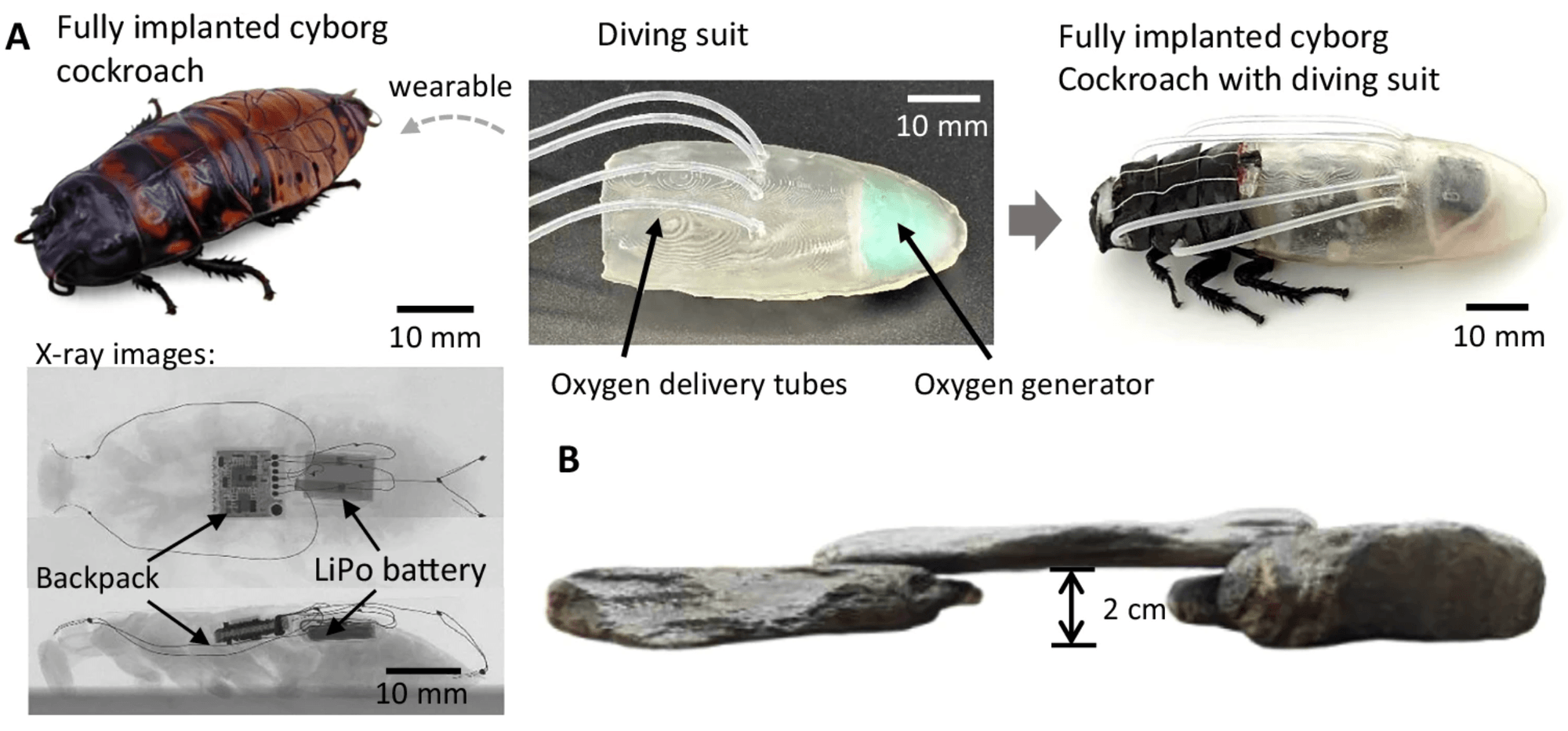
The cockroach "diving suit" (A) and a constructed crevice (B)
The “cyborg” insects’ size and low energy demands could make them helpful in accessing hard-to-reach areas, such as the inside of pipelines, or in disaster environments, such as in the aftermath of floods, according to the authors.
Cockroaches are among the “most promising” insects for this task, they say, because of their “robustness.” Madagascar hissing cockroaches can grow to be as large as about 7.5 centimeters—about the length of an adult human’s finger—and live up to five years. But the technology could also one day be applied to other insects, such as locusts and beetles, the authors write.
Disaster sites, such as flooded areas, can be hard or dangerous for humans to navigate, said Hirotaka Sato, senior author of the paper and a professor in the School of Mechanical and Aerospace Engineering at Nanyang Technological University, in Singapore, in a statement. This is particularly true if roads and other “access routes” get blocked by water and debris, he said.
“By expanding the operating parameters of our cyborg insects to include underwater travel, we believe that they can enhance search and rescue efforts,” Sato said.