
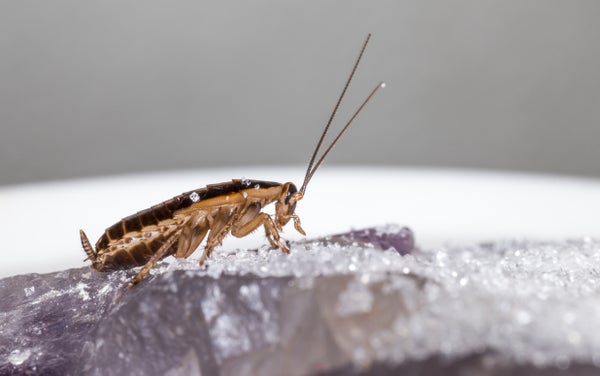
Earth boasts some 4,600 species of cockroach, but perhaps none is as widespread as the German cockroach (Blattella germanica), which is today found anywhere humans permanently inhabit. But despite its name, the cockroach was a newcomer to Germany as little as two decades before getting its moniker, which was a gift from Swedish biologist Carl Linnaeus at a time when Sweden was fighting the Seven Years’ War against what’s now Germany. Reaching Europe, much less the Americas, has been a recent stop on the insect’s path to world domination.
That’s according to research published May 20 in the journal Proceedings of the National Academy of Sciences USA that traces the origins of the common pest species as well as its spread around the globe. Its geographical ascendancy seems to boil down to its ability to adapt to humans, the researchers point out.
“I’ve been looking forward to someone doing something like this,” says Dominic Evangelista, an evolutionary biologist at the University of Illinois Urbana-Champaign, who was not involved in the new research. “We’re well aware of how humans affect the natural world, but we’re less aware of how organisms in nature might be adapting to us.”
On supporting science journalism
If you're enjoying this article, consider supporting our award-winning journalism by subscribing. By purchasing a subscription you are helping to ensure the future of impactful stories about the discoveries and ideas shaping our world today.
German cockroaches have adapted to living with humans with incredible speed and specificity, says Qian Tang, an evolutionary biologist at Harvard University and a co-author of the new research. Understanding the details of those adaptations—and how we might use that information to squash the cockroach—requires knowing where the German cockroach came from.
So Tang and his colleagues asked other cockroach-studying researchers around the world for local samples to analyze—an easy ask, he says, because researchers are used to getting samples from local pest control companies. All told, the scientists studied 281 German cockroaches from 17 countries, plus a handful of specimens from related species, and examined their genome to understand relationships among the global population.
They found that the German cockroach is most closely related to an Asian species called Blattella asahinai, with the two cockroaches likely diverging about 2,100 years ago. But “diverging” might be an exaggeration, says Tang, who likens B. asahinai to a wolf and B. germanica to a dog (albeit a rather less charismatic one). He says he’s not surprised that the analysis showed a close relationship between these two species, noting that the insects are so similar in appearance that they can be a challenge to differentiate.
The analysis suggests that from their origin in Asia, German cockroaches began to spread in two major waves. The first occurred about 1,200 years ago, and the researchers posit that these adventurous bugs may have hitched a ride with traders and soldiers of the Islamic empires of the era.
The second wave of German cockroach migration began about 390 years ago, the researchers found. That makes sense, Tang says, because to break out of the warm tropics into Europe and to cross oceans into the Americas, cockroaches needed humans to develop better home-heating technology and faster steam-powered ships. The researchers estimate that cockroaches first entered Europe about 270 years ago, which matches the timing of the earliest known records of cockroaches there.
Somewhere along the line, the German cockroach developed two talents that allowed it to thrive alongside modern humans. First, they rapidly evolve resistance to insecticides—they’re resistant to some 40 active ingredients and counting, Tang says. The pests have also developed a social foraging strategy with which they alert colony members to a food source, much like ants do. But scientists aren’t sure how these two skills evolved—and understanding the history of the cockroach may shed light on these adaptations and perhaps even on ways to counteract them, Tang says.
While Evangelista is pleased to see the new study dig into the past of the German cockroach, he says he would like more scientific attention on other cockroaches, particularly less notorious species.
“I would love to see a similar study with the American cockroach [Periplaneta americana, another common pest cockroach], and I would also like to see similar studies of cockroaches that are not hated by anyone,” Evangelista says. “If we had better studies of some more charismatic cockroaches, that might broaden people’s perspective on how interesting biodiversity is in general.”