
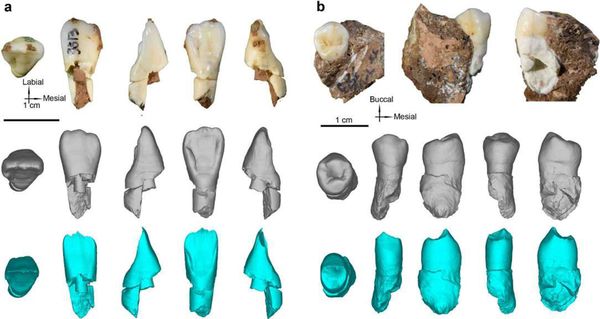
The Denisovans are considered one of modern humans’ closest ancient ancestors, yet we know very little about how they looked or lived. But new analyses of remains from Bianfu Cave in Yunnan province, southwestern China, reveal clues to not only how these ancient hominins looked but also how they survived and thrived at the site more than 130,000 years ago.
The findings could help place other ancient hominin remains as Denisovans—helping to color in more of their shadowy history.
“People recognized that maybe other archaic hominins were also Denisovan, but we needed more evidence,” says archaeologist Hao Li of China's Institute of Tibetan Plateau Research; Bianfu Cave is on the Tibetan Plateau. Until now, the only solid evidence of Denisovan life was confined to just two places: Siberia’s Denisova Cave, where the ancient hominin species was discovered in 2008, and China’s Baishiya Karst Cave in the northeastern Tibetan Plateau. The analyses by Li and his colleagues show Bianfu Cave is among the richest Denisovan sites known to exist: it includes many Denisovan bones, as well as simple stone and bone tools that Denisovans made and traces of the animals they hunted.
On supporting science journalism
If you're enjoying this article, consider supporting our award-winning journalism by subscribing. By purchasing a subscription you are helping to ensure the future of impactful stories about the discoveries and ideas shaping our world today.
Li is a co-author of one of two studies published 9 September in Nature describing the remains and artifacts. The bones were unearthed in 2019, but have only recently been identified as Denisovan, thanks to a distinctive amino acid found in tooth enamel. Identifying the samples using ancient DNA analysis was not an option, says geneticist Qiaomei Fu of China’s Institute of Vertebrate Paleontology and Paleoanthropology, who led the research team. The cave is very old and relatively warm: “These conditions were unsuitable for DNA preservation,” she says.
“These are great studies," says University of Toronto paleoanthropologist Bence Viola, who wasn't directly involved. The new discoveries add much about the species that was not known before—and especially about their teeth, which can now be compared to the teeth of unknown hominins from other sites, he says.
The newly described Denisovan remains include four teeth, part of an arm bone, and two skull fragments. Roughly 60,000 animal bone fragments were also recovered from the cave, which indicate these Denisovans mainly hunted deer and wild bovids, including water buffalo and gaur.
One skull fragment is between 167,000 and 161,000 years old, while the other skull fragment, arm bone and teeth are between 142,000 and 134,000 years old. The arm bone analysis is especially interesting: It suggests Denisovan bones were shaped more like those of modern humans than robust Neanderthals, which implies Denisovans may have looked more like modern humans than Neanderthals, too.
Genetic studies show Denisovans and Neanderthals were closely related. But while evidence of modern human interbreeding with Neanderthals is found in the genomes of all modern humans outside Africa, evidence of Denisovan interbreeding is found mainly in some modern populations in Southeast Asia and Oceania and in traces in human genomes from the rest of Asia, but not in genomes from Africa or Europe. More work will be needed to tease out exactly how the three species’ histories intertwine.