
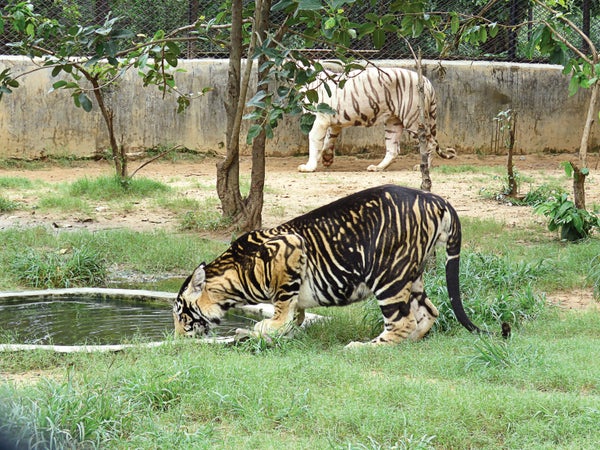
Tigers can indeed change their stripes—and in the Similipal Tiger Reserve in India, many have done just that. So-called black tigers, genetic mutants that sport unusually wide and merged stripes, were extremely rare even when tigers were plentiful centuries ago. But in Similipal today, one in three are black. A new study in the Proceedings of the National Academy of Sciences USA pinpoints the peculiar pattern’s genetic cause and reveals evolution at work among these endangered cats.
After sequencing the genomes of three zoo-born black tigers and their typical-coated parents, researchers at India’s National Center for Biological Sciences and their colleagues tracked the pattern to a tiny change in a gene called taqpep. They then spent months hiking about 1,500 kilometers of jungles across India, collecting tiger droppings, fur, blood and drool. Analyzing these samples helped them determine the prevalence of this genetic change—and its virtual absence in tigers outside Similipal.
Altered taqpep genes were already known to cause blotched tabby patterns in cats, as well as king cheetahs’ unusually large spots and stripes. But such patterns are so rare because they occur only when genes from both parents have matching mutations. The new study found that 10 out of the 12 Similipal tigers sampled had at least one copy of this particular taqpep change—and four were black tigers, with two copies each. But remarkably, not one of the 395 tigers surveyed outside the reserve had even one copy of the mutation. This suggests that the Similipal tigers are so isolated that they never breed with tigers outside that range and that the group has begun to maintain genetic changes over generations. “It was an astonishing finding,” remarks molecular ecologist and lead author Vinay Sagar.
On supporting science journalism
If you're enjoying this article, consider supporting our award-winning journalism by subscribing. By purchasing a subscription you are helping to ensure the future of impactful stories about the discoveries and ideas shaping our world today.
For senior author Uma Ramakrishnan, a molecular ecologist who has studied Indian tigers’ diminishing genetic diversity for more than a decade, this finding is “the most exciting discovery” of her career—stark observable evidence of tigers’ fragmentation across the region.
The extensive data collected for this research “provide the much needed baseline for further studies on the genetics of endangered tigers,” says University of Rochester evolutionary biologist Nancy Chen, who was not involved in the study. Although it is unknown if the unusual stripes help or harm the Similipal tigers, the markings underscore the fact that these animals are breeding exclusively among themselves—perhaps to their own peril.