See how academic freedom is changing around the world

Some countries have seen a stark decline in academic freedom over the past decade

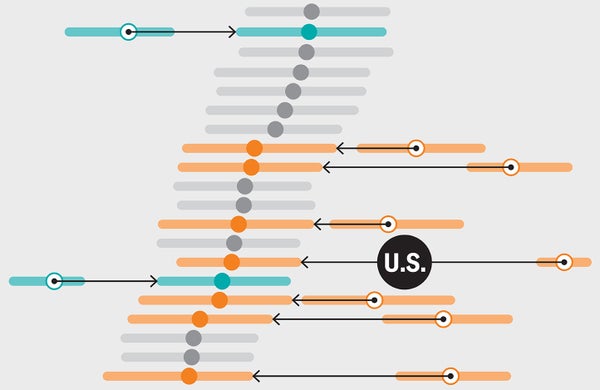
Detail of a chart with dots and error range bars. A U.S. label is associated with a pair of dots that show a drop in value.

Jen Christiansen

Join Our Community of Science Lovers!

The ability to research and teach without interference from politics, wealthy donors or religious institutions produces more and better science and innovation, studies have found. Yet academic freedom around the world has been declining. According to the Academic Freedom Index, 50 of 179 countries or territories experienced a significant drop between 2015 and 2025. Only nine improved. The analysis is a collaboration between the Friedrich Alexander University of Erlangen-Nuremberg in Germany and the V-Dem Project in Sweden, with input from more than 2,300 experts providing information from both inside and outside each country.

The report, published this year, found that the autonomy of a region’s academic institutions—one of the five variables that influence the overall index score—has a particularly strong impact on the freedom of individual researchers there.

“When institutional autonomy is undermined, higher education institutions and individual scholars become more exposed to external pressures, ranging from economic constraints to political and ideological restrictions,” the authors write. Institutional autonomy in the U.S., for instance, fell from a score of 3.3 in 2019 to 1.7 in 2025. “The decline in institutional autonomy in the United States stands out as a case of fast and steep deterioration,” the report notes. Many countries with previously high scores—including Hungary, India and Türkiye—have been declining as “political attacks, legal reforms, and administrative interventions have gradually undermined the autonomy of higher education institutions.”


On supporting science journalism

If you're enjoying this article, consider supporting our award-winning journalism by subscribing. By purchasing a subscription you are helping to ensure the future of impactful stories about the discoveries and ideas shaping our world today.
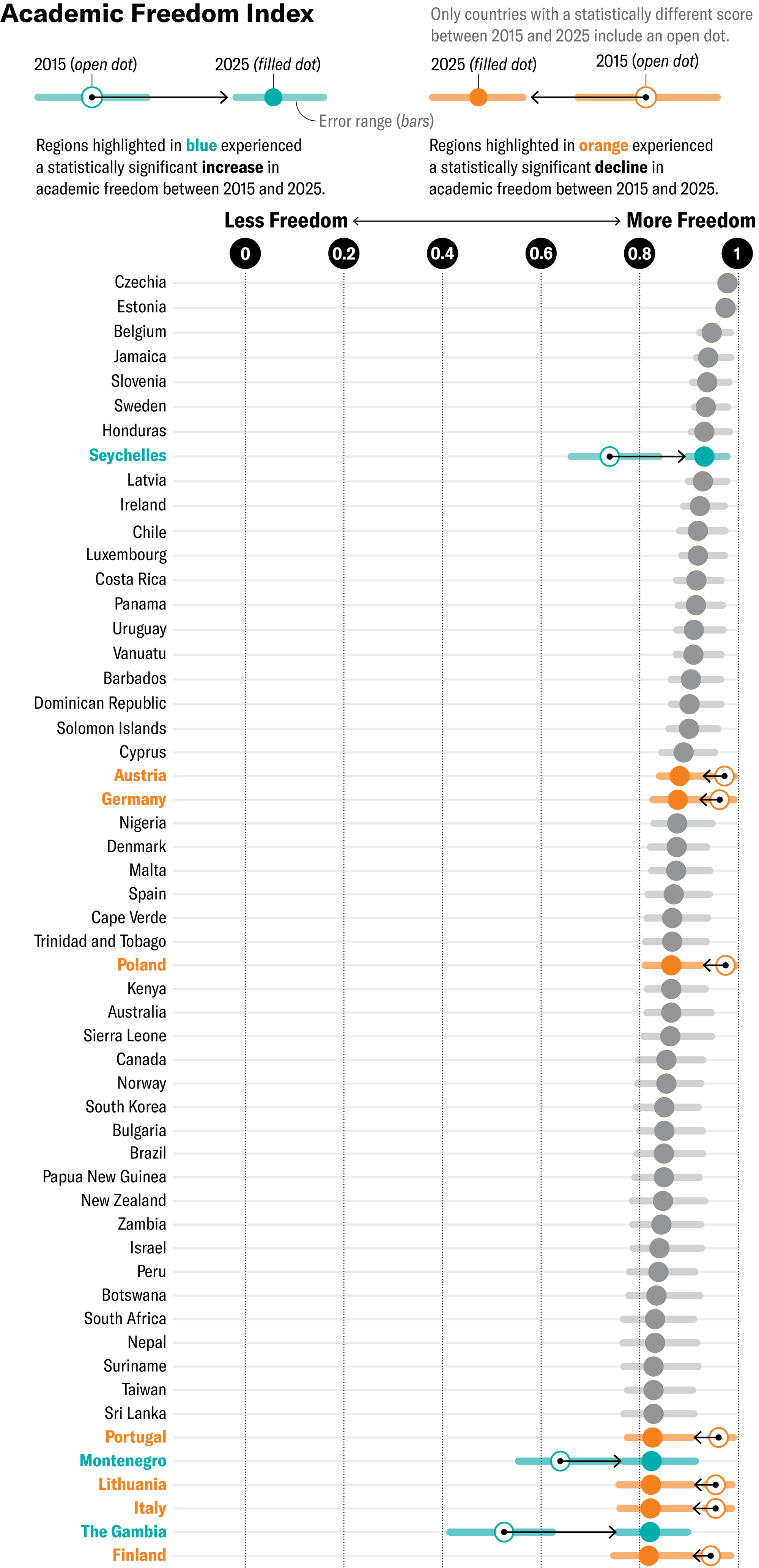

First in a series of three panels: Charts include a 2025 dot and error range bar representing the Academic Freedom Index value for each of 179 regions. Czechia has the highest value (more freedom). Nicaragua has the lowest (less freedom). Regions with a statistically different score between 2015 and 2025 also have a dot for the 2015 value. 50 dropped during that decade. Only 9 improved.
Second in a series of three panels showing Academic Freedom Index values for each of 179 regions.
Final in a series of three panels showing Academic Freedom Index values for each of 179 regions.

FEELING THE PRESSURE

Sometimes the priorities of an institution unduly influence the researchers’ work. Who is most at risk? An unrelated survey conducted by Nature Research Intelligence, with more than 6,000 respondents (all authors of scientific papers published in high-impact journals), indicates that early-career researchers feel most at the mercy of their institution’s inclinations. Scientists with a robust publishing record, in contrast, are more resilient to institutional pressure.

Chart includes response rates for this question “To what extent, if at all, is your research direction influenced by your institution?” Responses were grouped into categories based on number of published papers authored by the respondent (as a proxy for experience level). Authors with 51+ publications were most likely to respond “Not at all (I have complete autonomy over my research).” Authors with 1-10 publications were most likely to respond “Moderately (My research is influenced by my institution’s priorities.”

Jen Christiansen; Source: NRI Nature Index Research Leaders Survey (data)

Jen Christiansen is a senior graphics editor at Scientific American, where she art directs and produces illustrated explanatory diagrams and data visualizations. She is also author of the book Building Science Graphics: An Illustrated Guide to Communicating Science through Diagrams and Visualizations (CRC Press). In 1996 she began her publishing career in New York City at Scientific American. Subsequently she moved to Washington, D.C., to join the staff of National Geographic (first as an assistant art director–researcher hybrid and then as a designer), spent four years as a freelance science communicator and returned to Scientific American in 2007. Christiansen presents and writes on topics ranging from reconciling her love for art and science to her quest to learn more about the pulsar chart on the cover of Joy Division’s album Unknown Pleasures. She holds a graduate certificate in science communication from the University of California, Santa Cruz, and a B.A. in geology and studio art from Smith College. Follow Christiansen on Bluesky @jenchristiansen.com

More by Jen Christiansen
Scientific American Magazine Vol 335 Issue 1This article was published with the title “Academic Freedom in Decline” in Scientific American Magazine Vol. 335 No. 1 (), p. 130
doi:10.1038/scientificamerican072026-2IOfAbT9dICuEhOKriKyRZ

It’s Time to Stand Up for Science

If you enjoyed this article, I’d like to ask for your support. Scientific American has served as an advocate for science and industry for 180 years, and right now may be the most critical moment in that two-century history.

I’ve been a Scientific American subscriber since I was 12 years old, and it helped shape the way I look at the world. SciAm always educates and delights me, and inspires a sense of awe for our vast, beautiful universe. I hope it does that for you, too.

If you subscribe to Scientific American, you help ensure that our coverage is centered on meaningful research and discovery; that we have the resources to report on the decisions that threaten labs across the U.S.; and that we support both budding and working scientists at a time when the value of science itself too often goes unrecognized.

In return, you get essential news, captivating podcasts, brilliant infographics, can't-miss newsletters, must-watch videos, challenging games, and the science world's best writing and reporting. You can even gift someone a subscription.

There has never been a more important time for us to stand up and show why science matters. I hope you’ll support us in that mission.

Thank you,

David M. Ewalt, Editor in Chief, Scientific American

Subscribe