New Issue: Orbital Catastrophe Ahead? Read Now

See how gravitational waves warp time and space

The latest gravitational-wave discoveries include record-breaking cataclysms

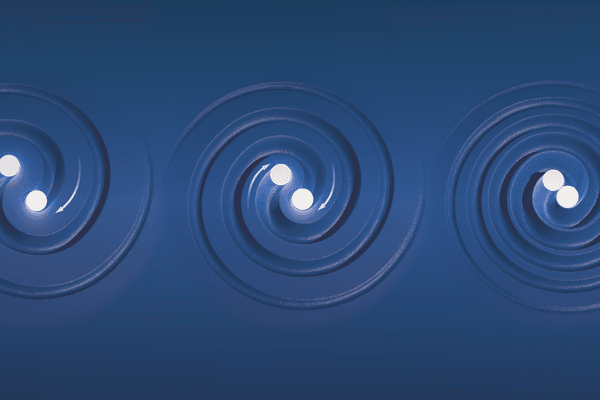
Cropped illustration of a binary system of two co-orbiting black holes causing ripples in spacetime.

Lucy Reading-Ikkanda

Join Our Community of Science Lovers!

Since gravitational waves were first detected, in 2015, physicists have found almost 400 of these undulations in the fabric of spacetime. A new catalog of the findings, released this year, includes waves made by the collision of the heaviest pair of black holes seen yet, plus ripples from a set of black holes that were spinning at about 40 percent of the speed of light before they smashed together.

The collective findings come from a trio of gravitational-wave detectors: the U.S.-based Laser Interferometer Gravitational-Wave Observatory (LIGO), the Virgo interferometer in Italy, and the Kamioka Gravitational Wave Detector (KAGRA) in Japan.

Albert Einstein predicted gravitational waves in 1916, shortly after publishing his general theory of relativity, which describes how gravity molds the shape of space around mass. The collision of massive bodies such as black holes and neutron stars produces such extreme warping of spacetime that the effects are discernible millions or sometimes billions of light-years away.


On supporting science journalism

If you're enjoying this article, consider supporting our award-winning journalism by subscribing. By purchasing a subscription you are helping to ensure the future of impactful stories about the discoveries and ideas shaping our world today.


Researchers are using gravitational waves to test Einstein’s theory of gravity in the hope of eventually finding cracks that point toward a deeper theory.

Graphic shows how a binary system of two co-orbiting black holes causes ripples in spacetime known as gravitational waves. The waves increase in frequency as the black holes get closer together, and the signal detected on Earth increases in intensity until it peaks at the merger.

Lucy Reading-Ikkanda

Graphic shows how gravitational waves are detected on Earth using highly sensitive instruments called laser interferometers.

Lucy Reading-Ikkanda

Clara Moskowitz is chief of reporters at Scientific American, where she covers astronomy, space, physics and mathematics. She has been at Scientific American for more than a decade; previously she worked at Space.com. Moskowitz has reported live from rocket launches, space shuttle liftoffs and landings, suborbital spaceflight training, mountaintop observatories, and more. She has a bachelor’s degree in astronomy and physics from Wesleyan University and a graduate degree in science communication from the University of California, Santa Cruz.

More by Clara Moskowitz

Lucy Reading-Ikkanda is a scientific information designer, art director, and illustrator based in Bedford, New York.

More by Lucy Reading-Ikkanda
Scientific American Magazine Vol 335 Issue 3This article was published with the title “Ripples in Space and Time” in Scientific American Magazine Vol. 335 No. 3 (), p. 94
doi:10.1038/scientificamerican102026-3Q28jb39s6KM5PkavTuDpe

Subscribe to Support Independent Journalism

Great science journalism requires human expertise, time, effort and creativity. And it costs money. That’s why I and the journalists here at Scientific American hope you’ll join our community.

When you subscribe, you are supporting staff and freelance journalists who are passionate about telling science stories that are true, important and compelling. Our editors and reporters are often experts in their fields, which means they understand the nuances of big discoveries and can untangle the breakthroughs from the hype. With a subscription, you are also supporting rigorous fact-checking to ensure the words we publish are precise and accurate. And you’re supporting original illustrations, graphics and photos that bring you closer to an advanced laboratory, an ice sheet in Antarctica or a space mission in orbit. You’re helping us craft other types of high-quality journalism as well: Our newsletters are carefully written, edited and curated by staffers you have or will come to know and love. Our Science Quickly podcast is based on original reporting, collaboration with editors and scientists and exacting production.

Subscriptions keep this engine running so we can continue to deliver thoughtful, rigorous and independent science journalism to you. In an era of viral misinformation, this work is crucial. If you value what we do, I hope you’ll consider joining us as a subscriber

Thank you,

Jeanna Bryner, Editor in Chief, Scientific American

Subscribe