
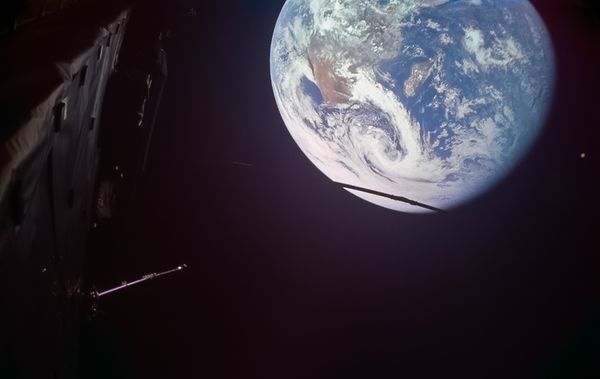
Early Monday morning, the European Space Agency’s Jupiter Icy Moons Explorer (Juice) zoomed by Earth as it prepared to slingshot itself off to the outer solar system.
The flyby’s goal was to let Juice use Earth’s gravity to fine-tune its trajectory—and along the way, it snapped some pretty pictures of our planet and the moon.

On supporting science journalism
If you're enjoying this article, consider supporting our award-winning journalism by subscribing. By purchasing a subscription you are helping to ensure the future of impactful stories about the discoveries and ideas shaping our world today.
Juice also had the opportunity to tune up and test its scientific tools, which will eventually be used to analyze the mysteries of Jupiter’s icy moons. During its Monday flyby, the spacecraft spent some time in the tail of Earth’s magnetic field, which stretches away from the sun, studying charged particles and activity out there.
“Juice’s journey to Jupiter provides only a few opportunities to calibrate and validate the instruments under well-understood environmental conditions,” said Juice project scientist Claire Vallat in a statement.
Also during Monday’s flyby, Juice captured images of Earth, zooming in on parts of Africa, and the moon with its NavCam instrument, which will be vital for steering the ship around Jupiter’s moons Ganymede, Europa and Callisto. Astronomers expect to gather more high-resolution images and data from the pit stop in the coming weeks. The spacecraft will also pass by Earth once more in 2029 before its final journey to Jupiter.

NavCam image of Madagascar.
Once Juice arrives at Jupiter sometime in 2031, the spacecraft will put these tools to work, observing the gas giant’s atmosphere and magnetic environment as well as the famous Great Red Spot—a roiling anticyclonic storm that has possibly been going on for hundreds of years. Juice will also circumnavigate the gas giant’s moons, which hold hidden oceans that may offer clues to life elsewhere in the universe.