See Your Body’s Cells in Size and Number

The larger a cell type is, the rarer it is in the body—and vice versa—a new study shows

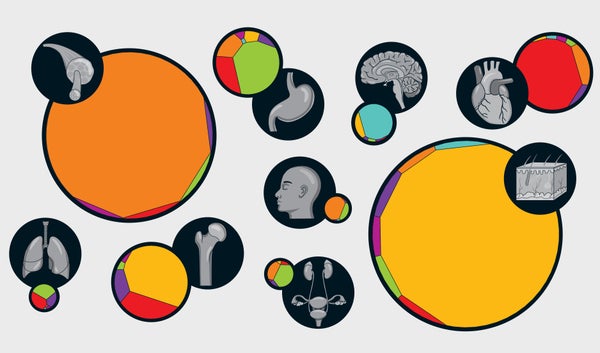
A series of Voronoi diagrams shows mass of body systems and breakdown by cell class.

Ni-ka Ford and Jen Christiansen

Join Our Community of Science Lovers!

Many aspects of our world, from the body mass of creatures in the animal kingdom to the population of cities across the globe, follow an intriguing mathematical pattern. Known as Zipf's law, the rule says that when something's size is doubled, that thing becomes about half as common. Researchers wondered whether the law extended to the human body. Ecologist Ian A. Hatton of McGill University, independent researcher Jeffery A. Shander and their colleagues amassed data about the volume and frequency of human cells and looked for the pattern. It turns out that it holds.

“As you double the volume of a cell, the frequency of cells of that size is halved,” Hatton says. Teensy, nonnucleated red blood cells are by far the most common cells in our bodies, whereas the comparatively gigantic muscle cells in our arms and legs are the scarcest. Being able to use a cell's size to estimate its frequency in the body could help doctors better understand certain body systems and hard-to-count cell types, the researchers say. The study suggests, for instance, that immune cells called lymphocytes are far more common than biologists realized.

Credit: Ni-ka Ford (illustrations) and Jen Christiansen (chart); “The Human Cell Count and Size Distribution,” by Ian A. Hatton et al., in PNAS, Vol. 120; September 2023 (data)


On supporting science journalism

If you're enjoying this article, consider supporting our award-winning journalism by subscribing. By purchasing a subscription you are helping to ensure the future of impactful stories about the discoveries and ideas shaping our world today.


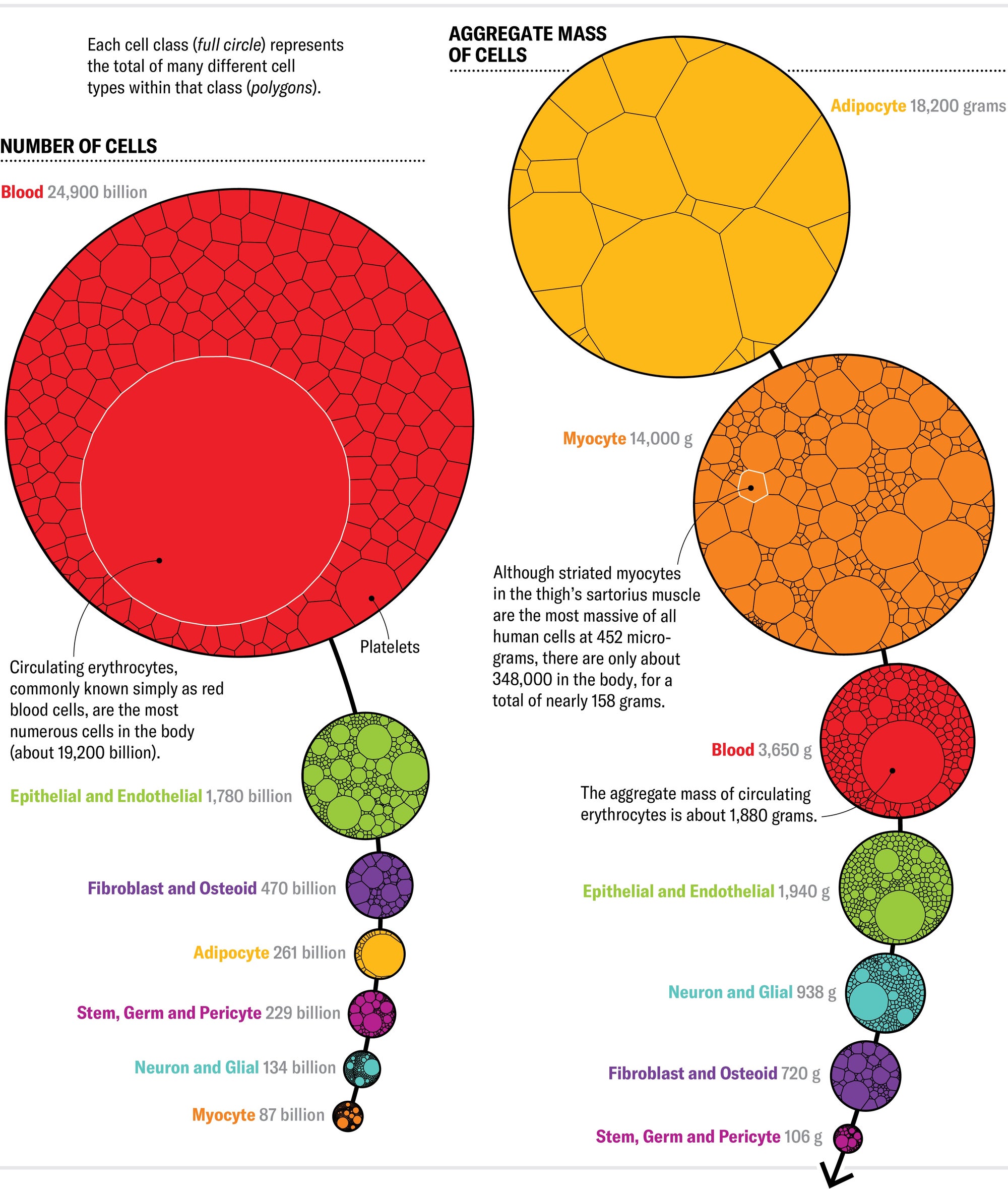
NUMBER AND AGGREGATE MASS OF CELLS IN THE HUMAN BODY, BY CELL CLASS

(Calculated for a 60-kilogram female form.) These two strands show the hierarchy of cells by number (frequency in the body) as well as by how much total biomass they account for in the body. The discrepancy between the two arises from the fact that the most numerous cells are often very small and therefore contribute only a modest amount of biomass, whereas the more massive cells, though relatively uncommon, make up much of our heft. Total cell mass does not equal total body mass, because bodies also include large volumes of water.
Credit: Jen Christiansen; “The Human Cell Count and Size Distribution,” by Ian A. Hatton et al., in PNAS, Vol. 120; September 2023 (data)

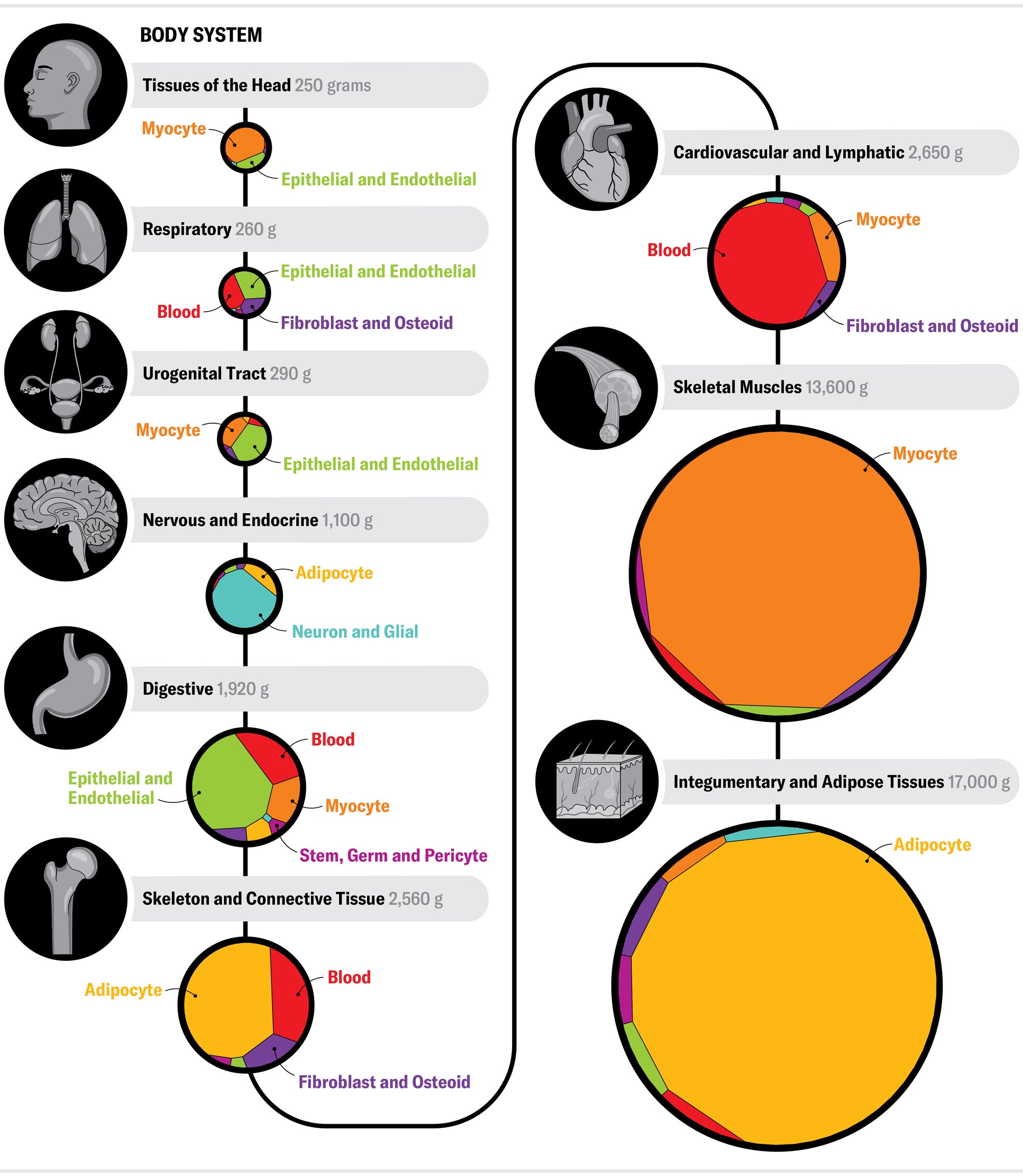
MASS OF BODY SYSTEMS

(Calculated for a 60-kilogram female form.) Different systems in the human body account for differing amounts of our total biomass. The largest system, the integumentary and adipose tissues, consists mainly of skin and fat.
Credit: Ni-ka Ford (illustrations) and Jen Christiansen (chart); “The Human Cell Count and Size Distribution,” by Ian A. Hatton et al., in PNAS, Vol. 120; September 2023 (data)

Clara Moskowitz is chief of reporters at Scientific American, where she covers astronomy, space, physics and mathematics. She has been at Scientific American for more than a decade; previously she worked at Space.com. Moskowitz has reported live from rocket launches, space shuttle liftoffs and landings, suborbital spaceflight training, mountaintop observatories, and more. She has a bachelor’s degree in astronomy and physics from Wesleyan University and a graduate degree in science communication from the University of California, Santa Cruz.

More by Clara Moskowitz

Jen Christiansen is acting chief of design and senior graphics editor at Scientific American, where she art directs and produces illustrated explanatory diagrams and data visualizations. She is also author of the book Building Science Graphics: An Illustrated Guide to Communicating Science through Diagrams and Visualizations (CRC Press). In 1996 she began her publishing career in New York City at Scientific American. Subsequently she moved to Washington, D.C., to join the staff of National Geographic (first as an assistant art director–researcher hybrid and then as a designer), spent four years as a freelance science communicator and returned to Scientific American in 2007. Christiansen presents and writes on topics ranging from reconciling her love for art and science to her quest to learn more about the pulsar chart on the cover of Joy Division’s album Unknown Pleasures. She holds a graduate certificate in science communication from the University of California, Santa Cruz, and a B.A. in geology and studio art from Smith College. Follow Christiansen on Bluesky @jenchristiansen.com

More by Jen Christiansen

Ni-ka Ford is a Certified Medical Illustrator who creates didactic illustrations and 3D visualizations for scientific research, journal publications, medical education, and patient educational materials. Her work can be found at www.enlightvisuals.com

More by Ni-ka Ford
Scientific American Magazine Vol 330 Issue 1This article was published with the title “Cells by Count and Size” in Scientific American Magazine Vol. 330 No. 1 (), p. 94
doi:10.1038/scientificamerican0124-94

It’s Time to Stand Up for Science

If you enjoyed this article, I’d like to ask for your support. Scientific American has served as an advocate for science and industry for 180 years, and right now may be the most critical moment in that two-century history.

I’ve been a Scientific American subscriber since I was 12 years old, and it helped shape the way I look at the world. SciAm always educates and delights me, and inspires a sense of awe for our vast, beautiful universe. I hope it does that for you, too.

If you subscribe to Scientific American, you help ensure that our coverage is centered on meaningful research and discovery; that we have the resources to report on the decisions that threaten labs across the U.S.; and that we support both budding and working scientists at a time when the value of science itself too often goes unrecognized.

In return, you get essential news, captivating podcasts, brilliant infographics, can't-miss newsletters, must-watch videos, challenging games, and the science world's best writing and reporting. You can even gift someone a subscription.

There has never been a more important time for us to stand up and show why science matters. I hope you’ll support us in that mission.

Thank you,

David M. Ewalt, Editor in Chief, Scientific American

Subscribe