
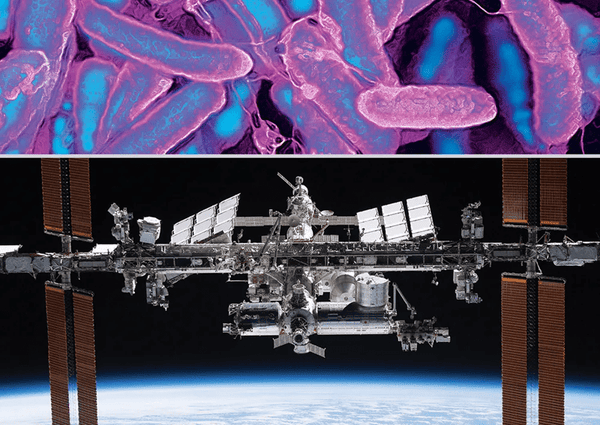
Bacteria and the viruses that infect them are perpetually at war. Their deadly clashes push both kinds of microbes to evolve new traits that meet the challenges of every environment they inhabit, from the human digestive tract to the seafloor’s hydrothermal vents—and even the harsh conditions of space.
To see how microgravity changes certain microbes, researchers sent bacteria-infecting viruses called bacteriophages to the International Space Station, and they found that the viruses adapted in ways that made them even more effective at infection.
In the experiment, detailed in PLOS Biology, the team incubated specimens of common lab bacteriophage T7 alongside its foe, Escherichia coli bacteria, for varying durations. They ran the same experiment on Earth and in space; the terrestrially reared viruses infected bacteria within two to four hours, but those in space took more than four hours to breach bacteria’s defenses. The infection took longer in orbit because microgravity is an unfamiliar stressor to which both microbes must adapt, the researchers suggest.
On supporting science journalism
If you're enjoying this article, consider supporting our award-winning journalism by subscribing. By purchasing a subscription you are helping to ensure the future of impactful stories about the discoveries and ideas shaping our world today.
Once the viruses adapted to microgravity by subtly shape-shifting, though, they became even more effective bacteria killers. “A simple microgravity experiment exposes these mutations that have much higher efficacy against pathogens,” says senior study author Srivatsan Raman, a chemical and biological engineer at the University of Wisconsin–Madison.
The difference between Earth and space may have to do with mixing. “Under normal gravity, fluid motion continually stirs the environment, increasing the chances that viruses and bacteria will meet,” explains Ester Lázaro, an astrobiologist who was not involved in the study. “In microgravity, this natural mixing is drastically diminished or disappears altogether.” To overcome this lack of mixing, microbes grown in low gravity changed on a genetic level. The bacteriophages gained mutations that slightly change the shape and structure of their outer membranes, for example, helping them grab onto the bacteria they’re attacking.
On their return to Earth, the space viruses were placed alongside a different strain of E. coli that’s responsible for particularly stubborn urinary tract infections and frequently resistant to bacteriophages. The evolved viruses were able to kill that bacterium, which Raman says is “really quite promising.” If exposing these bacteria-targeted viruses to new environmental stressors makes them more potent, scientists might be able to create versions strong enough to help the body fight treatment-resistant bacteria.
“T7 is one of our iconic model organisms, so there’s a lot known about this bacteriophage,” says Evelien Adriaenssens, a researcher at the Quadram Institute in England, who was not involved in the study. “It was cool to see that if you go into a different environment, there’s still new knowledge that comes up.”