
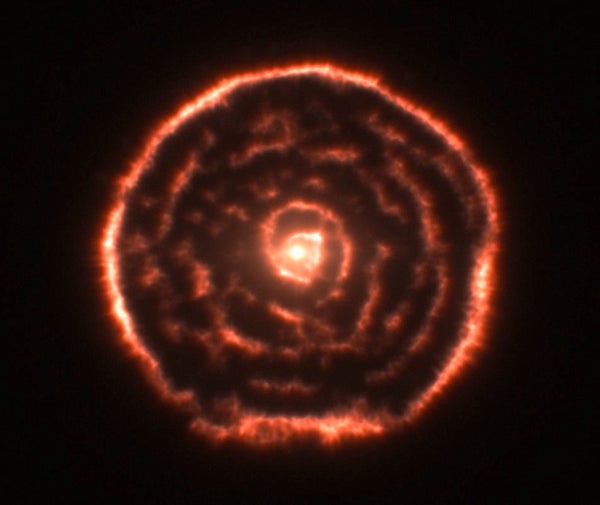
As stars age, they often shed their skins, so to speak, casting off expansive shells of dust and gas into interstellar space. A new look at the shell surrounding a type of aging star called a red giant shows that the star's ejected husk carries in its structure the imprint of its formation and subsequent evolution.
Matthias Maercker of the European Southern Observatory and the University of Bonn in Germany and his colleagues targeted R Sculptoris, a red giant star in the southern constellation of Sculptor, with the Atacama Large Millimeter/Submillimeter Array (ALMA). The radio telescope complex is already producing preliminary science, although it is still under construction in Chile's high-altitude Atacama Desert. ALMA will eventually consist of 50 widely spaced dish antennas, each of them 12 meters in diameter, plus a compact grouping of 16 additional dishes. As of last month 40 of the 66 planned antennas had been deployed. Data from the myriad dishes can be melded together by a computerized correlator to provide a single high-resolution radio image of an astronomical object.
The peek afforded by ALMA revealed that the shell around R Sculptoris is not spherical, as had been assumed, but has been twisted into a spiral, as depicted in the visualization of ALMA data above. Such spiral structure is thought to mark the presence of a stellar companion, so it now appears that R Sculptoris has an unseen binary partner. Maercker and his colleagues published the results of their observations in the October 11 issue of Nature. (Scientific American is part of Nature Publishing Group.)
On supporting science journalism
If you're enjoying this article, consider supporting our award-winning journalism by subscribing. By purchasing a subscription you are helping to ensure the future of impactful stories about the discoveries and ideas shaping our world today.
The researchers could also infer from the shell's structure a timetable for its creation. R Sculptoris looks to have erupted the shell of material in a sort of stellar convulsion called a thermal pulse about 1,800 years ago. The thermal pulse lasted about 200 years, Maercker and his colleagues have concluded, during which time the star cast off about three times the mass of Jupiter in dust and gas.
—John Matson