
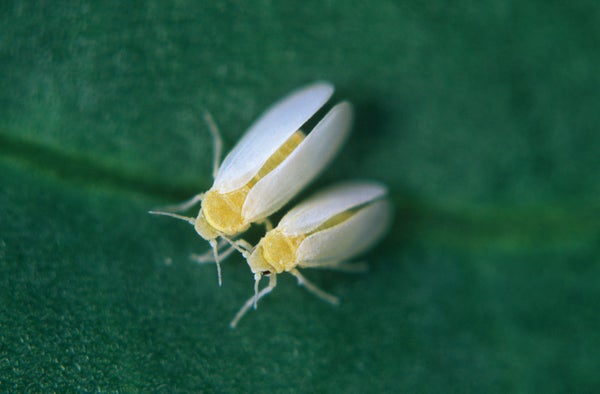
Tiny, sap-eating whiteflies wreak agricultural havoc by spreading multiple plant viruses and secreting sticky, mold-attracting goo on the 500-odd plant species they eat. Now a study in Science Advances reveals one secret to their outsize clout. Scientists led by Youjun Zhang of the Chinese Academy of Agricultural Sciences found that these persistent pests have acquired bacterial genes that let them process nitrogen with incredible efficiency.
“Nitrogen makes the world go round,” as Harvard University evolutionary biologist Naomi Pierce puts it. Animals use nitrogen-containing amino acids to make proteins and DNA, but those processes create toxic by-products. Some insects have evolved relationships with symbiotic bacteria that recycle usable nitrogen from this waste.
The new study suggests whiteflies were able to leave this partnership millions of years ago by incorporating two nitrogen- recycling genes from such bacteria into their own DNA. Ted Turlings, a chemical ecologist at Switzerland’s University of Neuchâtel and one of the study’s senior authors, says viruses—which are known experts in transferring DNA—most likely took those genes from bacteria and happened to deposit them in a nearby insect genome. This process is called horizontal gene transfer.
On supporting science journalism
If you're enjoying this article, consider supporting our award-winning journalism by subscribing. By purchasing a subscription you are helping to ensure the future of impactful stories about the discoveries and ideas shaping our world today.
The “in-house” genes now help whiteflies convert more amino acids into waste when they have too much nitrogen in their bodies, then recycle that waste back into amino acids when they don’t have enough. Plants vary a lot in amino acid content; the captured genes may be what lets these pests thrive on such a wide variety of them, the study authors say.
Cooperating with bacteria to recycle nitrogen would be more energetically expensive for the flies than cutting out the middleman and just doing it themselves. And it takes still more energy to make sure the relationship doesn’t turn parasitic, Pierce says: “If you have a symbiont living in your body, you need to have ways to control it. Otherwise, it could end up controlling you.”
The transferred genes may be a helpful survival tactic for whiteflies, but Turlings says they could also be an Achilles’ heel. Because these genes are particular to whiteflies, pest-control strategies such as modifying plants to disrupt the flies’ genes will not harm other organisms. “This is as close to perfect as you can get in terms of specificity,” he says.
Whiteflies’ acquisition history goes beyond this case; they are also known to have gained plant genes that let them neutralize the plants’ defensive toxins, says University of Amsterdam’s Petra Bleeker, who studies plant-insect interactions. “It seems that horizontal gene transfer is not uncommon in insects,” she says, “but whiteflies appear to be champions.”