
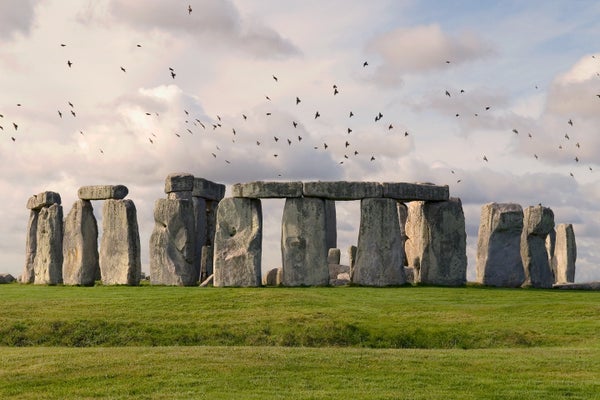
One of the massive rocks at the mysterious Stonehenge structure in southern England may have been toted in from about 500 miles away—a remarkable feat to accomplish some 4,500 years ago.
Called the “Altar Stone,” this 16-foot-long, six-ton slab of grayish-green sandstone is located at the heart of the monument’s inner circle. Archaeologists have long assumed that the rock, like other so-called bluestones, was brought to the site from western Wales. “It’s just been one of those long-standing ideas that nobody’s really tested,” says David Nash, a geographer at the University of Brighton in England, who has analyzed other rocks within Stonehenge.
But in new research published on August 14 in Nature, scientists tested that assumption and reached a startling conclusion: The Altar Stone seems to have instead come from northeastern Scotland. That’s much, much farther away from Stonehenge than Wales and in a different direction to boot. Still, it remains a mystery who brought the rock to Stonehenge, how they did it and how long the journey took. Perhaps Stonehenge’s builders sought out the rock and sailed it home; perhaps inhabitants of Scotland brought it south by land as they themselves visited the site; or perhaps it arrived by entirely different means, the researchers say.
On supporting science journalism
If you're enjoying this article, consider supporting our award-winning journalism by subscribing. By purchasing a subscription you are helping to ensure the future of impactful stories about the discoveries and ideas shaping our world today.

Stonehenge’s Altar Stone is buried in the ground and has been mostly covered by two fallen sarsen stones.
Nick Pearce/Aberystwyth University
To determine the Altar Stone’s origins, scientists analyzed three different types of minerals in its sandstone. Sandstone forms when tiny particles erode off local mountains and combine into sediment that ultimately gets compressed into rock. These rock particles contain fragile minerals called apatite and rutile that tell scientists about recent geology, as well as zircon, a super sturdy mineral that can let researchers peer billions of years into the past.
As a crystal of zircon, apatite or rutile forms, trace amounts of radioactive uranium get incorporated into its structure. That uranium decays into lead at a known rate. By measuring the ratio of uranium and lead, scientists can calculate when a grain of rock formed. Replicating the process for many grains in a slab of rock gives researchers a sort of distinctive “fingerprint” of their age.
The new analysis showed Altar Stone’s mineral age fingerprint doesn’t match that of stones anywhere in southern England or Wales, where rocks are generally made of much younger minerals. But the Altar Stone’s profile is similar to that of a rock formation called the Orcadian Basin, which is exposed across swaths of Scotland and up into the islands off its northeastern coast.
The analysis wasn’t comprehensive enough to determine where, precisely, the Altar Stone came from. The researchers hope to tackle that question in future work by collecting samples from across the Orcadian Basin to compare with the Stonehenge data and by analyzing additional minerals to sharpen the story of each rock.
The new research is strictly based in geology, and the authors don’t offer any hypotheses for what might have prompted the ancient builders to haul such a large rock over such a long distance or how they accomplished the feat. It may have even simply been a matter of geological appreciation. “Humans have always had a fascination with finding the perfect rock, and maybe the Neolithic Britons were the same,” said Anthony Clarke, a doctoral student at Curtin University in Australia and a co-author of the new research, during a recent press conference.
But those theories will surely come.
“We’ve got the geology story now, so I’m really looking forward to hearing what other colleagues make of the archaeological story,” says Heather Sebire, an archaeologist who wasn’t involved in the new research. Sebire is senior property curator for Stonehenge at English Heritage, which manages the site.
While the study’s researchers say they never expected to identify the rock as Scottish, Sebire and Nash say they aren’t surprised, given the known trade routes at the time for more portable artifacts such as pottery and axes. “It isn’t a huge shock if there’s potentially that level of communication and connectedness,” Nash says. “If people are prepared to move stone from Wales to Stonehenge, then moving them from other parts of the British Isles to Stonehenge isn’t that far-fetched.”
And for Sebire, the finding suggests Stonehenge has long held the magnetic appeal and iconic status that burnish the monument today. “In the modern day, people come from all around the world to come to Stonehenge; it draws people in,” she says. “It gives me the impression that it was the same idea [back then]—that people wanted to come and contribute to the site.”