
Next time you purchase white button mushrooms at the grocery store, just remember, they may be cute and bite-size but they have a relative out west that occupies some 2,384 acres (965 hectares) of soil in Oregon's Blue Mountains. Put another way, this humongous fungus would encompass 1,665 football fields, or nearly four square miles (10 square kilometers) of turf.
The discovery of this giant Armillaria ostoyae in 1998 heralded a new record holder for the title of the world's largest known organism, believed by most to be the 110-foot- (33.5-meter-) long, 200-ton blue whale. Based on its current growth rate, the fungus is estimated to be 2,400 years old but could be as ancient as 8,650 years, which would earn it a place among the oldest living organisms as well.
A team of forestry scientists discovered the giant after setting out to map the population of this pathogenic fungus in eastern Oregon. The team paired fungal samples in petri dishes to see if they fused (see photo below), a sign that they were from the same genetic individual, and used DNA fingerprinting to determine where one individual fungus ended.
On supporting science journalism
If you're enjoying this article, consider supporting our award-winning journalism by subscribing. By purchasing a subscription you are helping to ensure the future of impactful stories about the discoveries and ideas shaping our world today.
This one, A. ostoyae, causes Armillaria root disease, which kills swaths of conifers in many parts of the U.S. and Canada. The fungus primarily grows along tree roots via hyphae, fine filaments that mat together and excrete digestive enzymes. But Armillaria has the unique ability to extend rhizomorphs, flat shoestringlike structures, that bridge gaps between food sources and expand the fungus's sweeping perimeter ever more.
A combination of good genes and a stable environment has allowed this particularly ginormous fungus to continue its creeping existence over the past millennia. "These are very strange organisms to our anthropocentric way of thinking," says biochemist Myron Smith of Carleton University in Ottawa, Ontario. An Armillaria individual consists of a network of hyphae, he explains. "Collectively, this network is called the mycelium and is of an indefinite shape and size."
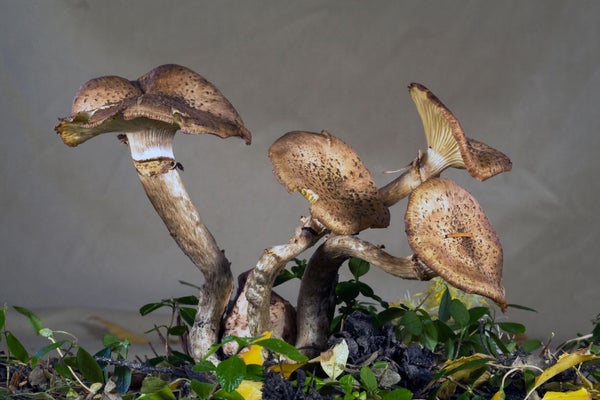
All fungi in the Armillaria genus are known as honey mushrooms, for the yellow-capped and sweet fruiting bodies they produce. Some varieties share this penchant for monstrosity but are more benign in nature. In fact the very first massive fungus discovered in 1992—a 37-acre (15-hectare) Armillaria bulbosa, which was later renamed Armillaria gallica—is annually celebrated at a "fungus fest" in the nearby town of Crystal Falls, Mich.
Myron Smith was a PhD candidate in botany at the University of Toronto when he and colleagues discovered this exclusive fungus in the hardwood forests near Crystal Falls. "This was kind of a side project," Smith recalls. "We were looking at the boundaries of [fungal] individuals using genetic tests and the first year we didn't find the edge."
Next, the microbiologists developed a new way to tell an individual apart from a group of closely related siblings using a battery of molecular genetic techniques. The major test compared fungal genes for telltale signs of inbreeding, where heterozygous strips of DNA become homozygous. That's when they realized they had struck it big. The individual Armillaria bulbosa they found weighed over 100 tons (90.7 metric tons) and was roughly 1,500 years old.
"People had ideas that maybe they were big but nobody had any idea they were that big," says Tom Volk, a biology professor at the University of Wisconsin–La Crosse. "Well it's certainly the biggest publicity that mycology is going to get—maybe ever."
Soon afterward, the discovery of an even bigger fungus in southwestern Washington was announced by Terry Shaw, then in Colorado with the U.S. Forest Service (USFS), and Ken Russell, a forest pathologist at Washington State Department of Natural Resources, in 1992. Their fungus, a specimen of Armillaria ostoyae, covered about 1,500 acres (600 hectares) or 2.5 square miles (6.5 square kilometers). And in 2003 Catherine Parks of the USFS in Oregon and her colleagues published their discovery of the current behemoth 2,384-acre Armillaria ostoyae.
Ironically, the discovery of such huge fungi specimens rekindled the debate of what constitutes an individual organism. "It's one set of genetically identical cells that are in communication with one another that have a sort of common purpose or at least can coordinate themselves to do something," Volk explains.
Both the giant blue whale and the humongous fungus fit comfortably within this definition. So does the 6,615-ton (six-million-kilogram) colony of a male quaking aspen tree and his clones that covers 107 acres (43 hectares) of a Utah mountainside.
And, at second glance, even those button mushrooms aren't so tiny. A large mushroom farm can produce as much as one million pounds (454 metric tons) of them in a year. "The mushrooms that people grow in the mushroom houses&133;; they're nearly genetically identical from one grower to another," Smith says. "So in a large mushroom-growing facility that would be a genetic individual—and it's massive!"
In fact, humongous may be in the nature of things for a fungus. "We think that these things are not very rare," Volk says. "We think that they're in fact normal."